




If A and B be two sets such that n(A) =15, n(B) = 25, then the number of possible values of $\text{n}\left( \text{A }\Delta \text{ B} \right)$(symmetric difference of A and B) is
A. 30
B. 16
C. 26
D. 40
Answer
 Verified
646.2k+ views
Hint: Cardinality for the symmetric difference of two sets is the number of disjoint elements in the two sets, i.e. the number of elements that are not common in both the sets. The formula to find $\text{n}\left( \text{A }\Delta \text{ B} \right)$, where A and B are the two sets, is $\text{n}\left( \text{A}\bigcup{\text{B}} \right)\text{ }-\text{ n}\left( \text{A}\bigcap{\text{B}} \right)$. $\text{n}\left( \text{A}\bigcup{\text{B}} \right)$is the total number of combined elements in the sets A and B, while $\text{n}\left( \text{A}\bigcap{\text{B}} \right)$is the number of common elements in the two sets A and B.
Complete step-by-step answer:
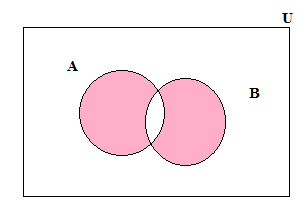
In the above diagram, the portion shaded is the number of elements in the symmetric difference of the two sets A and B. U is the universal set.
Now, it is given that, n(A) =15, n(B) = 25
To find $\text{n}\left( \text{A }\Delta \text{ B} \right)$, it is better to find the number of common elements in the two sets and then subtracting them from each of the two sets, and thereby adding the total number of uncommon elements in A and B.
We know the formula, $\text{n}\left( \text{A}\bigcup{\text{B}} \right)\text{ = n}\left( \text{A} \right)\text{ + n}\left( \text{B} \right)\text{ }-\text{ n}\left( \text{A}\bigcap{\text{B}} \right)$.
Hence, it can be said,
$\begin{align}
& \text{n}\left( \text{A}\Delta \text{B} \right)\text{ = n}\left( \text{A}\bigcup{\text{B}} \right)\text{ }-\text{ n}\left( \text{A}\bigcap{\text{B}} \right) \\
& \text{ = n}\left( \text{A} \right)\text{ + n}\left( \text{B} \right)\text{ }-\text{ 2n}\left( \text{A}\bigcap{\text{B}} \right)\text{ }.....\left( \text{i} \right) \\
\end{align}$
Case I:
The minimum number of common elements in the two sets is possible when the two sets are completely disjoint, i.e. $\text{n}\left( \text{A}\bigcap{\text{B}} \right)\text{ = 0}$.Thus, then we will get the maximum number of elements in the symmetric difference of A and B. Putting the value n(A) = 15, n(B) = 25, $\text{n}\left( \text{A}\bigcap{\text{B}} \right)\text{ = 0}$ in the formula (i), we get ${{\left( \text{n}\left( \text{A }\Delta \text{ B} \right) \right)}_{\max }}\text{= 40}$.
Case II:
The maximum number of common elements in the two sets is possible when the smaller set is a subset of the bigger set. Here, since n(B) > n(A), A can be a subset of B. In that case, $\text{n}\left( \text{A}\bigcap{\text{B}} \right)\text{ = n}\left( \text{A} \right)=\text{ 15}$. Thus, we will get the minimum number of elements in the symmetric difference of A and B. Putting the value n(A) = 15, n(B) = 25, $\text{n}\left( \text{A}\bigcap{\text{B}} \right)\text{ = 15}$ in the formula (i), we get ${{\left( \text{n}\left( \text{A }\Delta \text{ B} \right) \right)}_{\min }}\text{= 40 }-\text{ 2*15 = 10}$.
Hence, we observe in the formula (i) that in this expression n(A) + n(B) is a constant term, the only term that is varying is $\text{n}\left( \text{A}\bigcap{\text{B}} \right)$. Now, $\text{n}\left( \text{A}\bigcap{\text{B}} \right)$ can take any values from 0 to 15, as we can conclude from the two cases mentioned above. Thus, $\text{n}\left( \text{A}\bigcap{\text{B}} \right)$can take 16 values.
Therefore, the total number of possible values of $\text{n}\left( \text{A }\Delta \text{ B} \right)$is 16.
Thus, the correct answer is option B.
Note: One can choose to solve this problem by visual inspection as well rather than putting it into formula. That is, simply by counting the total number of disjoint elements in the two sets. But, this method is easier to follow only if the set cardinalities are small. It is better to use formulas if the set cardinalities are moderately to very large.
Complete step-by-step answer:
In the above diagram, the portion shaded is the number of elements in the symmetric difference of the two sets A and B. U is the universal set.
Now, it is given that, n(A) =15, n(B) = 25
To find $\text{n}\left( \text{A }\Delta \text{ B} \right)$, it is better to find the number of common elements in the two sets and then subtracting them from each of the two sets, and thereby adding the total number of uncommon elements in A and B.
We know the formula, $\text{n}\left( \text{A}\bigcup{\text{B}} \right)\text{ = n}\left( \text{A} \right)\text{ + n}\left( \text{B} \right)\text{ }-\text{ n}\left( \text{A}\bigcap{\text{B}} \right)$.
Hence, it can be said,
$\begin{align}
& \text{n}\left( \text{A}\Delta \text{B} \right)\text{ = n}\left( \text{A}\bigcup{\text{B}} \right)\text{ }-\text{ n}\left( \text{A}\bigcap{\text{B}} \right) \\
& \text{ = n}\left( \text{A} \right)\text{ + n}\left( \text{B} \right)\text{ }-\text{ 2n}\left( \text{A}\bigcap{\text{B}} \right)\text{ }.....\left( \text{i} \right) \\
\end{align}$
Case I:
The minimum number of common elements in the two sets is possible when the two sets are completely disjoint, i.e. $\text{n}\left( \text{A}\bigcap{\text{B}} \right)\text{ = 0}$.Thus, then we will get the maximum number of elements in the symmetric difference of A and B. Putting the value n(A) = 15, n(B) = 25, $\text{n}\left( \text{A}\bigcap{\text{B}} \right)\text{ = 0}$ in the formula (i), we get ${{\left( \text{n}\left( \text{A }\Delta \text{ B} \right) \right)}_{\max }}\text{= 40}$.
Case II:
The maximum number of common elements in the two sets is possible when the smaller set is a subset of the bigger set. Here, since n(B) > n(A), A can be a subset of B. In that case, $\text{n}\left( \text{A}\bigcap{\text{B}} \right)\text{ = n}\left( \text{A} \right)=\text{ 15}$. Thus, we will get the minimum number of elements in the symmetric difference of A and B. Putting the value n(A) = 15, n(B) = 25, $\text{n}\left( \text{A}\bigcap{\text{B}} \right)\text{ = 15}$ in the formula (i), we get ${{\left( \text{n}\left( \text{A }\Delta \text{ B} \right) \right)}_{\min }}\text{= 40 }-\text{ 2*15 = 10}$.
Hence, we observe in the formula (i) that in this expression n(A) + n(B) is a constant term, the only term that is varying is $\text{n}\left( \text{A}\bigcap{\text{B}} \right)$. Now, $\text{n}\left( \text{A}\bigcap{\text{B}} \right)$ can take any values from 0 to 15, as we can conclude from the two cases mentioned above. Thus, $\text{n}\left( \text{A}\bigcap{\text{B}} \right)$can take 16 values.
Therefore, the total number of possible values of $\text{n}\left( \text{A }\Delta \text{ B} \right)$is 16.
Thus, the correct answer is option B.
Note: One can choose to solve this problem by visual inspection as well rather than putting it into formula. That is, simply by counting the total number of disjoint elements in the two sets. But, this method is easier to follow only if the set cardinalities are small. It is better to use formulas if the set cardinalities are moderately to very large.
Recently Updated Pages
Master Class 12 Economics: Engaging Questions & Answers for Success

Master Class 12 English: Engaging Questions & Answers for Success
Master Class 12 Social Science: Engaging Questions & Answers for Success
Master Class 12 Maths: Engaging Questions & Answers for Success
Master Class 12 Physics: Engaging Questions & Answers for Success
Master Class 9 General Knowledge: Engaging Questions & Answers for Success
Trending doubts
One Metric ton is equal to kg A 10000 B 1000 C 100 class 11 physics CBSE
Difference Between Prokaryotic Cells and Eukaryotic Cells
Find the value of the expression given below sin 30circ class 11 maths CBSE
Two of the body parts which do not appear in MRI are class 11 biology CBSE
1 ton equals to A 100 kg B 1000 kg C 10 kg D 10000 class 11 physics CBSE
Draw a diagram of nephron and explain its structur class 11 biology CBSE