




If a and b are unit vectors and |a+b| = 1, then |a-b| is equal to
[a] $\sqrt{2}$
[b] 1
[c] $\sqrt{5}$
[d] $\sqrt{3}$
Answer
 Verified
666k+ views
Hint: Observe that the vector a+b and a-b are orthogonal to each other. Use Pythagoras theorem in triangle BCD and hence find |a-b|. Alternatively use ${{\left| \mathbf{a} \right|}^{2}}=\mathbf{a}\cdot \mathbf{a}$. Apply the formula for $\left| \mathbf{a}+\mathbf{b} \right|$ and $\left| \mathbf{a}-\mathbf{b} \right|$ and add the two results. Hence find the value of $\left| \mathbf{a}-\mathbf{b} \right|$.
Complete step-by-step answer:
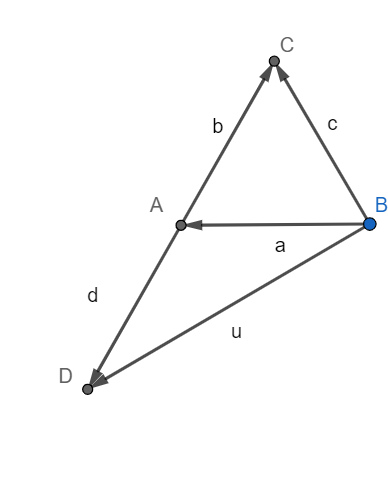
Here AD = -b
Sine AB = AD = 1 unit, we have $\angle ABD=\angle ADB$.
Also, we have $\angle CAB$ is an exterior angle of triangle ABD.
Hence $\angle CAB=\angle ADB+\angle ABD=2\angle ABD$
In triangle ABC, we have AB = AC. Hence $\angle ABC=\angle ACB$
Hence by angle sum property of a triangle, we have
$\begin{align}
& \angle CAB+\angle ABC+\angle ACB=180{}^\circ \\
& \Rightarrow \angle CAB=180{}^\circ -2\angle ABC \\
\end{align}$
Hence, we have
$\begin{align}
& 2\angle ABD=180{}^\circ -2\angle ABC \\
& \Rightarrow 2\left( \angle ABD+\angle ABC \right)=180{}^\circ \\
& \Rightarrow 2\left( \angle CBD \right)=180{}^\circ \\
& \Rightarrow \angle CBD=90{}^\circ \\
\end{align}$
Hence triangle CBD is a right-angled triangle right angled at B.
Now in triangle CBD, by Pythagora’s theorem, we have
$B{{C}^{2}}+B{{D}^{2}}=C{{D}^{2}}$
Since BC = BA+AC, we have
c = a+b.
Hence, BC = 1 unit, since |a+b|=1.
Also DC = |a|+|-a|=2|a|=2.
Hence, we have
$\begin{align}
& 1+B{{D}^{2}}=4 \\
& \Rightarrow B{{D}^{2}}=3 \\
& \Rightarrow BD=\sqrt{3} \\
\end{align}$
Now, we have
BD = a+d.
Since d = -b, we have
BD = a-b.
Hence |a-b| $=\sqrt{3}$
Hence option [d] is correct.
Note: [1] Alternate proof of $\angle CBD=90{}^\circ $
As is evident from the diagram $\angle CBD$ is the angle between the vector u and c.
Hence we have $\cos \left( \angle CBD \right)=\dfrac{\mathbf{u}\cdot \mathbf{c}}{\left| \mathbf{u} \right|\left| \mathbf{c} \right|}=\dfrac{\left( \mathbf{a}-\mathbf{b} \right)\left( \mathbf{a}+\mathbf{b} \right)}{\left| \mathbf{a}-\mathbf{b} \right|\left| \mathbf{a}+\mathbf{b} \right|}=\dfrac{{{\left| \mathbf{a} \right|}^{2}}-{{\left| \mathbf{b} \right|}^{2}}+\mathbf{a}\cdot \mathbf{b}-\mathbf{a}\cdot \mathbf{b}}{\left| \mathbf{a}-\mathbf{b} \right|\left| \mathbf{a}+\mathbf{b} \right|}=\dfrac{1-1}{\left| \mathbf{a}-\mathbf{b} \right|\left| \mathbf{a}+\mathbf{b} \right|}=0$
Hence we have $\angle CBD=90{}^\circ $
[2] Alternative solution: Best Method
We know that
${{\left| \mathbf{a} \right|}^{2}}=\mathbf{a}\cdot \mathbf{a}$
Hence, we have
${{\left| \mathbf{a}+\mathbf{b} \right|}^{2}}=\left( \mathbf{a}+\mathbf{b} \right)\cdot \left( \mathbf{a}+\mathbf{b} \right)=\mathbf{a}\cdot \mathbf{a}+\mathbf{a}\cdot \mathbf{b}+\mathbf{b}\cdot \mathbf{a}+\mathbf{b}\cdot \mathbf{b}={{\left| \mathbf{a} \right|}^{2}}+{{\left| \mathbf{b} \right|}^{2}}+2\mathbf{a}\cdot \mathbf{b}=2+2\mathbf{a}\cdot \mathbf{b}$
Also, we have
${{\left| \mathbf{a}-\mathbf{b} \right|}^{2}}=\left( \mathbf{a}-\mathbf{b} \right)\cdot \left( \mathbf{a}-\mathbf{b} \right)=\mathbf{a}\cdot \mathbf{a}-\mathbf{a}\cdot \mathbf{b}-\mathbf{b}\cdot \mathbf{a}+\mathbf{b}\cdot \mathbf{b}={{\left| \mathbf{a} \right|}^{2}}+{{\left| \mathbf{b} \right|}^{2}}-2\mathbf{a}\cdot \mathbf{b}=2-2\mathbf{a}\cdot \mathbf{b}$
Adding, we get
${{\left| \mathbf{a}-\mathbf{b} \right|}^{2}}+{{\left| \mathbf{a}+\mathbf{b} \right|}^{2}}=4$
Given that |a+b| = 1, we get
$\begin{align}
& {{\left| \mathbf{a}-\mathbf{b} \right|}^{2}}+1=4 \\
& \Rightarrow {{\left| \mathbf{a}-\mathbf{b} \right|}^{2}}=3 \\
& \Rightarrow \left| \mathbf{a}-\mathbf{b} \right|=\sqrt{3} \\
\end{align}$
which is the same as obtained above.
Complete step-by-step answer:
Here AD = -b
Sine AB = AD = 1 unit, we have $\angle ABD=\angle ADB$.
Also, we have $\angle CAB$ is an exterior angle of triangle ABD.
Hence $\angle CAB=\angle ADB+\angle ABD=2\angle ABD$
In triangle ABC, we have AB = AC. Hence $\angle ABC=\angle ACB$
Hence by angle sum property of a triangle, we have
$\begin{align}
& \angle CAB+\angle ABC+\angle ACB=180{}^\circ \\
& \Rightarrow \angle CAB=180{}^\circ -2\angle ABC \\
\end{align}$
Hence, we have
$\begin{align}
& 2\angle ABD=180{}^\circ -2\angle ABC \\
& \Rightarrow 2\left( \angle ABD+\angle ABC \right)=180{}^\circ \\
& \Rightarrow 2\left( \angle CBD \right)=180{}^\circ \\
& \Rightarrow \angle CBD=90{}^\circ \\
\end{align}$
Hence triangle CBD is a right-angled triangle right angled at B.
Now in triangle CBD, by Pythagora’s theorem, we have
$B{{C}^{2}}+B{{D}^{2}}=C{{D}^{2}}$
Since BC = BA+AC, we have
c = a+b.
Hence, BC = 1 unit, since |a+b|=1.
Also DC = |a|+|-a|=2|a|=2.
Hence, we have
$\begin{align}
& 1+B{{D}^{2}}=4 \\
& \Rightarrow B{{D}^{2}}=3 \\
& \Rightarrow BD=\sqrt{3} \\
\end{align}$
Now, we have
BD = a+d.
Since d = -b, we have
BD = a-b.
Hence |a-b| $=\sqrt{3}$
Hence option [d] is correct.
Note: [1] Alternate proof of $\angle CBD=90{}^\circ $
As is evident from the diagram $\angle CBD$ is the angle between the vector u and c.
Hence we have $\cos \left( \angle CBD \right)=\dfrac{\mathbf{u}\cdot \mathbf{c}}{\left| \mathbf{u} \right|\left| \mathbf{c} \right|}=\dfrac{\left( \mathbf{a}-\mathbf{b} \right)\left( \mathbf{a}+\mathbf{b} \right)}{\left| \mathbf{a}-\mathbf{b} \right|\left| \mathbf{a}+\mathbf{b} \right|}=\dfrac{{{\left| \mathbf{a} \right|}^{2}}-{{\left| \mathbf{b} \right|}^{2}}+\mathbf{a}\cdot \mathbf{b}-\mathbf{a}\cdot \mathbf{b}}{\left| \mathbf{a}-\mathbf{b} \right|\left| \mathbf{a}+\mathbf{b} \right|}=\dfrac{1-1}{\left| \mathbf{a}-\mathbf{b} \right|\left| \mathbf{a}+\mathbf{b} \right|}=0$
Hence we have $\angle CBD=90{}^\circ $
[2] Alternative solution: Best Method
We know that
${{\left| \mathbf{a} \right|}^{2}}=\mathbf{a}\cdot \mathbf{a}$
Hence, we have
${{\left| \mathbf{a}+\mathbf{b} \right|}^{2}}=\left( \mathbf{a}+\mathbf{b} \right)\cdot \left( \mathbf{a}+\mathbf{b} \right)=\mathbf{a}\cdot \mathbf{a}+\mathbf{a}\cdot \mathbf{b}+\mathbf{b}\cdot \mathbf{a}+\mathbf{b}\cdot \mathbf{b}={{\left| \mathbf{a} \right|}^{2}}+{{\left| \mathbf{b} \right|}^{2}}+2\mathbf{a}\cdot \mathbf{b}=2+2\mathbf{a}\cdot \mathbf{b}$
Also, we have
${{\left| \mathbf{a}-\mathbf{b} \right|}^{2}}=\left( \mathbf{a}-\mathbf{b} \right)\cdot \left( \mathbf{a}-\mathbf{b} \right)=\mathbf{a}\cdot \mathbf{a}-\mathbf{a}\cdot \mathbf{b}-\mathbf{b}\cdot \mathbf{a}+\mathbf{b}\cdot \mathbf{b}={{\left| \mathbf{a} \right|}^{2}}+{{\left| \mathbf{b} \right|}^{2}}-2\mathbf{a}\cdot \mathbf{b}=2-2\mathbf{a}\cdot \mathbf{b}$
Adding, we get
${{\left| \mathbf{a}-\mathbf{b} \right|}^{2}}+{{\left| \mathbf{a}+\mathbf{b} \right|}^{2}}=4$
Given that |a+b| = 1, we get
$\begin{align}
& {{\left| \mathbf{a}-\mathbf{b} \right|}^{2}}+1=4 \\
& \Rightarrow {{\left| \mathbf{a}-\mathbf{b} \right|}^{2}}=3 \\
& \Rightarrow \left| \mathbf{a}-\mathbf{b} \right|=\sqrt{3} \\
\end{align}$
which is the same as obtained above.
Recently Updated Pages
Basicity of sulphurous acid and sulphuric acid are

Master Class 12 Economics: Engaging Questions & Answers for Success
Master Class 12 Biology: Engaging Questions & Answers for Success
Master Class 11 English: Engaging Questions & Answers for Success
Master Class 11 Physics: Engaging Questions & Answers for Success
Master Class 11 Computer Science: Engaging Questions & Answers for Success
Trending doubts
What is the Total Duration of Football Match?
Explain the Treaty of Vienna of 1815 class 10 social science CBSE
In football, which nation is called "La Roja"?
Why is there a time difference of about 5 hours between class 10 social science CBSE
10 examples of evaporation in daily life with explanations
What is the full form of POSCO class 10 social science CBSE