




If A and B are arbitrary events, then
A) \[P\left( {A \cap B} \right) \ge P\left( A \right) + P\left( B \right)\]
B) \[P\left( {A \cap B} \right) \le P\left( A \right) + P\left( B \right)\]
C) \[P\left( {A \cap B} \right) = P\left( A \right) + P\left( B \right)\]
D) None of these.
Answer
 Verified
591.9k+ views
Hint:
We will draw a Venn-diagram for both the events A and B and we will find \[P\left( A \right)\], \[P\left( B \right)\] and \[P\left( {A \cap B} \right)\] using the Venn-diagram. Then, we will compare \[P\left( A \right) + P\left( B \right)\] and \[P\left( {A \cap B} \right)\] to find the correct option.
Complete step by step solution:
Let’s represent event \[A\] by the 1st circle and event \[B\] by the $2^{\text{nd}}$ circle.
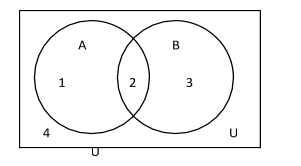
From the figure, we can see that \[P\left( A \right)\] is represented by region 1 and region 2.
\[P\left( A \right) = 1 + 2{\rm{ }}\left( 1 \right)\]
We can also see that \[P\left( B \right)\] is represented by region 2 and region 3.
\[P\left( B \right) = 2 + 3{\rm{ }}\left( 2 \right)\].
\[P\left( {A \cap B} \right)\] means the intersection of\[A\] and \[B\]and is represented by the region which is common to both \[A\] and \[B\]. So, we will represent \[P\left( {A \cap B} \right)\] by region 2.
\[P\left( {A \cap B} \right) = 2{\rm{ }}\left( 3 \right)\].
\[P\left( {A \cup B} \right)\] means the union of\[A\] and \[B\]and is represented by the region that covers both \[A\] and \[B\].
So, we will represent \[P\left( {A \cup B} \right)\] by region 1, region 2 and region 3.
\[P\left( {A \cup B} \right) = 1 + 2 + 3{\rm{ }}\left( 4 \right)\].
Let’s add equation (1) and equation (2).
\[P\left( A \right) + P\left( B \right) = 1 + 2 + 2 + 3\]
Let’s subtract equation (4) from the sum of equation (2) and equation (1).
\[\begin{array}{l}P\left( A \right) + P\left( B \right) - P\left( {A \cup B} \right) = 1 + 2 + 2 + 3 - \left( {1 + 2 + 3} \right)\\P\left( A \right) + P\left( B \right) - P\left( {A \cup B} \right) = 2{\rm{ }}\left( 5 \right)\end{array}\]
Let’s compare equation (5) and equation (3).
\[P\left( {A \cap B} \right) = P\left( A \right) + P\left( B \right) - P\left( {A \cup B} \right)\]
Let’s add \[P\left( {A \cup B} \right)\] to both sides of the equation.
\[P\left( {A \cap B} \right) + P\left( {A \cup B} \right) = P\left( A \right) + P\left( B \right)\]
We have to add something to \[P\left( {A \cap B} \right)\] to \[P\left( A \right) + P\left( B \right)\]. This means that \[P\left( {A \cap B} \right)\]is smaller than \[P\left( A \right) + P\left( B \right)\]. \[P\left( {A \cap B} \right)\]can also be equal to \[P\left( A \right) + P\left( B \right)\]if value of \[P\left( {A \cup B} \right)\]is 0.
\[\therefore P\left( {A \cap B} \right) \le P\left( A \right) + P\left( B \right)\].
Option (B) is the correct option.
Note:
We can directly use the formula \[P\left( {A \cap B} \right) = P\left( A \right) + P\left( B \right) - P\left( {A \cup B} \right)\] to solve this question. We need to be careful about the fact that \[P\left( {A \cup B} \right)\] is not equal to \[P\left( A \right) + P\left( B \right)\].
We will draw a Venn-diagram for both the events A and B and we will find \[P\left( A \right)\], \[P\left( B \right)\] and \[P\left( {A \cap B} \right)\] using the Venn-diagram. Then, we will compare \[P\left( A \right) + P\left( B \right)\] and \[P\left( {A \cap B} \right)\] to find the correct option.
Complete step by step solution:
Let’s represent event \[A\] by the 1st circle and event \[B\] by the $2^{\text{nd}}$ circle.
From the figure, we can see that \[P\left( A \right)\] is represented by region 1 and region 2.
\[P\left( A \right) = 1 + 2{\rm{ }}\left( 1 \right)\]
We can also see that \[P\left( B \right)\] is represented by region 2 and region 3.
\[P\left( B \right) = 2 + 3{\rm{ }}\left( 2 \right)\].
\[P\left( {A \cap B} \right)\] means the intersection of\[A\] and \[B\]and is represented by the region which is common to both \[A\] and \[B\]. So, we will represent \[P\left( {A \cap B} \right)\] by region 2.
\[P\left( {A \cap B} \right) = 2{\rm{ }}\left( 3 \right)\].
\[P\left( {A \cup B} \right)\] means the union of\[A\] and \[B\]and is represented by the region that covers both \[A\] and \[B\].
So, we will represent \[P\left( {A \cup B} \right)\] by region 1, region 2 and region 3.
\[P\left( {A \cup B} \right) = 1 + 2 + 3{\rm{ }}\left( 4 \right)\].
Let’s add equation (1) and equation (2).
\[P\left( A \right) + P\left( B \right) = 1 + 2 + 2 + 3\]
Let’s subtract equation (4) from the sum of equation (2) and equation (1).
\[\begin{array}{l}P\left( A \right) + P\left( B \right) - P\left( {A \cup B} \right) = 1 + 2 + 2 + 3 - \left( {1 + 2 + 3} \right)\\P\left( A \right) + P\left( B \right) - P\left( {A \cup B} \right) = 2{\rm{ }}\left( 5 \right)\end{array}\]
Let’s compare equation (5) and equation (3).
\[P\left( {A \cap B} \right) = P\left( A \right) + P\left( B \right) - P\left( {A \cup B} \right)\]
Let’s add \[P\left( {A \cup B} \right)\] to both sides of the equation.
\[P\left( {A \cap B} \right) + P\left( {A \cup B} \right) = P\left( A \right) + P\left( B \right)\]
We have to add something to \[P\left( {A \cap B} \right)\] to \[P\left( A \right) + P\left( B \right)\]. This means that \[P\left( {A \cap B} \right)\]is smaller than \[P\left( A \right) + P\left( B \right)\]. \[P\left( {A \cap B} \right)\]can also be equal to \[P\left( A \right) + P\left( B \right)\]if value of \[P\left( {A \cup B} \right)\]is 0.
\[\therefore P\left( {A \cap B} \right) \le P\left( A \right) + P\left( B \right)\].
Option (B) is the correct option.
Note:
We can directly use the formula \[P\left( {A \cap B} \right) = P\left( A \right) + P\left( B \right) - P\left( {A \cup B} \right)\] to solve this question. We need to be careful about the fact that \[P\left( {A \cup B} \right)\] is not equal to \[P\left( A \right) + P\left( B \right)\].
Recently Updated Pages
Basicity of sulphurous acid and sulphuric acid are

Master Class 11 Business Studies: Engaging Questions & Answers for Success
Master Class 11 Computer Science: Engaging Questions & Answers for Success
Master Class 11 Economics: Engaging Questions & Answers for Success
Master Class 11 Social Science: Engaging Questions & Answers for Success
Master Class 11 English: Engaging Questions & Answers for Success
Trending doubts
One Metric ton is equal to kg A 10000 B 1000 C 100 class 11 physics CBSE
The largest wind power cluster is located in the state class 11 social science CBSE
Explain zero factorial class 11 maths CBSE
State and prove Bernoullis theorem class 11 physics CBSE
What steps did the French revolutionaries take to create class 11 social science CBSE
Which among the following are examples of coming together class 11 social science CBSE