




If A and B are any two sets, then $A \cup \left( {A \cap B} \right)$ is equal to:
(A) A
(B) B
(C) ${A^c}$
(D) ${B^c}$
Answer
 Verified
570.3k+ views
Hint: The given question revolves around sets and set theory. A set is a well-defined collection of distinct elements. Sets have a variety of properties which are used, like associative property, commutative property, distributive property etc. In the problem, we are required to prove an equation involving the sets. So, we will use the distributive property of sets to distribute the union operator over the intersection of two sets and then simplify to get to the required answer.
Complete answer:
In the given problem, we are provided with two sets: A and B.
Now, we need to find the value of $A \cup \left( {A \cap B} \right)$.
So, we have, $A \cup \left( {A \cap B} \right)$
We know the distributive property of sets as $A \cup (B \cap C) = (A \cup B) \cap (A \cup C)$. Therefore, using this property, we get,
$ \Rightarrow A \cup (A \cap B) = (A \cup A) \cap (A \cup B)$
Now, the union of the same sets results in the same set.
Therefore, $A \cup A = A$
Using this result, we get,
$ \Rightarrow A \cup (A \cap B) = A \cap (A \cup B)$
Now, we know that $A \cup B$ is the set which contains all the elements of both the sets of A and B.
Therefore, we can say that, $A \cup B$ also contains each and every element of A.
Also, we know that the intersection of any two sets is the set of all the common elements between the two sets.
So, the intersection of $A$ and $A \cup B$, will have the common elements of both the sets.
As, in both of these sets, all the elements of set A are common.
Therefore, $A \cap (A \cup B) = A$
So, option (A) is the correct answer.
Note:
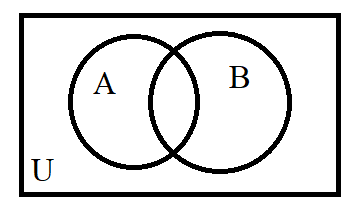
The union of two sets refers to the combined set of both sets, with the elements common to both sets written only once. And the Intersection of the two sets is the set of all the common elements between the two sets. We must know the definitions of the union and intersection of the two sets to solve such problems. A very useful method of understanding sets is the Venn diagram. In the Venn diagram, the sets are represented as circles. These are used as it is easier to visualise the sets and any kind of functioning that occurs between the sets. For example, an intersection between two sets is shown as a small portion of overlapping between the circles which is shaded in the Venn diagram. While, a union is shown, as both the circles are shaded with a small overlapping between them.
Complete answer:
In the given problem, we are provided with two sets: A and B.
Now, we need to find the value of $A \cup \left( {A \cap B} \right)$.
So, we have, $A \cup \left( {A \cap B} \right)$
We know the distributive property of sets as $A \cup (B \cap C) = (A \cup B) \cap (A \cup C)$. Therefore, using this property, we get,
$ \Rightarrow A \cup (A \cap B) = (A \cup A) \cap (A \cup B)$
Now, the union of the same sets results in the same set.
Therefore, $A \cup A = A$
Using this result, we get,
$ \Rightarrow A \cup (A \cap B) = A \cap (A \cup B)$
Now, we know that $A \cup B$ is the set which contains all the elements of both the sets of A and B.
Therefore, we can say that, $A \cup B$ also contains each and every element of A.
Also, we know that the intersection of any two sets is the set of all the common elements between the two sets.
So, the intersection of $A$ and $A \cup B$, will have the common elements of both the sets.
As, in both of these sets, all the elements of set A are common.
Therefore, $A \cap (A \cup B) = A$
So, option (A) is the correct answer.
Note:
The union of two sets refers to the combined set of both sets, with the elements common to both sets written only once. And the Intersection of the two sets is the set of all the common elements between the two sets. We must know the definitions of the union and intersection of the two sets to solve such problems. A very useful method of understanding sets is the Venn diagram. In the Venn diagram, the sets are represented as circles. These are used as it is easier to visualise the sets and any kind of functioning that occurs between the sets. For example, an intersection between two sets is shown as a small portion of overlapping between the circles which is shaded in the Venn diagram. While, a union is shown, as both the circles are shaded with a small overlapping between them.
Recently Updated Pages
Master Class 11 Social Science: Engaging Questions & Answers for Success

Master Class 11 English: Engaging Questions & Answers for Success
Master Class 11 Accountancy: Engaging Questions & Answers for Success
Master Class 11 Physics: Engaging Questions & Answers for Success
Master Class 11 Computer Science: Engaging Questions & Answers for Success
Master Class 11 Business Studies: Engaging Questions & Answers for Success
Trending doubts
Find the value of the expression given below sin 30circ class 11 maths CBSE
Draw a diagram of nephron and explain its structur class 11 biology CBSE
Proton was discovered by A Thomson B Rutherford C Chadwick class 11 chemistry CBSE
The teeth used for biting and cutting food are called class 11 biology CBSE
Frogs heart when taken out of the body continues to class 11 biology CBSE
10 examples of diffusion in everyday life