




If 2n = 14, (n = 7), then what will happen during meiosis?
A) 7 sets of chromosomes will be passed to the offspring from the maternal side only.
B) 7 sets of chromosomes will be passed to the offspring from the paternal side only.
C) The characters will get mixed up and passed to offspring.
D) None of the above.
Answer
 Verified
496.2k+ views
Hint: Meiosis is a division that occurs in a diploid cell and gives rise to four haploid cells or nuclei, each having half the number of chromosomes as compared to the parent cell and called reductional division.
Complete answer:
The term meiosis was first introduced by Farmer and Moore (1905). Meiosis division takes place just after the DNA and chromosome replication is completed. Meiosis can be divided into 2 steps –
Karyokinesis is the process of division of the nucleus and the nucleus is divided into two identical nuclei.
Cytokinesis is the process of division of cytoplasm and this cytoplasm, with all organelles and cell membranes distributed equally.
There are two sets of chromosomes in a cell undergoing meiosis. If in a cell there are 14 numbers of diploid chromosomes then during meiosis they will form 7 pairs of chromosomes. It will exchange segments and result in mixed characters which are passed to the offspring. The chromosomes of one set are contributed by the father parent and are called paternal chromosomes, while those of the other set are contributed by the mother parent and are called maternal chromosomes.
For each paternal chromosome, there is always a corresponding maternal chromosome that is similar in size, shape and nature of inherited characters. These are called homologous characters.
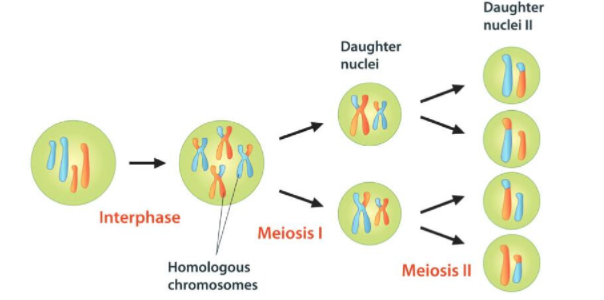
So, the correct answer is an option (C) The characters will get mixed up and passed to offspring.
Note: Significance of meiosis-
- It increases genetic variability.
- Variability contributes to evolution resulting in the formation of new species.
- It helps in sexual reproduction by the formation of gametes (haploid cells involved in reproduction).
Complete answer:
The term meiosis was first introduced by Farmer and Moore (1905). Meiosis division takes place just after the DNA and chromosome replication is completed. Meiosis can be divided into 2 steps –
Karyokinesis is the process of division of the nucleus and the nucleus is divided into two identical nuclei.
Cytokinesis is the process of division of cytoplasm and this cytoplasm, with all organelles and cell membranes distributed equally.
There are two sets of chromosomes in a cell undergoing meiosis. If in a cell there are 14 numbers of diploid chromosomes then during meiosis they will form 7 pairs of chromosomes. It will exchange segments and result in mixed characters which are passed to the offspring. The chromosomes of one set are contributed by the father parent and are called paternal chromosomes, while those of the other set are contributed by the mother parent and are called maternal chromosomes.
For each paternal chromosome, there is always a corresponding maternal chromosome that is similar in size, shape and nature of inherited characters. These are called homologous characters.
So, the correct answer is an option (C) The characters will get mixed up and passed to offspring.
Note: Significance of meiosis-
- It increases genetic variability.
- Variability contributes to evolution resulting in the formation of new species.
- It helps in sexual reproduction by the formation of gametes (haploid cells involved in reproduction).
Recently Updated Pages
Master Class 10 Social Science: Engaging Questions & Answers for Success

Master Class 10 Science: Engaging Questions & Answers for Success
Master Class 10 Maths: Engaging Questions & Answers for Success
Master Class 10 General Knowledge: Engaging Questions & Answers for Success
Master Class 10 Computer Science: Engaging Questions & Answers for Success
Class 10 Question and Answer - Your Ultimate Solutions Guide
Trending doubts
What is the full form of PNG A Petrol Natural Gas B class 10 chemistry CBSE
Explain the Treaty of Vienna of 1815 class 10 social science CBSE
In cricket, how many legal balls are there in a standard over?
Why is there a time difference of about 5 hours between class 10 social science CBSE
Who Won 36 Oscar Awards? Record Holder Revealed
What is the median of the first 10 natural numbers class 10 maths CBSE