




If (-2,2) and (k,0) are the two diametrically opposite points of a circle of radius 1, then the equation of the circle is:
$
A. {\text{ }}{{\text{x}}^2} + {y^2} - 2x - 4y - 4 = 0 \\
B. {\text{ }}{{\text{x}}^2} + {y^2} + 4x - 2y - 4 = 0 \\
C. {\text{ }}{{\text{x}}^2} + {y^2} - 4x + 2y + 4 = 0 \\
D. {\text{ }}{{\text{x}}^2} + {y^2} + 4x - 2y + 4 = 0 \\
E. {\text{ }}{{\text{x}}^2} + {y^2} - 4x - 2y - 4 = 0 \\
$
Answer
 Verified
633.3k+ views
Hint – Here we will proceed by finding midpoint M of PQ ends by using the midpoint formula i.e. $\dfrac{{{x_1} + {y_1}}}{2},\dfrac{{{x_2} + {y_2}}}{2}$. Then we will equate given radius with MP i.e. half part of the diameter by using distance formula i.e. $D = \sqrt {{{\left( {{x_2} - {x_1}} \right)}^2} + {{\left( {{y_2} - {y_1}} \right)}^2}} $ to get the required equation.
Complete Step-by-Step solution:
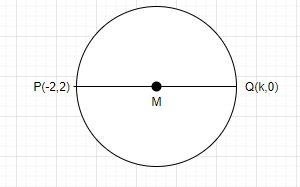
Since P (-2,2) and Q (k,0) are the endpoints of a diameter. (given)
Therefore, midpoint M of PQ by using the midpoint formula- $\dfrac{{{x_1} + {y_1}}}{2},\dfrac{{{x_2} + {y_2}}}{2}$
Substituting the values of P and Q, we get $ = \dfrac{{ - 2 + k}}{2},\dfrac{{2 + 0}}{2}$
Which means M $ = \left( {\dfrac{K}{2} - 1,1} \right)$
As midpoint divides diameter into two equal parts i.e. radius.
So MP will also be the radius of the circle.
Now we will use distance formula to calculate the equation of radius
i.e. MP = radius
Formula- $D = \sqrt {{{\left( {{x_2} - {x_1}} \right)}^2} + {{\left( {{y_2} - {y_1}} \right)}^2}} $
Where M $ = \left( {\dfrac{K}{2} - 1,1} \right)$
And P (-2,2)
Thus applying formula, we get
Or $MP = \sqrt {{{\left( { - 2 - \dfrac{k}{2} + 1} \right)}^2} + {{\left( {2 - 1} \right)}^2}} = 1$
Or $\sqrt {{{\left( { - 1 - \dfrac{k}{2}} \right)}^2} + 1} = 1$
$ \Rightarrow 1 + \dfrac{{{k^2}}}{4} + k + 1 = 1$
$ \Rightarrow {k^2} + 4k + 4 = 0$
$ \Rightarrow {\left( {k + 2} \right)^2} = 0$
$ \Rightarrow k = - 2$
Therefore, mid-point M $ = \left( { - \dfrac{2}{2} - 1,1} \right) = \left( { - 2,1} \right)$ which is equal to the centre of the circle.
Hence, equation of circle is-
${\left( {x + 2} \right)^2} + {\left( {y - 1} \right)^2} = {1^2}$
$ \Rightarrow {x^2} + 4x + 4 + {y^2} - 2y + 1 = 1$
Or ${x^2} + {y^2} + 4x - 2y + 4 = 0$
Hence option D is right.
Note – In order to solve this type of question, one can make mistakes to omit the step of calculating the midpoint of the circle which will help in equating the radius with the calculated mid-point. Also we must know the standard form of the circle i.e. ${x^2} + {y^2} + Dx + Ey + F = 0$ where D, E, F are constants to solve similar types of questions.
Complete Step-by-Step solution:
Since P (-2,2) and Q (k,0) are the endpoints of a diameter. (given)
Therefore, midpoint M of PQ by using the midpoint formula- $\dfrac{{{x_1} + {y_1}}}{2},\dfrac{{{x_2} + {y_2}}}{2}$
Substituting the values of P and Q, we get $ = \dfrac{{ - 2 + k}}{2},\dfrac{{2 + 0}}{2}$
Which means M $ = \left( {\dfrac{K}{2} - 1,1} \right)$
As midpoint divides diameter into two equal parts i.e. radius.
So MP will also be the radius of the circle.
Now we will use distance formula to calculate the equation of radius
i.e. MP = radius
Formula- $D = \sqrt {{{\left( {{x_2} - {x_1}} \right)}^2} + {{\left( {{y_2} - {y_1}} \right)}^2}} $
Where M $ = \left( {\dfrac{K}{2} - 1,1} \right)$
And P (-2,2)
Thus applying formula, we get
Or $MP = \sqrt {{{\left( { - 2 - \dfrac{k}{2} + 1} \right)}^2} + {{\left( {2 - 1} \right)}^2}} = 1$
Or $\sqrt {{{\left( { - 1 - \dfrac{k}{2}} \right)}^2} + 1} = 1$
$ \Rightarrow 1 + \dfrac{{{k^2}}}{4} + k + 1 = 1$
$ \Rightarrow {k^2} + 4k + 4 = 0$
$ \Rightarrow {\left( {k + 2} \right)^2} = 0$
$ \Rightarrow k = - 2$
Therefore, mid-point M $ = \left( { - \dfrac{2}{2} - 1,1} \right) = \left( { - 2,1} \right)$ which is equal to the centre of the circle.
Hence, equation of circle is-
${\left( {x + 2} \right)^2} + {\left( {y - 1} \right)^2} = {1^2}$
$ \Rightarrow {x^2} + 4x + 4 + {y^2} - 2y + 1 = 1$
Or ${x^2} + {y^2} + 4x - 2y + 4 = 0$
Hence option D is right.
Note – In order to solve this type of question, one can make mistakes to omit the step of calculating the midpoint of the circle which will help in equating the radius with the calculated mid-point. Also we must know the standard form of the circle i.e. ${x^2} + {y^2} + Dx + Ey + F = 0$ where D, E, F are constants to solve similar types of questions.
Recently Updated Pages
Master Class 12 Business Studies: Engaging Questions & Answers for Success

Master Class 12 Biology: Engaging Questions & Answers for Success
Master Class 12 Chemistry: Engaging Questions & Answers for Success
Class 12 Question and Answer - Your Ultimate Solutions Guide
Master Class 11 Social Science: Engaging Questions & Answers for Success
Master Class 11 English: Engaging Questions & Answers for Success
Trending doubts
Explain the Treaty of Vienna of 1815 class 10 social science CBSE
Which Indian city is known as the "City of Victory"?
Which instrument is used to measure the Blood Pressure?
Who Won 36 Oscar Awards? Record Holder Revealed
What is the median of the first 10 natural numbers class 10 maths CBSE
Why is it 530 pm in india when it is 1200 afternoon class 10 social science CBSE