




If 10% of the main current is to be passed through the moving coil galvanometer of resistance \[99\Omega \], then the required shunt resistance will be:
A. \[9.9\Omega \]
B. \[10\Omega \]
C. \[11\Omega \]
D. \[9\Omega \]
Answer
 Verified
627.9k+ views
Hint: In this question first we draw an ammeter by connecting a resistance ${R_{sh}}$ in a shunt across the galvanometer whose resistance is given as $99\Omega $. Then equating the potential as they are connected in parallel that is ${V_{Rsh}} = {V_G}$ and using this we can write ${I_{sh}} \times {R_{sh}} = {I_G} \times 99$. Then after solving this we get the shunt resistance as \[11\Omega \].
Complete Step-by-Step solution:
The first step is to know how an ammeter is constructed using a galvanometer. When we connect a parallel resistance across the galvanometer with very low resistance. And as mentioned in the question that only 10% of the main current is passing through the galvanometer. So we have drawn the ammeter with all the current components as shown in figure 1.
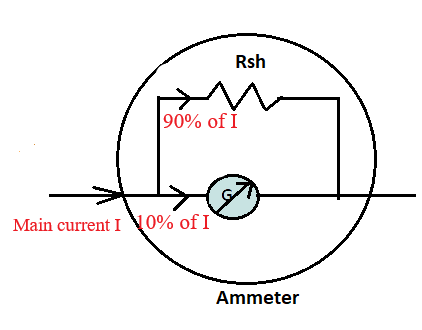
Here, let us assume the main current be \[I\]
So current through galvanometer is ${I_G} = 10\% I = \dfrac{{10}}{{100}}I$
Now the current through the shunt resistance ${R_{sh}}$ is
${I_{sh}} = I - {I_G} = I - \dfrac{{10}}{{100}}I$
$ \Rightarrow {I_{sh}} = \dfrac{{90}}{{100}}I$
Now we are given that the resistance of galvanometer is $99\Omega $, so to find the overall shunt resistance ${R_{sh}}$ which can be further be used to calculate the overall ammeter resistance as
${R_A} = {R_{sh}}\parallel 99$
From the figure, we can see that the potential across ${R_{sh}}$ is the same as potential across$G$ that is
${V_{Rsh}} = {V_G}$
$ \Rightarrow {I_{sh}} \times {R_{sh}} = {I_G} \times 99$
Now solving this equation we will get
$ \Rightarrow \dfrac{{90}}{{100}}{I} \times {R_{sh}} = \dfrac{{10}}{{100}}{I} \times 99$
$ \Rightarrow {R_{sh}} = \dfrac{{1{0}}}{{9{0}}} \times 99 = 11$
Therefore the overall shunt resistance is $11\Omega $. So option C is correct.
Note: For these kinds of questions we first need to know how to construct an ammeter, voltmeter, and wattmeter using a galvanometer. Then we can find the overall resistances either by parallel connection or by the series connection of all the resistance that is present. We also need to have a good knowledge of KVL and KCL.
Complete Step-by-Step solution:
The first step is to know how an ammeter is constructed using a galvanometer. When we connect a parallel resistance across the galvanometer with very low resistance. And as mentioned in the question that only 10% of the main current is passing through the galvanometer. So we have drawn the ammeter with all the current components as shown in figure 1.
Figure1
Here, let us assume the main current be \[I\]
So current through galvanometer is ${I_G} = 10\% I = \dfrac{{10}}{{100}}I$
Now the current through the shunt resistance ${R_{sh}}$ is
${I_{sh}} = I - {I_G} = I - \dfrac{{10}}{{100}}I$
$ \Rightarrow {I_{sh}} = \dfrac{{90}}{{100}}I$
Now we are given that the resistance of galvanometer is $99\Omega $, so to find the overall shunt resistance ${R_{sh}}$ which can be further be used to calculate the overall ammeter resistance as
${R_A} = {R_{sh}}\parallel 99$
From the figure, we can see that the potential across ${R_{sh}}$ is the same as potential across$G$ that is
${V_{Rsh}} = {V_G}$
$ \Rightarrow {I_{sh}} \times {R_{sh}} = {I_G} \times 99$
Now solving this equation we will get
$ \Rightarrow \dfrac{{90}}{{100}}{I} \times {R_{sh}} = \dfrac{{10}}{{100}}{I} \times 99$
$ \Rightarrow {R_{sh}} = \dfrac{{1{0}}}{{9{0}}} \times 99 = 11$
Therefore the overall shunt resistance is $11\Omega $. So option C is correct.
Note: For these kinds of questions we first need to know how to construct an ammeter, voltmeter, and wattmeter using a galvanometer. Then we can find the overall resistances either by parallel connection or by the series connection of all the resistance that is present. We also need to have a good knowledge of KVL and KCL.
Recently Updated Pages
Master Class 11 English: Engaging Questions & Answers for Success

Master Class 11 Maths: Engaging Questions & Answers for Success
Class 11 Question and Answer - Your Ultimate Solutions Guide
Master Class 11 Biology: Engaging Questions & Answers for Success
Master Class 11 Physics: Engaging Questions & Answers for Success
Master Class 11 Accountancy: Engaging Questions & Answers for Success
Trending doubts
Explain the Treaty of Vienna of 1815 class 10 social science CBSE
Who Won 36 Oscar Awards? Record Holder Revealed
What is the median of the first 10 natural numbers class 10 maths CBSE
Why is it 530 pm in india when it is 1200 afternoon class 10 social science CBSE
Select the word that is correctly spelled a Twelveth class 10 english CBSE
Why is there a time difference of about 5 hours between class 10 social science CBSE