




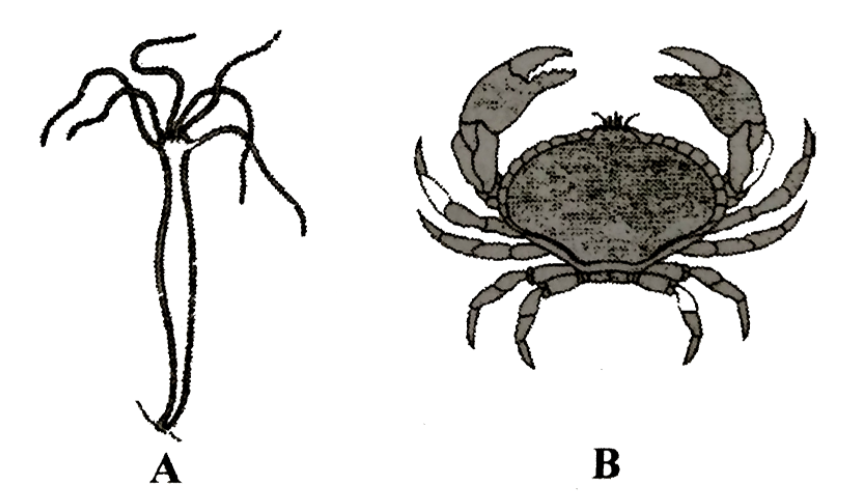
Identify the type of symmetry in the given animal’s A and B
A. A-bilateral, B-symmetrical
B. A-bilateral, B-bilateral
C. A-radial, B-bilateral
D. A-radial, B-radial
Answer
 Verified
619.5k+ views
Hint: If a Hydra is cut through the central axis, it produces correspondence or regular body parts. If the scorpion is cut along the middle of the body longitudinally, it produces two equal halves i.e. right and left halves.
Complete answer: Animals are classified on the basis of symmetry of their body plan. On this basis, there are three types of symmetry; radial symmetry, bilateral symmetry and asymmetry. In bilateral symmetry, if there is a line passing through the middle of the body of an animal longitudinally then, there will be two equal halves i.e. right and left half of the body. If a body is cut from the centre or around the central axis, the animal exhibits correspondence or regularity of body parts, which is known as radial symmetry. There is no left and right half in radial symmetry. Asymmetric animals are those animals that do not show any symmetry along any of the axes. ‘A’ in the diagram is Hydra which possesses a radial symmetry and ‘B’ in the diagram is a scorpion which possesses a bilateral symmetry. Radial symmetry animals have top and bottom surfaces, but no left and right sides, or front and back.
Hence, the correct answer is option C.
Note: The body plan of humans, butterflies, wasps, honey bees, etc. and many others possess bilateral symmetry. Bilateral symmetry is also known as mirror symmetry. Corals, jellyfish, starfish and others exhibit radial symmetry. Radial symmetry marks the body plan of phylum Ctenophora.
Complete answer: Animals are classified on the basis of symmetry of their body plan. On this basis, there are three types of symmetry; radial symmetry, bilateral symmetry and asymmetry. In bilateral symmetry, if there is a line passing through the middle of the body of an animal longitudinally then, there will be two equal halves i.e. right and left half of the body. If a body is cut from the centre or around the central axis, the animal exhibits correspondence or regularity of body parts, which is known as radial symmetry. There is no left and right half in radial symmetry. Asymmetric animals are those animals that do not show any symmetry along any of the axes. ‘A’ in the diagram is Hydra which possesses a radial symmetry and ‘B’ in the diagram is a scorpion which possesses a bilateral symmetry. Radial symmetry animals have top and bottom surfaces, but no left and right sides, or front and back.
Hence, the correct answer is option C.
Note: The body plan of humans, butterflies, wasps, honey bees, etc. and many others possess bilateral symmetry. Bilateral symmetry is also known as mirror symmetry. Corals, jellyfish, starfish and others exhibit radial symmetry. Radial symmetry marks the body plan of phylum Ctenophora.
Recently Updated Pages
Basicity of sulphurous acid and sulphuric acid are

Master Class 11 English: Engaging Questions & Answers for Success
Master Class 11 Physics: Engaging Questions & Answers for Success
Master Class 11 Computer Science: Engaging Questions & Answers for Success
Master Class 11 Chemistry: Engaging Questions & Answers for Success
Master Class 11 Social Science: Engaging Questions & Answers for Success
Trending doubts
Difference Between Prokaryotic Cells and Eukaryotic Cells
Two of the body parts which do not appear in MRI are class 11 biology CBSE
One Metric ton is equal to kg A 10000 B 1000 C 100 class 11 physics CBSE
10 examples of friction in our daily life
Draw a diagram of nephron and explain its structur class 11 biology CBSE
What will happen if the mucus is not secreted by the class 11 biology CBSE