




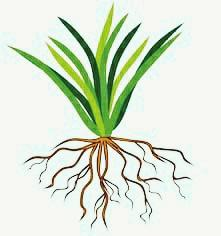
Identify the type of root.
A.Tap root
B.Fibrous root
C.Adventitious root
D.Prop root
Answer
 Verified
597.9k+ views
Hint: The root system called the descending growing downwards portion of the plant. When the seed germinates the radicle is the first organ to come out. Which elongates to form primary or the taproot. That gives off lateral branches secondary and tertiary roots and thus forms the root system.
Complete step by step answer:Plants have three types of root systems:
(i) Taproot - This system consists of the main taproot that is larger and grows faster than the branch.
(ii) Fibrous root system - it has all roots of the same size the whole root system is fibrous and branches usually grow in all directions. mostly found in monocots. Its main function of the fibrous root is to anchor the plant.
(iii) Adventitious- usually originate from the stem, branches, leaves, or old woody roots. Most commonly occur in monocots and pteridophytes, but also many dicots.
Roots perform certain functions such as absorbing water and nutrients from the soil anchor the plant firmly and help in storing food as well as nutrients. Roots in most of the plant transport water and minerals to it. In the above image, roots are branching out in randomly all directions and are almost of the same size.
So, the answer is B Fibrous roots.
Note:
Fibrous roots, on the other hand, are bushy roots in which thin, moderately branching roots grow from the stem. Rice, wheat, maize, marigold, banana and all monocotyledons are known as some examples of the fibrous root system.
Complete step by step answer:Plants have three types of root systems:
(i) Taproot - This system consists of the main taproot that is larger and grows faster than the branch.
(ii) Fibrous root system - it has all roots of the same size the whole root system is fibrous and branches usually grow in all directions. mostly found in monocots. Its main function of the fibrous root is to anchor the plant.
(iii) Adventitious- usually originate from the stem, branches, leaves, or old woody roots. Most commonly occur in monocots and pteridophytes, but also many dicots.
Roots perform certain functions such as absorbing water and nutrients from the soil anchor the plant firmly and help in storing food as well as nutrients. Roots in most of the plant transport water and minerals to it. In the above image, roots are branching out in randomly all directions and are almost of the same size.
So, the answer is B Fibrous roots.
Note:
Fibrous roots, on the other hand, are bushy roots in which thin, moderately branching roots grow from the stem. Rice, wheat, maize, marigold, banana and all monocotyledons are known as some examples of the fibrous root system.
Recently Updated Pages
Master Class 5 English: Engaging Questions & Answers for Success

Master Class 5 Maths: Engaging Questions & Answers for Success
Master Class 5 Social Science: Engaging Questions & Answers for Success
Master Class 5 Science: Engaging Questions & Answers for Success
Class 5 Question and Answer - Your Ultimate Solutions Guide
Master Class 9 General Knowledge: Engaging Questions & Answers for Success
Trending doubts
One Metric ton is equal to kg A 10000 B 1000 C 100 class 11 physics CBSE
What is cell theory Who formulated it class 11 biology CBSE
Phyllotaxy is the arrangement of ALeaflets BLeaves class 11 biology CBSE
Difference Between Prokaryotic Cells and Eukaryotic Cells
The symbiotic association of fungi and algae is called class 11 biology CBSE
Cell theory was formulated by A Schleiden and Schwann class 11 biology CBSE