




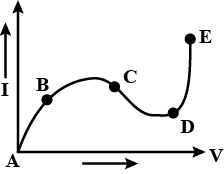
Identify the portion corresponding to negative resistance.
A) AB
B) BC
C) CD
D) D
Answer
 Verified
591k+ views
Hint: According to the ohm’s law the voltage across a circuit will be proportional to the current through the circuit. This proportionality constant is resistance. And for high current, the resistance will be low.
Complete step by step answer:
Given a graph where the voltage across the circuit is plotted in X-axis and the current through the circuit in Y-axis. The slope of the graph will be given as,
$\dfrac{I}{V}$
Where, $I$ is the current and $V$ is the voltage.
Let’s analyze the Ohm’s law that the voltage across a circuit will be proportional to the current through the circuit.
That is, $V = RI$
Where $R$ is the resistance of the circuit.
From the above equation,
$\Rightarrow \dfrac{I}{V} = \dfrac{1}{R}$
The slope of the graph is reciprocal of the resistance. In the graph, the region AB shows that the voltage increases directly with the current. In the region BC even the voltage is increasing, the current has only a slight increase. But in the region CD, the current is decreasing with the voltage. The graph went negative in that region. And the current is low which indicates the only a small amount of current is flowing through the circuit. The negative resistance is a property where the voltage increases and the current decreases. The region CD shows this property.
Therefore the correct answer is option C.
Note:
We have to note that for negative resistance the slope will be very low. Since the current is decreasing. And the voltage has a higher value than the current. So the region having a slope value less will show negative resistance.
Complete step by step answer:
Given a graph where the voltage across the circuit is plotted in X-axis and the current through the circuit in Y-axis. The slope of the graph will be given as,
$\dfrac{I}{V}$
Where, $I$ is the current and $V$ is the voltage.
Let’s analyze the Ohm’s law that the voltage across a circuit will be proportional to the current through the circuit.
That is, $V = RI$
Where $R$ is the resistance of the circuit.
From the above equation,
$\Rightarrow \dfrac{I}{V} = \dfrac{1}{R}$
The slope of the graph is reciprocal of the resistance. In the graph, the region AB shows that the voltage increases directly with the current. In the region BC even the voltage is increasing, the current has only a slight increase. But in the region CD, the current is decreasing with the voltage. The graph went negative in that region. And the current is low which indicates the only a small amount of current is flowing through the circuit. The negative resistance is a property where the voltage increases and the current decreases. The region CD shows this property.
Therefore the correct answer is option C.
Note:
We have to note that for negative resistance the slope will be very low. Since the current is decreasing. And the voltage has a higher value than the current. So the region having a slope value less will show negative resistance.
Recently Updated Pages
Basicity of sulphurous acid and sulphuric acid are

Master Class 12 English: Engaging Questions & Answers for Success
Master Class 12 Social Science: Engaging Questions & Answers for Success
Master Class 12 Maths: Engaging Questions & Answers for Success
Master Class 12 Economics: Engaging Questions & Answers for Success
Master Class 12 Physics: Engaging Questions & Answers for Success
Trending doubts
Which are the Top 10 Largest Countries of the World?
Draw a labelled sketch of the human eye class 12 physics CBSE
Draw ray diagrams each showing i myopic eye and ii class 12 physics CBSE
Give 10 examples of unisexual and bisexual flowers
Coming together federation is practiced in A India class 12 social science CBSE
How was the Civil Disobedience Movement different from class 12 social science CBSE