




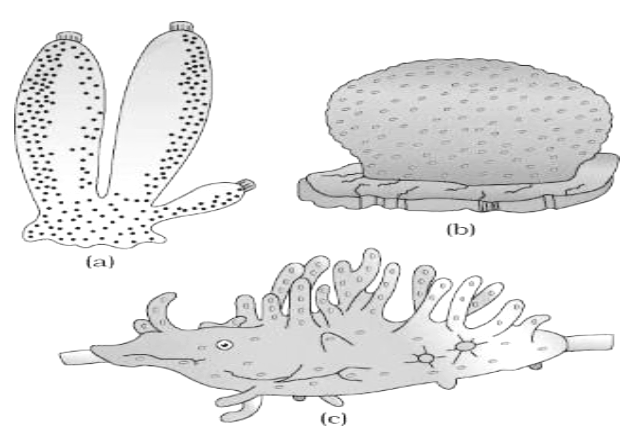
Identify the given figures A,B and C and select the correct option.
a. A- Sycon, B Euspongia, C-Spongilla
b. A- Euspongia, B spongilla, C- Sycon
c. A - Spongilla, B - Sycon, C – Euspongia
d. A - Euspongia, B Sycon, C- Spongilla
Answer
 Verified
623.4k+ views
Hint: Sponges are the members of the phylum Porifera, the body of sponges is porous and made of tubular channels, which useful for the water to circulate and it also contains the jelly-like substance called Mesohyl is present in the sponges.
Complete answer:
> Sycon: It is a genus of the calcareous sponge, where these sponges are small, which grow up to 7.5 centimeters, and the length of this sponges are range from 2.5 centimeters to 7.5 cms, these are tube-shaped sponges which are white to cream in color, the sycon sponges are also called as Q TIP Sponges, and they are also called as an aquarium hobbyist, and they are frequent hitchhikers brought in to the water.
> Euspongia:
Euspongia or also called spongia, these are the genus of the marine sponges, these types of sponges almost contain 60 species, Some species of euspongia are used as a cleaning tool, but later they have been replaced by the synthetic parts of the plant.
> Spongilla:
When coming to the spongilla, it belongs to the family spongillidae, they are the freshwater sponges, and they usually found in the lakes, and slow water streams, and this sponges are floating in the water, and they also attached to the rocks and lags and filter the water from various aquatic organisms such as protozoans etc.
Hence, the correct answer is option (A), a) sycon, b) euspongia, C) spongilla.
Note: Most of the body of the sponge is hollow, while it only contains the mesohyl which is present at the middle to withstand the shape, the adult and matured sponges are sessile, while they are of two types, marine and freshwater sponges, some of them may move at the speed of 1 to 4mm per day.
Complete answer:
> Sycon: It is a genus of the calcareous sponge, where these sponges are small, which grow up to 7.5 centimeters, and the length of this sponges are range from 2.5 centimeters to 7.5 cms, these are tube-shaped sponges which are white to cream in color, the sycon sponges are also called as Q TIP Sponges, and they are also called as an aquarium hobbyist, and they are frequent hitchhikers brought in to the water.
> Euspongia:
Euspongia or also called spongia, these are the genus of the marine sponges, these types of sponges almost contain 60 species, Some species of euspongia are used as a cleaning tool, but later they have been replaced by the synthetic parts of the plant.
> Spongilla:
When coming to the spongilla, it belongs to the family spongillidae, they are the freshwater sponges, and they usually found in the lakes, and slow water streams, and this sponges are floating in the water, and they also attached to the rocks and lags and filter the water from various aquatic organisms such as protozoans etc.
Hence, the correct answer is option (A), a) sycon, b) euspongia, C) spongilla.
Note: Most of the body of the sponge is hollow, while it only contains the mesohyl which is present at the middle to withstand the shape, the adult and matured sponges are sessile, while they are of two types, marine and freshwater sponges, some of them may move at the speed of 1 to 4mm per day.
Recently Updated Pages
Master Class 11 English: Engaging Questions & Answers for Success

Master Class 11 Social Science: Engaging Questions & Answers for Success
Master Class 11 Maths: Engaging Questions & Answers for Success
Master Class 11 Biology: Engaging Questions & Answers for Success
Master Class 11 Physics: Engaging Questions & Answers for Success
Master Class 11 Chemistry: Engaging Questions & Answers for Success
Trending doubts
One Metric ton is equal to kg A 10000 B 1000 C 100 class 11 physics CBSE
Difference Between Prokaryotic Cells and Eukaryotic Cells
1 ton equals to A 100 kg B 1000 kg C 10 kg D 10000 class 11 physics CBSE
Find the value of the expression given below sin 30circ class 11 maths CBSE
Two of the body parts which do not appear in MRI are class 11 biology CBSE
What are hard magnetic materials class 11 physics CBSE