




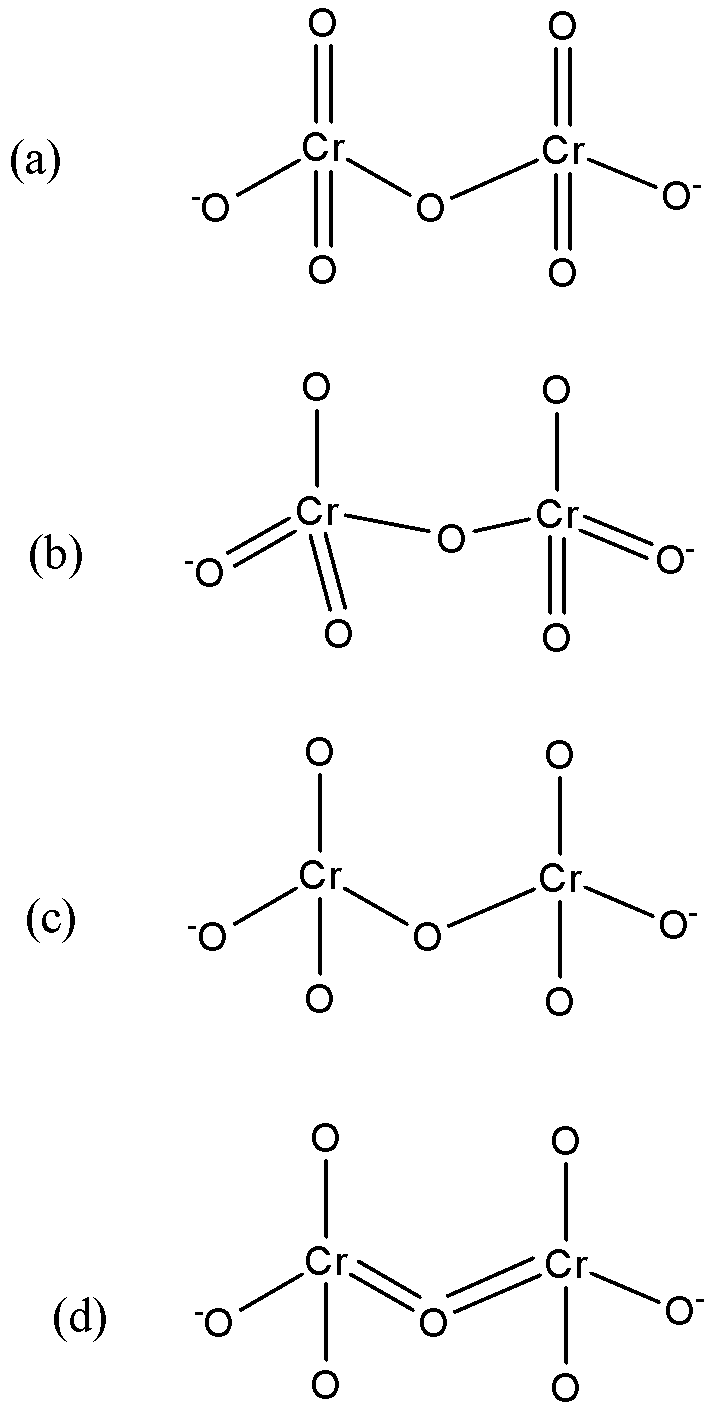
Identify the correct structure of dichromate ion:
Answer
 Verified
662.1k+ views
Hint: The correct structure has 4 double bonds. All the 4 double bonds are arranged in such a manner that they have the least repulsion and they have symmetry in the structure.
Complete step by step solution:
The formula of dichromate is $C{{r}_{2}}{{O}_{7}}^{2-}$.
The dichromate structure has 2 chromium ions as central metal ions forming a bridge with a common oxygen atom.
It has four double bonds- 2 on each chromium ions in such a manner that they are in the opposite direction.
The structure is:
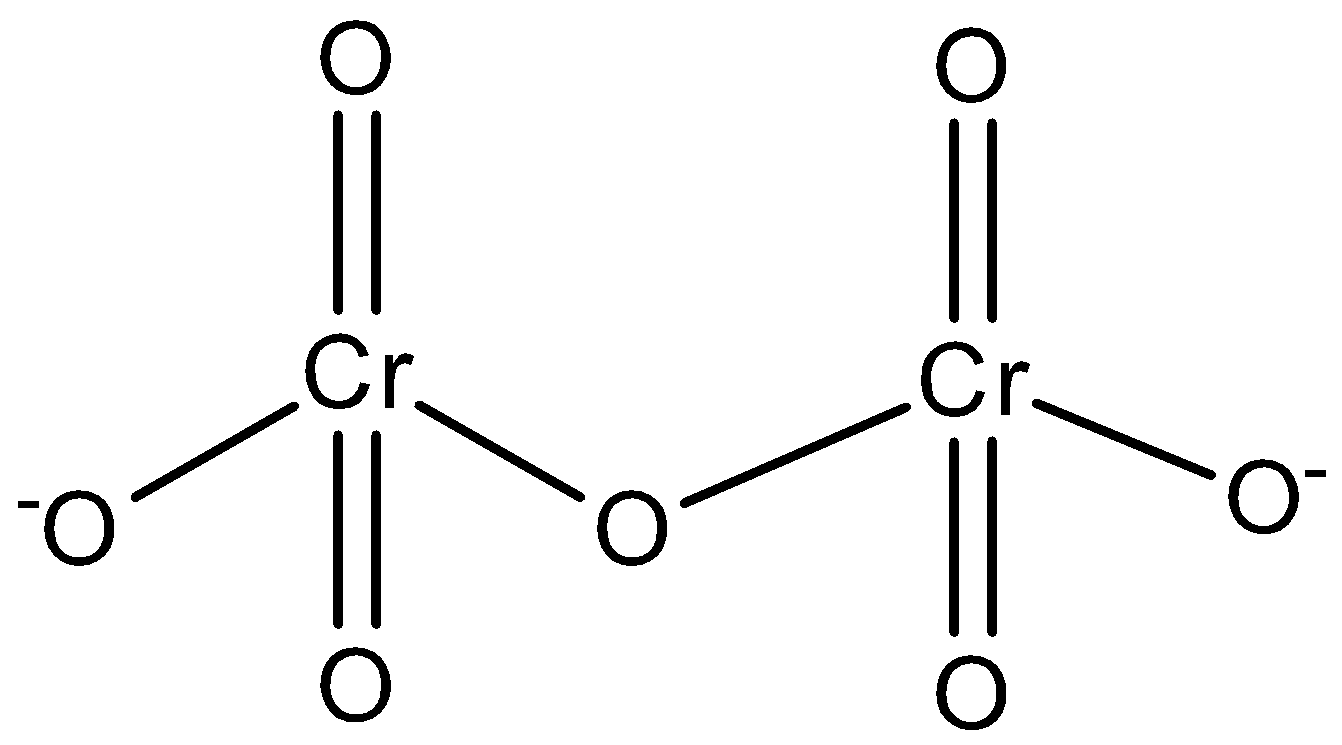
In $C{{r}_{2}}{{O}_{7}}^{2-}$ ion, the two Cr-O bonds which share an oxygen atom at the common vertex of two tetrahedral units are longer than the other six equivalent bonds.
The bond length of Cr and the common O atom is 179pm.
All the other Cr-O bonds are 163pm.
The bond angle of the oxygen atom which is bridged between 2 chromium ions has ${{126}^{\circ }}$.
It is important to know that in both $Cr{{O}_{4}}^{2-}$ and $C{{r}_{2}}{{O}_{7}}^{2-}$ and ions, Cr (VI) has ${{d}^{0}}$a configuration. Hence, the yellow color of $Cr{{O}_{4}}^{2-}$ the orange color $C{{r}_{2}}{{O}_{7}}^{2-}$ is not due to d-d transition but due to charge transfer, i.e., momentary transfer of charge from O-atom to metal atom thereby changing ${{O}^{2-}}$ ion momentarily to ${{O}^{-}}$ ion and reducing the oxidation state of chromium atom from +6 to +5.
So, the correct answer is “Option A”.
Note: You might get confused between the option (a) and (c) because the structure of (c) is also referred but the difference is that in option (c) the 2- charge is on the whole molecule. But the actual structure is an option (a).
Complete step by step solution:
The formula of dichromate is $C{{r}_{2}}{{O}_{7}}^{2-}$.
The dichromate structure has 2 chromium ions as central metal ions forming a bridge with a common oxygen atom.
It has four double bonds- 2 on each chromium ions in such a manner that they are in the opposite direction.
The structure is:
In $C{{r}_{2}}{{O}_{7}}^{2-}$ ion, the two Cr-O bonds which share an oxygen atom at the common vertex of two tetrahedral units are longer than the other six equivalent bonds.
The bond length of Cr and the common O atom is 179pm.
All the other Cr-O bonds are 163pm.
The bond angle of the oxygen atom which is bridged between 2 chromium ions has ${{126}^{\circ }}$.
It is important to know that in both $Cr{{O}_{4}}^{2-}$ and $C{{r}_{2}}{{O}_{7}}^{2-}$ and ions, Cr (VI) has ${{d}^{0}}$a configuration. Hence, the yellow color of $Cr{{O}_{4}}^{2-}$ the orange color $C{{r}_{2}}{{O}_{7}}^{2-}$ is not due to d-d transition but due to charge transfer, i.e., momentary transfer of charge from O-atom to metal atom thereby changing ${{O}^{2-}}$ ion momentarily to ${{O}^{-}}$ ion and reducing the oxidation state of chromium atom from +6 to +5.
So, the correct answer is “Option A”.
Note: You might get confused between the option (a) and (c) because the structure of (c) is also referred but the difference is that in option (c) the 2- charge is on the whole molecule. But the actual structure is an option (a).
Recently Updated Pages
Which of the following graphs shows the variation of class 12 physics CBSE

Draw a labelled diagram of the human male reproductive class 12 biology CBSE
Describe the experiment to compare the emf of two cells class 12 physics CBSE
What is standard hydrogen electrode
What is conventional current and electric current class 12 physics CBSE
2Bromopentane is treated with an alcoholic KOH solution class 12 chemistry CBSE
Trending doubts
Draw a labelled sketch of the human eye class 12 physics CBSE
Which are the Top 10 Largest Countries of the World?
Differentiate between homogeneous and heterogeneous class 12 chemistry CBSE
Draw ray diagrams each showing i myopic eye and ii class 12 physics CBSE
Which is the correct genotypic ratio of mendel dihybrid class 12 biology CBSE
What is the Full Form of PVC, PET, HDPE, LDPE, PP and PS ?