




Identify the binary mixtures that can be separated into individual compounds, by differential extraction, as shown in the given scheme:
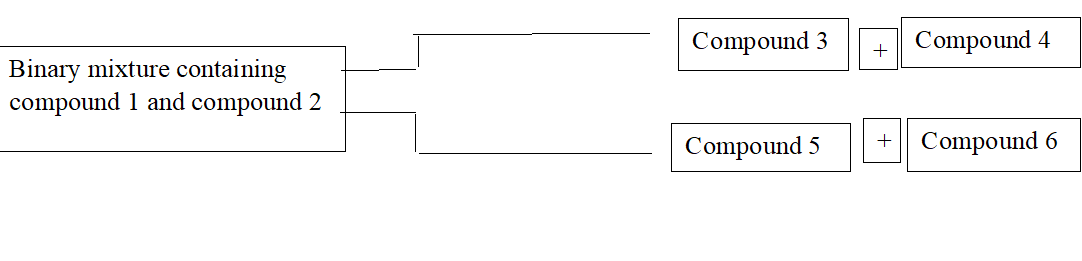
This question has multiple correct options
A. \[{{C}_{6}}{{H}_{5}}OH,{{C}_{6}}{{H}_{5}}COOH\]
B. \[{{C}_{6}}{{H}_{5}}COOH,{{C}_{6}}{{H}_{5}}C{{H}_{2}}OH\]
C. \[{{C}_{6}}{{H}_{5}}C{{H}_{2}}OH,{{C}_{6}}{{H}_{5}}OH\]
D. \[{{C}_{6}}{{H}_{5}}C{{H}_{2}}OH,{{C}_{6}}{{H}_{5}}C{{H}_{2}}COOH\]
Answer
 Verified
607.2k+ views
Hint: Binary mixtures are those which have two components. In this only one component of the mixture is collected in pure form.
Complete Solution :
Binary mixtures have usually two components out of which both can be liquid, one can be solid and solid etc. Binary mixtures which contain solid and liquid can be separated by physical methods. Others can be separated by some other processes like distillation, neutralization, centrifugation etc. the separation is based on the solubility of acidic/basic solution. In this type of separation only one component of mixture is collected which is pure in nature.
In the question if we take option
A. \[{{C}_{6}}{{H}_{5}}OH,{{C}_{6}}{{H}_{5}}COOH\] can be separated with \[NaHC{{O}_{3}}\] but with \[NaOH\]is not possible this case, so option A is not correct.
B. \[{{C}_{6}}{{H}_{5}}COOH,{{C}_{6}}{{H}_{5}}C{{H}_{2}}OH\] separation is possible by both \[NaHC{{O}_{3}}\]and \[NaOH\] in this case.
C. \[{{C}_{6}}{{H}_{5}}C{{H}_{2}}OH,{{C}_{6}}{{H}_{5}}OH\] can be separated with \[NaOH\] only not with \[NaHC{{O}_{3}}\] so this option is not correct.
D. \[{{C}_{6}}{{H}_{5}}C{{H}_{2}}OH,{{C}_{6}}{{H}_{5}}C{{H}_{2}}COOH\] separation is possible by both \[NaHC{{O}_{3}}\] and \[NaOH\] in this case.
So, the correct answer is “Option B and D”.
Note: Separation of binary compounds are depend upon the strength of its acidity and basicity and strength of some organic compounds can be show by:
\[{{C}_{6}}{{H}_{5}}COOH,{{C}_{6}}{{H}_{5}}C{{H}_{2}}COOH>{{H}_{2}}C{{O}_{3}}>{{C}_{6}}{{H}_{5}}OH>{{H}_{2}}O>{{C}_{6}}{{H}_{5}}C{{H}_{2}}OH\]
Complete Solution :
Binary mixtures have usually two components out of which both can be liquid, one can be solid and solid etc. Binary mixtures which contain solid and liquid can be separated by physical methods. Others can be separated by some other processes like distillation, neutralization, centrifugation etc. the separation is based on the solubility of acidic/basic solution. In this type of separation only one component of mixture is collected which is pure in nature.
In the question if we take option
A. \[{{C}_{6}}{{H}_{5}}OH,{{C}_{6}}{{H}_{5}}COOH\] can be separated with \[NaHC{{O}_{3}}\] but with \[NaOH\]is not possible this case, so option A is not correct.
B. \[{{C}_{6}}{{H}_{5}}COOH,{{C}_{6}}{{H}_{5}}C{{H}_{2}}OH\] separation is possible by both \[NaHC{{O}_{3}}\]and \[NaOH\] in this case.
C. \[{{C}_{6}}{{H}_{5}}C{{H}_{2}}OH,{{C}_{6}}{{H}_{5}}OH\] can be separated with \[NaOH\] only not with \[NaHC{{O}_{3}}\] so this option is not correct.
D. \[{{C}_{6}}{{H}_{5}}C{{H}_{2}}OH,{{C}_{6}}{{H}_{5}}C{{H}_{2}}COOH\] separation is possible by both \[NaHC{{O}_{3}}\] and \[NaOH\] in this case.
So, the correct answer is “Option B and D”.
Note: Separation of binary compounds are depend upon the strength of its acidity and basicity and strength of some organic compounds can be show by:
\[{{C}_{6}}{{H}_{5}}COOH,{{C}_{6}}{{H}_{5}}C{{H}_{2}}COOH>{{H}_{2}}C{{O}_{3}}>{{C}_{6}}{{H}_{5}}OH>{{H}_{2}}O>{{C}_{6}}{{H}_{5}}C{{H}_{2}}OH\]
Recently Updated Pages
Master Class 12 Economics: Engaging Questions & Answers for Success

Master Class 12 English: Engaging Questions & Answers for Success
Master Class 12 Social Science: Engaging Questions & Answers for Success
Master Class 12 Maths: Engaging Questions & Answers for Success
Master Class 12 Physics: Engaging Questions & Answers for Success
Master Class 9 General Knowledge: Engaging Questions & Answers for Success
Trending doubts
One Metric ton is equal to kg A 10000 B 1000 C 100 class 11 physics CBSE
Difference Between Prokaryotic Cells and Eukaryotic Cells
Find the value of the expression given below sin 30circ class 11 maths CBSE
Two of the body parts which do not appear in MRI are class 11 biology CBSE
Draw a diagram of nephron and explain its structur class 11 biology CBSE
10 examples of friction in our daily life