




Identify and select the limless amphibian
A) Ichthyophis
B) Ichthyosaurus
C) Salamandra
D) Naja
Answer
 Verified
611.4k+ views
Hint: Amphibians belonging to the genus Caecilians are limbless.
Complete Answer:
Wondering about the limbless amphibians, you are confused because the class amphibia happens to be under Tetrapoda, and they are supposed to have four limbs. Well, such exceptional animals are indicative of the route of evolution.
So, let’s talk about the amphibians first. Amphibians are vertebrates, meaning that they showed the presence of a notochord during the embryonic development, which is then replaced by the vertebral column. Amphibians are such animals that need both water and land to complete their life cycle. They need water for the purpose of their fertilization. Frogs, toads, salamanders, etc. are some amphibians.
Certain characteristic features of amphibians are written below:
1) These are ectothermic animals.
2) Their body has a head and a trunk. Tail may or may not be present.
3) They do not have scales but the skin is kept moist to help in cutaneous respiration.
4) They generally have two pairs of limbs for locomotion. Exceptions to this are the amphibians belonging to the genus Caecilians, such as Ichthyophis. These are limbless amphibians.
5) They have a three chambered heart.
6) Their sexes are separate and fertilization occurs externally in water
The limbless amphibians are commonly seen in Southeast Asia, the southern Philippines, and the western Indo-Australian Archipelago. They have a short and broad body structure. They have a characteristic yellow or cream stripe running across the body.
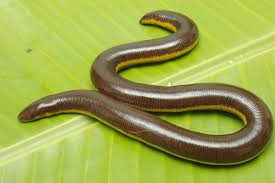
Therefore, the correct answer is option A.
Note: - Ichthyosaurus is an extinct aquatic reptile.
- Salamandra is an amphibian with four limbs and a tail.
- Naja is a reptile.
Complete Answer:
Wondering about the limbless amphibians, you are confused because the class amphibia happens to be under Tetrapoda, and they are supposed to have four limbs. Well, such exceptional animals are indicative of the route of evolution.
So, let’s talk about the amphibians first. Amphibians are vertebrates, meaning that they showed the presence of a notochord during the embryonic development, which is then replaced by the vertebral column. Amphibians are such animals that need both water and land to complete their life cycle. They need water for the purpose of their fertilization. Frogs, toads, salamanders, etc. are some amphibians.
Certain characteristic features of amphibians are written below:
1) These are ectothermic animals.
2) Their body has a head and a trunk. Tail may or may not be present.
3) They do not have scales but the skin is kept moist to help in cutaneous respiration.
4) They generally have two pairs of limbs for locomotion. Exceptions to this are the amphibians belonging to the genus Caecilians, such as Ichthyophis. These are limbless amphibians.
5) They have a three chambered heart.
6) Their sexes are separate and fertilization occurs externally in water
The limbless amphibians are commonly seen in Southeast Asia, the southern Philippines, and the western Indo-Australian Archipelago. They have a short and broad body structure. They have a characteristic yellow or cream stripe running across the body.
Therefore, the correct answer is option A.
Note: - Ichthyosaurus is an extinct aquatic reptile.
- Salamandra is an amphibian with four limbs and a tail.
- Naja is a reptile.
Recently Updated Pages
Master Class 11 Social Science: Engaging Questions & Answers for Success

Master Class 11 Physics: Engaging Questions & Answers for Success
Master Class 11 Maths: Engaging Questions & Answers for Success
Master Class 11 Economics: Engaging Questions & Answers for Success
Master Class 11 Computer Science: Engaging Questions & Answers for Success
Master Class 11 Chemistry: Engaging Questions & Answers for Success
Trending doubts
One Metric ton is equal to kg A 10000 B 1000 C 100 class 11 physics CBSE
There are 720 permutations of the digits 1 2 3 4 5 class 11 maths CBSE
1 Quintal is equal to a 110 kg b 10 kg c 100kg d 1000 class 11 physics CBSE
State and prove Bernoullis theorem class 11 physics CBSE
Difference Between Prokaryotic Cells and Eukaryotic Cells
Discuss the various forms of bacteria class 11 biology CBSE