




Identify a member of Porifera
(a)Spongilla
(b)Euglena
(c )Penicillium
(d)Hydra
Answer
 Verified
654.6k+ views
Hint: A member of phylum Porifera whose colour is influenced by its symbiotic relationship with an alga that lives intracellularly in the host. Poriferans are pore-bearing animals. They are commonly known as sponges.
Complete answer:
Spongilla is a freshwater sponge which is bright green due to the presence of Zoochlorella, a green alga that lives symbiotically with any invertebrate or protozoans. They use $CO_2$ and nitrogenous and phosphorus wastes from the host and offer oxygen and beneficial nutrients to their hosts.
Additional Information:
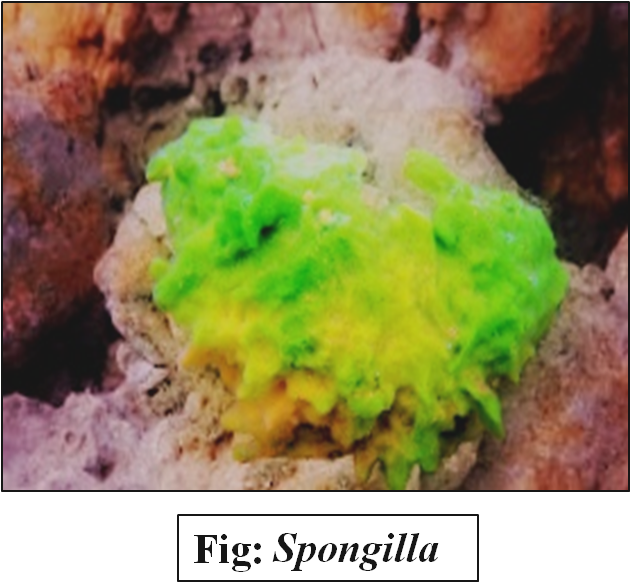
Spongilla belongs to phylum Porifera, commonly known as pore-bearing animals or sponges. Some important characteristics of Porifera are as follows:
Level of organization: Sponges are primitive multicellular animals with a cellular grade of organization.
Body form: Their body is porous with mainly two types of pores i.e. inhalant pores referred to as Ostia and exhalent pores referred to as oscula. Ostia leads to a central cavity, spongocoel, through a system of canals. Spongocoel opens to the external environment via one or two oscula.
Skeleton: An internal skeleton is present which may consist of calcareous(of Calcium) or siliceous (of Silica) spicules or of fine spongin fibres.
Canal System: A complex canal system in Spongilla maintains continuous water current flowing into the spongocoel. The canal system helps in nutrition, excretion, reproduction and respiration.
-Euglena is an example of Kingdom Protista. It consists of all of the unicellular eukaryotic organisms. They exhibit dual-mode of nutrition- photosynthetic and holozoic( in absence of light).
-Penicillium is a fungus, a kingdom for eukaryotic, non-photosynthetic, heterotrophic and thalloid organisms.
-Hydra belongs to the Phylum Coelenterata. They are radially symmetrical, diploblastic and multicellular with a tissue grade of organization.
So, the correct answer is ‘Spongilla.’
Note: Spongilla is found both in clear sunlight or under the rocks and logs. When growing in the sunlight, it looks green due to the presence of algae. The Spongilla which grows on the undersides of rocks or logs is usually pale coloured due to the absence or low densities of zoochlorellae as they are not well exposed to the sunlight. Zoochlorella in green Spongilla is found to be predominantly intracellular i.e. reside in membrane-bound vacuoles of the host(in this case Spongilla).
Complete answer:
Spongilla is a freshwater sponge which is bright green due to the presence of Zoochlorella, a green alga that lives symbiotically with any invertebrate or protozoans. They use $CO_2$ and nitrogenous and phosphorus wastes from the host and offer oxygen and beneficial nutrients to their hosts.
Additional Information:
Spongilla belongs to phylum Porifera, commonly known as pore-bearing animals or sponges. Some important characteristics of Porifera are as follows:
Level of organization: Sponges are primitive multicellular animals with a cellular grade of organization.
Body form: Their body is porous with mainly two types of pores i.e. inhalant pores referred to as Ostia and exhalent pores referred to as oscula. Ostia leads to a central cavity, spongocoel, through a system of canals. Spongocoel opens to the external environment via one or two oscula.
Skeleton: An internal skeleton is present which may consist of calcareous(of Calcium) or siliceous (of Silica) spicules or of fine spongin fibres.
Canal System: A complex canal system in Spongilla maintains continuous water current flowing into the spongocoel. The canal system helps in nutrition, excretion, reproduction and respiration.
-Euglena is an example of Kingdom Protista. It consists of all of the unicellular eukaryotic organisms. They exhibit dual-mode of nutrition- photosynthetic and holozoic( in absence of light).
-Penicillium is a fungus, a kingdom for eukaryotic, non-photosynthetic, heterotrophic and thalloid organisms.
-Hydra belongs to the Phylum Coelenterata. They are radially symmetrical, diploblastic and multicellular with a tissue grade of organization.
So, the correct answer is ‘Spongilla.’
Note: Spongilla is found both in clear sunlight or under the rocks and logs. When growing in the sunlight, it looks green due to the presence of algae. The Spongilla which grows on the undersides of rocks or logs is usually pale coloured due to the absence or low densities of zoochlorellae as they are not well exposed to the sunlight. Zoochlorella in green Spongilla is found to be predominantly intracellular i.e. reside in membrane-bound vacuoles of the host(in this case Spongilla).
Recently Updated Pages
Master Class 11 Social Science: Engaging Questions & Answers for Success

Master Class 11 English: Engaging Questions & Answers for Success
Master Class 11 Accountancy: Engaging Questions & Answers for Success
Master Class 11 Physics: Engaging Questions & Answers for Success
Master Class 11 Computer Science: Engaging Questions & Answers for Success
Master Class 11 Business Studies: Engaging Questions & Answers for Success
Trending doubts
One Metric ton is equal to kg A 10000 B 1000 C 100 class 11 physics CBSE
Find the value of the expression given below sin 30circ class 11 maths CBSE
Draw a diagram of nephron and explain its structur class 11 biology CBSE
10 examples of friction in our daily life
Proton was discovered by A Thomson B Rutherford C Chadwick class 11 chemistry CBSE
The teeth used for biting and cutting food are called class 11 biology CBSE