




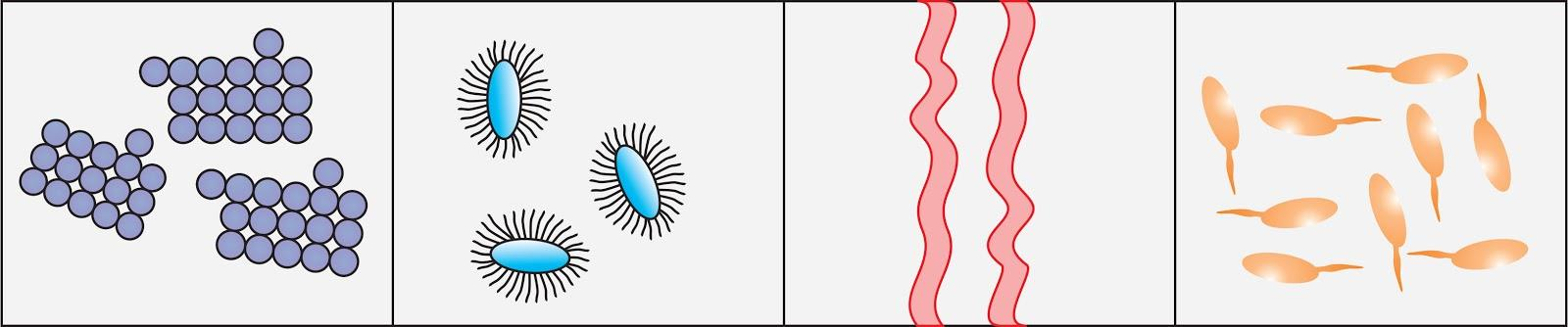
(i) Identify the following bacteria based on their shape
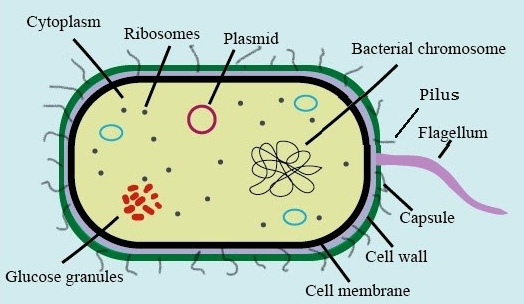
(ii) Draw and label the following parts of the bacteria.
(a) Flagella (b) Pilli (c) Cell wall (d) Cytoplasm (e) Cell membrane
Answer
 Verified
586.5k+ views
Hint: Bacteria are prokaryotic, single-celled, microscopic organisms. Bacterias are mainly classified into four types according to their basic shapes which are spherical, rod, spiral and comma shape.
Complete answer:
Bacteria are unicellular and are also known as microbes. In fact, the cell structure is very simple in contrast to other organisms. They do not contain a well-defined nucleus or membrane-bound cell organelles. Some bacterias instead contain a circular genetic material called a plasmid.
Bacteria are divided into four categories on the basis of their shape. The name of the shape according to the above image is given below.
1. Spherical(cocci) eg. Micrococcus flavus
2. Rod shaped(bacilli) eg. Bacillus cereus
3. Spiral(spirilla) eg. Spirillum volutans
4. Comma shaped(vibros) eg. Vibrio cholerae
They can either exist as one cell or in clusters.
-Monococcus: Single and round bacteria
Diplococcus: A diplococcus cell divides in one particular plane and remains attached to the initial cell.
-Streptococcus: cells divide repeatedly to form a chain-like structure
-Tetracoccus: initially consist of four cells which divide into two or three planes to form a bunch like structure.
Sarcina: cells divide into three planes to form a cube-like structure and have a regular shape.
A labeled diagram of a bacterial cell is given below.
Additional information:
Approximately there are ten times as many bacterial cells in the body of a human as the human cells. A lot of bacterias are mainly found in the lining of the digestive system. Some bacteria also reside in the soil or in dead plants where they play an important role in the cycling of different and necessary nutrients. Some also cause spoilage of food and also contribute to crop damage. In addition to this, some bacterias also play an important role in the production of fermented food such as yogurt or soy sauce. In contrast to this, some bacterias are parasites or pathogens which cause harm to other living beings.
Note:
Bacteria can be classified on the basis of many criteria. They are mainly classified to identify and distinguish from one another and also to group them based on certain criteria that are in the interest of microbiologists or other scientists.
Complete answer:
Bacteria are unicellular and are also known as microbes. In fact, the cell structure is very simple in contrast to other organisms. They do not contain a well-defined nucleus or membrane-bound cell organelles. Some bacterias instead contain a circular genetic material called a plasmid.
Bacteria are divided into four categories on the basis of their shape. The name of the shape according to the above image is given below.
1. Spherical(cocci) eg. Micrococcus flavus
2. Rod shaped(bacilli) eg. Bacillus cereus
3. Spiral(spirilla) eg. Spirillum volutans
4. Comma shaped(vibros) eg. Vibrio cholerae
They can either exist as one cell or in clusters.
-Monococcus: Single and round bacteria
Diplococcus: A diplococcus cell divides in one particular plane and remains attached to the initial cell.
-Streptococcus: cells divide repeatedly to form a chain-like structure
-Tetracoccus: initially consist of four cells which divide into two or three planes to form a bunch like structure.
Sarcina: cells divide into three planes to form a cube-like structure and have a regular shape.
A labeled diagram of a bacterial cell is given below.
Additional information:
Approximately there are ten times as many bacterial cells in the body of a human as the human cells. A lot of bacterias are mainly found in the lining of the digestive system. Some bacteria also reside in the soil or in dead plants where they play an important role in the cycling of different and necessary nutrients. Some also cause spoilage of food and also contribute to crop damage. In addition to this, some bacterias also play an important role in the production of fermented food such as yogurt or soy sauce. In contrast to this, some bacterias are parasites or pathogens which cause harm to other living beings.
Note:
Bacteria can be classified on the basis of many criteria. They are mainly classified to identify and distinguish from one another and also to group them based on certain criteria that are in the interest of microbiologists or other scientists.
Recently Updated Pages
Basicity of sulphurous acid and sulphuric acid are

Master Class 11 English: Engaging Questions & Answers for Success
Master Class 11 Physics: Engaging Questions & Answers for Success
Master Class 11 Computer Science: Engaging Questions & Answers for Success
Master Class 11 Chemistry: Engaging Questions & Answers for Success
Master Class 11 Social Science: Engaging Questions & Answers for Success
Trending doubts
Difference Between Prokaryotic Cells and Eukaryotic Cells
Two of the body parts which do not appear in MRI are class 11 biology CBSE
One Metric ton is equal to kg A 10000 B 1000 C 100 class 11 physics CBSE
10 examples of friction in our daily life
Draw a diagram of nephron and explain its structur class 11 biology CBSE
What will happen if the mucus is not secreted by the class 11 biology CBSE