




(i) Calculate the work done when $F=\left( 5\hat{i}+3\hat{j}+2\hat{k} \right)N$ and $S=\left( 3\hat{i}-\hat{j}+2\hat{k} \right)m$ acting in the same direction.
(ii) Show with the help of a vector diagram that the work-done is a scalar product of force and displacement.
Answer
 Verified
590.4k+ views
Hint: A scalar product can be defined as the product of two vector quantities which results in a scalar. Force is a vector quantity and displacement is also a vector quantity. Work done can be defined as the dot product or scalar product of the force and the displacement.
Complete step-by-step solution
The force on the object is given as, $F=\left( 5\hat{i}+3\hat{j}+2\hat{k} \right)N$
The distance covered by the object is, $S=\left( 3\hat{i}-\hat{j}+2\hat{k} \right)m$
The work done on an object on which a force is acting and moves by a distance can be given by the dot product of the force and the distance. Simply, we can define that work done by a force can be defined as the product of the force in the direction of movement of the object and the distance covered by the object.
Work done is,
$\begin{align}
&\Rightarrow W=\vec{F}.\vec{S}=\left( 5\hat{i}+3\hat{j}+2\hat{k} \right).\left( 3\hat{i}-\hat{j}+2\hat{k} \right) \\
& \Rightarrow W=15-3+4 \\
& \Rightarrow W=16J \\
\end{align}$
So, the work done is 16 joules. The force and the displacement are vector quantities, while the work done is a scalar quantity.
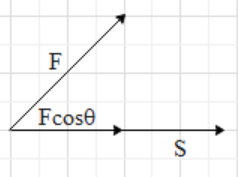
Find the component of the force F in the direction of the displacement. The component of the force is $F\cos \theta $, where $\theta $ is the angle between the force and the displacement. Then multiply the component of a force and the displacement to find the work done.
$W=FS\cos \theta $
Note: A scalar quantity can be defined as a quantity which has only magnitude, not direction. A vector quantity can be defined as the quantity which has both the direction and the magnitude. We have the force and displacement as a vector quantity. But the work done found from the force and the displacement is a scalar quantity.
Complete step-by-step solution
The force on the object is given as, $F=\left( 5\hat{i}+3\hat{j}+2\hat{k} \right)N$
The distance covered by the object is, $S=\left( 3\hat{i}-\hat{j}+2\hat{k} \right)m$
The work done on an object on which a force is acting and moves by a distance can be given by the dot product of the force and the distance. Simply, we can define that work done by a force can be defined as the product of the force in the direction of movement of the object and the distance covered by the object.
Work done is,
$\begin{align}
&\Rightarrow W=\vec{F}.\vec{S}=\left( 5\hat{i}+3\hat{j}+2\hat{k} \right).\left( 3\hat{i}-\hat{j}+2\hat{k} \right) \\
& \Rightarrow W=15-3+4 \\
& \Rightarrow W=16J \\
\end{align}$
So, the work done is 16 joules. The force and the displacement are vector quantities, while the work done is a scalar quantity.
Find the component of the force F in the direction of the displacement. The component of the force is $F\cos \theta $, where $\theta $ is the angle between the force and the displacement. Then multiply the component of a force and the displacement to find the work done.
$W=FS\cos \theta $
Note: A scalar quantity can be defined as a quantity which has only magnitude, not direction. A vector quantity can be defined as the quantity which has both the direction and the magnitude. We have the force and displacement as a vector quantity. But the work done found from the force and the displacement is a scalar quantity.
Recently Updated Pages
Master Class 11 Business Studies: Engaging Questions & Answers for Success

Master Class 11 Computer Science: Engaging Questions & Answers for Success
Master Class 11 Economics: Engaging Questions & Answers for Success
Master Class 11 Social Science: Engaging Questions & Answers for Success
Master Class 11 English: Engaging Questions & Answers for Success
Master Class 11 Chemistry: Engaging Questions & Answers for Success
Trending doubts
Draw a diagram of nephron and explain its structur class 11 biology CBSE
Explain zero factorial class 11 maths CBSE
Chemical formula of Bleaching powder is A Ca2OCl2 B class 11 chemistry CBSE
Name the part of the brain responsible for the precision class 11 biology CBSE
The growth of tendril in pea plants is due to AEffect class 11 biology CBSE
One Metric ton is equal to kg A 10000 B 1000 C 100 class 11 physics CBSE