




Hydrazobenzene on treatment with ${{\text{H}}_{\text{2}}}{\text{S}}{{\text{O}}_{\text{4}}}$ forms:
A) Azobenzene
B) Azobenzene sulfonic acid
C) Benzidine
D) None of the above
Answer
 Verified
626.4k+ views
Hint: To solve this we must know that hydrazobenzene is also known as diphenylhydrazine. The structure is two benzene rings to which $ - {\text{NH}}$ groups are attached. These two rings are then connected through the nitrogen-nitrogen $\left( {{\text{N}} - {\text{N}}} \right)$ bond. ${{\text{H}}_{\text{2}}}{\text{S}}{{\text{O}}_{\text{4}}}$ which is known as sulphuric acid creates an acidic medium. A rearrangement reaction occurs.
Complete solution:
We know that hydrazobenzene as the name suggests hydrazo group is $ - {\text{NH}}$ group and benzene indicates that this hydrazo group is attached to the benzene ring.
Hydrazobenzene is two benzene rings to which $ - {\text{NH}}$ groups are attached. These two rings are then connected through the nitrogen-nitrogen $\left( {{\text{N}} - {\text{N}}} \right)$ bond.
The structure for hydrazobenzene is as follows:
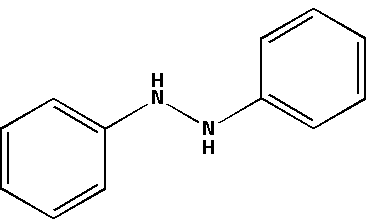
${{\text{H}}_{\text{2}}}{\text{S}}{{\text{O}}_{\text{4}}}$ which is known as sulphuric acid creates an acidic medium. Hydrazobenzene in an acidic medium accepts protons from the sulphuric acid. In an acidic medium, hydrazobenzene undergoes a rearrangement reaction.
The mechanism of the reaction when hydrazobenzene reacts with sulphuric acid i.e. ${{\text{H}}_{\text{2}}}{\text{S}}{{\text{O}}_{\text{4}}}$ is as follows:
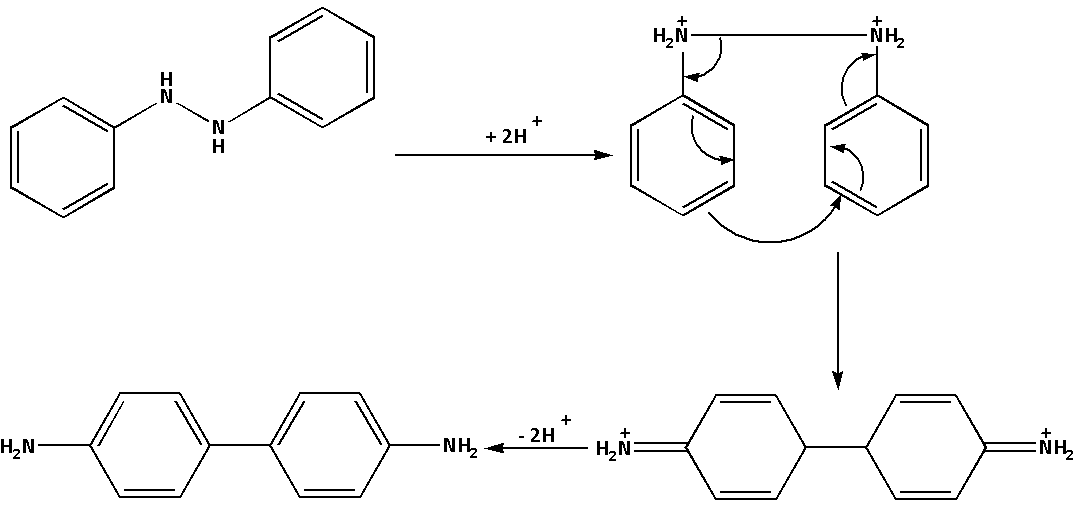
In the reaction, where hydrazobenzene reacts with sulphuric acid i.e. ${{\text{H}}_{\text{2}}}{\text{S}}{{\text{O}}_{\text{4}}}$ a rearrangement reaction leads to the formation of benzidine. Thus, benzidine is a product of rearrangement of hydrazobenzene in an acidic medium.
Benzidine is not a naturally occurring substance and is synthesized mainly from hydrazobenzene on reacting it with sulphuric acid i.e. ${{\text{H}}_{\text{2}}}{\text{S}}{{\text{O}}_{\text{4}}}$.
Thus, hydrazobenzene on treatment with ${{\text{H}}_{\text{2}}}{\text{S}}{{\text{O}}_{\text{4}}}$ forms benzidine.
Thus, the correct option is (C) benzidine.
Note: Benzidine is greyish-red, yellowish or white coloured powder. Benzidine can also be synthesized from nitrobenzene. Nitrobenzene is first converted to diphenylhydrazine or hydrazobenzene using iron powder as a reducing agent which then undergoes the same rearrangement reaction in acidic medium as shown above.
Complete solution:
We know that hydrazobenzene as the name suggests hydrazo group is $ - {\text{NH}}$ group and benzene indicates that this hydrazo group is attached to the benzene ring.
Hydrazobenzene is two benzene rings to which $ - {\text{NH}}$ groups are attached. These two rings are then connected through the nitrogen-nitrogen $\left( {{\text{N}} - {\text{N}}} \right)$ bond.
The structure for hydrazobenzene is as follows:
${{\text{H}}_{\text{2}}}{\text{S}}{{\text{O}}_{\text{4}}}$ which is known as sulphuric acid creates an acidic medium. Hydrazobenzene in an acidic medium accepts protons from the sulphuric acid. In an acidic medium, hydrazobenzene undergoes a rearrangement reaction.
The mechanism of the reaction when hydrazobenzene reacts with sulphuric acid i.e. ${{\text{H}}_{\text{2}}}{\text{S}}{{\text{O}}_{\text{4}}}$ is as follows:
In the reaction, where hydrazobenzene reacts with sulphuric acid i.e. ${{\text{H}}_{\text{2}}}{\text{S}}{{\text{O}}_{\text{4}}}$ a rearrangement reaction leads to the formation of benzidine. Thus, benzidine is a product of rearrangement of hydrazobenzene in an acidic medium.
Benzidine is not a naturally occurring substance and is synthesized mainly from hydrazobenzene on reacting it with sulphuric acid i.e. ${{\text{H}}_{\text{2}}}{\text{S}}{{\text{O}}_{\text{4}}}$.
Thus, hydrazobenzene on treatment with ${{\text{H}}_{\text{2}}}{\text{S}}{{\text{O}}_{\text{4}}}$ forms benzidine.
Thus, the correct option is (C) benzidine.
Note: Benzidine is greyish-red, yellowish or white coloured powder. Benzidine can also be synthesized from nitrobenzene. Nitrobenzene is first converted to diphenylhydrazine or hydrazobenzene using iron powder as a reducing agent which then undergoes the same rearrangement reaction in acidic medium as shown above.
Recently Updated Pages
Master Class 12 Physics: Engaging Questions & Answers for Success

Master Class 12 Social Science: Engaging Questions & Answers for Success
Master Class 12 English: Engaging Questions & Answers for Success
Master Class 12 Maths: Engaging Questions & Answers for Success
Master Class 12 Business Studies: Engaging Questions & Answers for Success
Master Class 12 Chemistry: Engaging Questions & Answers for Success
Trending doubts
Draw a labelled sketch of the human eye class 12 physics CBSE
Which are the Top 10 Largest Countries of the World?
Draw ray diagrams each showing i myopic eye and ii class 12 physics CBSE
Which is the correct genotypic ratio of mendel dihybrid class 12 biology CBSE
Give 10 examples of unisexual and bisexual flowers
What is the Full Form of PVC, PET, HDPE, LDPE, PP and PS ?