




Hybridisation of carbon in ${C_3}{O_2}$ is:
(A) sp
(B) $s{p^2}$
(C) $s{p^3}$
(D) $s{p^3}d$
Answer
 Verified
633.9k+ views
Hint: First see the number of electrons in the outermost orbits of the element and then count the number of bonding regions and lone pairs formed by it in the particular compound. Accordingly see what the hybridisation will be.
Complete answer:
-Hybridisation is a basic concept of mixing of atomic orbitals to form new hybrid orbitals to form chemical bonds according to the valence bond theory.
-Before trying to deduce the hybridisation let us check a little about carbon atoms. It has an atomic number of 6 and its electronic configuration is: $1{s^2}2{s^2}2{p^2}$. We know that it can accommodate 4 more electrons in its outermost shell and form a maximum of 4 bonds.
-${C_3}{O_2}$ is the molecular formula of carbon suboxide or tricarbon dioxide. It is an oxide of carbon and also a member of the linear oxocarbon series ($O = {C_n} = O$).
Its structure is as follows:
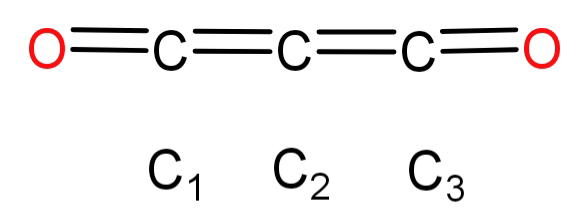
In this we can see that each carbon forms double bonds with 2 other atoms (either other carbon or oxygen) and each carbon has 2 sigma (σ) and 2 pi (π) bonds. Also carbon has 4 electrons in its outermost shell and it cannot form more than 4 bonds, so no more bonding regions are possible. Let us just see the 3 carbon atoms and their bonding patterns:
For carbon 1 (${C_1}$): We can see that it forms 1 double bond with an oxygen atom and one with another carbon atom and hence has only 2 bonding domains. It forms 2 sigma (σ) and 2 pi (π) bonds. Hence its hybridisation is sp.
For carbon 2 (${C_2}$): We can see that it forms 2 double bonds, each with a different carbon atom and hence has only 2 bonding domains. It forms 2 sigma (σ) and 2 pi (π) bonds. Hence its hybridisation is sp.
For carbon 3 (${C_3}$):We can see that it forms 1 double bond with an oxygen atom and one with another carbon atom and hence has only 2 bonding domains. It forms 2 sigma (σ) and 2 pi (π) bonds. Hence its hybridisation is sp.
Hence we can say that the hybridisation of carbon in ${C_3}{O_2}$ is sp.
The correct option will be: (A) sp
Note:
Remember that a double bond is counted as 1 electron region only and not 2 electron regions. Carbon superoxide is also considered as anhydride of malonic anhydride or second anhydride of malonic acid because it can be formed by heating a dry mixture of malonic acid (or its ester) and phosphorous pentoxide.
Complete answer:
-Hybridisation is a basic concept of mixing of atomic orbitals to form new hybrid orbitals to form chemical bonds according to the valence bond theory.
-Before trying to deduce the hybridisation let us check a little about carbon atoms. It has an atomic number of 6 and its electronic configuration is: $1{s^2}2{s^2}2{p^2}$. We know that it can accommodate 4 more electrons in its outermost shell and form a maximum of 4 bonds.
-${C_3}{O_2}$ is the molecular formula of carbon suboxide or tricarbon dioxide. It is an oxide of carbon and also a member of the linear oxocarbon series ($O = {C_n} = O$).
Its structure is as follows:
In this we can see that each carbon forms double bonds with 2 other atoms (either other carbon or oxygen) and each carbon has 2 sigma (σ) and 2 pi (π) bonds. Also carbon has 4 electrons in its outermost shell and it cannot form more than 4 bonds, so no more bonding regions are possible. Let us just see the 3 carbon atoms and their bonding patterns:
For carbon 1 (${C_1}$): We can see that it forms 1 double bond with an oxygen atom and one with another carbon atom and hence has only 2 bonding domains. It forms 2 sigma (σ) and 2 pi (π) bonds. Hence its hybridisation is sp.
For carbon 2 (${C_2}$): We can see that it forms 2 double bonds, each with a different carbon atom and hence has only 2 bonding domains. It forms 2 sigma (σ) and 2 pi (π) bonds. Hence its hybridisation is sp.
For carbon 3 (${C_3}$):We can see that it forms 1 double bond with an oxygen atom and one with another carbon atom and hence has only 2 bonding domains. It forms 2 sigma (σ) and 2 pi (π) bonds. Hence its hybridisation is sp.
Hence we can say that the hybridisation of carbon in ${C_3}{O_2}$ is sp.
The correct option will be: (A) sp
Note:
Remember that a double bond is counted as 1 electron region only and not 2 electron regions. Carbon superoxide is also considered as anhydride of malonic anhydride or second anhydride of malonic acid because it can be formed by heating a dry mixture of malonic acid (or its ester) and phosphorous pentoxide.
Recently Updated Pages
The given figure shows two endocrine glands marked class 11 biology NEET_UG

Match columnI with columnII and select the correct class 11 biology NEET
Match column I with column II and select the correct class 11 biology NEET_UG
Which floral family has left 9 right + 1 arrangement class 11 biology NEET_UG
Which is not a variety of sheep A Lohi B Beetal C Nellore class 11 biology NEET_UG
Match column I with column II and select the correct class 11 biology NEET_UG
Trending doubts
One Metric ton is equal to kg A 10000 B 1000 C 100 class 11 physics CBSE
Draw a diagram of a plant cell and label at least eight class 11 biology CBSE
Difference Between Prokaryotic Cells and Eukaryotic Cells
Draw a well labelled diagram of reflex arc and explain class 11 biology CBSE
Two of the body parts which do not appear in MRI are class 11 biology CBSE
1 ton equals to A 100 kg B 1000 kg C 10 kg D 10000 class 11 physics CBSE