




How many sperm enter an egg?
Answer
 Verified
489.9k+ views
Hint: Sperm is called the male sex cells or male gametes which are formed in the testes (reproductive organ of male) while egg or ova is called the female sex cells or female gametes which are formed in the ovaries (the reproductive organ of female).
Complete Answer-
The internal fertilization takes place inside the human body. The male gametes that are made in the testes of man are introduced into the women vagina through penis during mating (or copulation). In the vagina the millions of sperms are introduced at one time. Sperms are highly active in nature and also mobile or moving. They move up into the uterus with the help of the cervix. From the uterus, sperm are passed into the ampullary-isthmic junction of the oviduct. One of the oviducts contains an egg cell released by the ovary during ovulation.
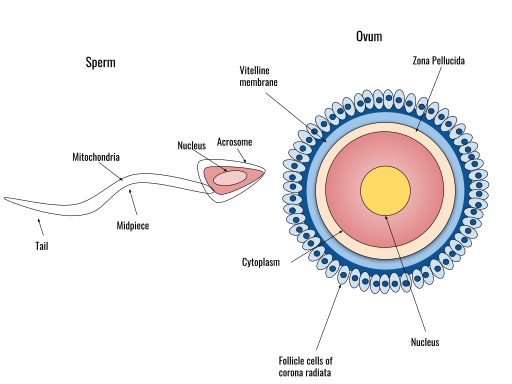
Only one sperm fuses with the egg or ovum to form a zygote in the oviduct. A sperm comes in contact with the layer of the ovum (zona pellucida) and induces the changes in the membrane to block the entry of additional sperm. The enzymes of the acrosome of sperm help to dissolve the zona pellucida and plasma membrane of the ovum and the head of the sperm is allowed to enter the cytoplasm of the ovum. This process is termed as fertilization.
Note:
We can now say that the fertilization takes place in the oviduct. After fertilization a diploid zygote is formed and divides rapidly by mitosis and forms a hollow ball of hundreds of cells called an embryo. Then the embryo is embedded into the thick lining of the uterus and this process is called implantation. The embryo grows and develops and then becomes a foetus.
Complete Answer-
The internal fertilization takes place inside the human body. The male gametes that are made in the testes of man are introduced into the women vagina through penis during mating (or copulation). In the vagina the millions of sperms are introduced at one time. Sperms are highly active in nature and also mobile or moving. They move up into the uterus with the help of the cervix. From the uterus, sperm are passed into the ampullary-isthmic junction of the oviduct. One of the oviducts contains an egg cell released by the ovary during ovulation.
Only one sperm fuses with the egg or ovum to form a zygote in the oviduct. A sperm comes in contact with the layer of the ovum (zona pellucida) and induces the changes in the membrane to block the entry of additional sperm. The enzymes of the acrosome of sperm help to dissolve the zona pellucida and plasma membrane of the ovum and the head of the sperm is allowed to enter the cytoplasm of the ovum. This process is termed as fertilization.
Note:
We can now say that the fertilization takes place in the oviduct. After fertilization a diploid zygote is formed and divides rapidly by mitosis and forms a hollow ball of hundreds of cells called an embryo. Then the embryo is embedded into the thick lining of the uterus and this process is called implantation. The embryo grows and develops and then becomes a foetus.
Recently Updated Pages
Master Class 10 Computer Science: Engaging Questions & Answers for Success

Master Class 10 General Knowledge: Engaging Questions & Answers for Success
Master Class 10 English: Engaging Questions & Answers for Success
Master Class 10 Social Science: Engaging Questions & Answers for Success
Master Class 10 Maths: Engaging Questions & Answers for Success
Master Class 10 Science: Engaging Questions & Answers for Success
Trending doubts
What is the median of the first 10 natural numbers class 10 maths CBSE
Which women's tennis player has 24 Grand Slam singles titles?
Who is the Brand Ambassador of Incredible India?
Why is there a time difference of about 5 hours between class 10 social science CBSE
Write a letter to the principal requesting him to grant class 10 english CBSE
State and prove converse of BPT Basic Proportionality class 10 maths CBSE