




How do you graph \[y = \sin 2x\]?
Answer
 Verified
592.8k+ views
Hint: We need to graph the given function. We will use the domain and some values of \[x\] lying between \[ - \pi \] and \[\pi \] to find some values of \[y\]. Then, we will use the values of \[y\] to find the coordinates of points lying on the required graph, and use the coordinates obtained to graph the function.
Complete step-by-step solution:
The domain of all sine functions is the set of all real numbers.
Thus, the domain of the function \[y = \sin 2x\] is given by \[\left\{ {x:x \in R} \right\}\]. This means that the function \[y = \sin 2x\] exists for all values of \[x\], and is a continuous function.
Now, we will find some values of \[y\] for some values of \[x\] lying between \[ - \pi \] and \[\pi \].
Substituting \[x = - \pi \] in the function \[y = \sin 2x\], we get
\[\begin{array}{l}y = \sin \left( {2\left( { - \pi } \right)} \right)\\ \Rightarrow y = \sin \left( { - 2\pi } \right)\end{array}\]
The sine of an angle \[ - x\] can be written as \[\sin \left( { - x} \right) = - \sin x\].
Simplifying the expression, we get
\[\begin{array}{l} \Rightarrow y = - \sin \left( {2\pi } \right)\\ \Rightarrow y = 0\end{array}\]
Substituting \[x = - \dfrac{{3\pi }}{4}\] in the function \[y = \sin 2x\], we get
\[\begin{array}{l} \Rightarrow y = \sin \left( {2\left( { - \dfrac{{3\pi }}{4}} \right)} \right)\\ \Rightarrow y = \sin \left( { - \dfrac{{3\pi }}{2}} \right)\end{array}\]
As sine function is an odd function, so we can writ above equation as
\[ \Rightarrow y = - \sin \left( {\dfrac{{3\pi }}{2}} \right)\]
Substituting the value of the angle, we get
\[ \Rightarrow y = 1\]
Substituting \[x = - \dfrac{\pi }{2}\] in the function \[y = \sin 2x\], we get
\[\begin{array}{l} \Rightarrow y = \sin \left( {2\left( { - \dfrac{\pi }{2}} \right)} \right)\\ \Rightarrow y = \sin \left( { - \pi } \right)\end{array}\]
As sine function is an odd function, so we can writ above equation as
\[\begin{array}{l} \Rightarrow y = - \sin \left( \pi \right)\\ \Rightarrow y = 0\end{array}\]
Substituting \[x = - \dfrac{\pi }{4}\] in the function \[y = \sin 2x\], we get
\[\begin{array}{l} \Rightarrow y = \sin \left( {2\left( { - \dfrac{\pi }{4}} \right)} \right)\\ \Rightarrow y = \sin \left( { - \dfrac{\pi }{2}} \right)\end{array}\]
Substituting the value of the angle, we get
\[ \Rightarrow y = - 1\]
Substituting \[x = 0\] in the function \[y = \sin 2x\], we get
\[\begin{array}{l} \Rightarrow y = \sin \left( {2\left( 0 \right)} \right)\\ \Rightarrow y = \sin \left( 0 \right)\end{array}\]
Substituting the value of the angle, we get
\[ \Rightarrow y = 0\]
Substituting \[x = \dfrac{\pi }{4}\] in the function \[y = \sin 2x\], we get
\[\begin{array}{l} \Rightarrow y = \sin \left( {2\left( {\dfrac{\pi }{4}} \right)} \right)\\ \Rightarrow y = \sin \left( {\dfrac{\pi }{2}} \right)\end{array}\]
Substituting the value of the angle, we get
\[ \Rightarrow y = 1\]
Substituting \[x = \dfrac{\pi }{2}\] in the function \[y = \sin 2x\], we get
\[\begin{array}{l} \Rightarrow y = \sin \left( {2\left( {\dfrac{\pi }{2}} \right)} \right)\\ \Rightarrow y = \sin \left( \pi \right)\end{array}\]
Substituting the value of the angle, we get
\[ \Rightarrow y = 0\]
Substituting \[x = \dfrac{{3\pi }}{4}\] in the function \[y = \sin 2x\], we get
\[\begin{array}{l} \Rightarrow y = \sin \left( {2\left( {\dfrac{{3\pi }}{4}} \right)} \right)\\ \Rightarrow y = \sin \left( {\dfrac{{3\pi }}{2}} \right)\end{array}\]
Substituting the value of the angle, we get
\[ \Rightarrow y = - 1\]
Substituting \[x = \pi \] in the function \[y = \sin 2x\], we get
\[\begin{array}{l} \Rightarrow y = \sin \left( {2\left( \pi \right)} \right)\\ \Rightarrow y = \sin \left( {2\pi } \right)\end{array}\]
Substituting the value of the angle, we get
\[ \Rightarrow y = 0\]
Arranging the values of \[x\] and \[y\] in a table and writing the coordinates, we get
Now, we will use the coordinates of the points to plot the required graph.
Plotting the graphs and joining the curve, we get
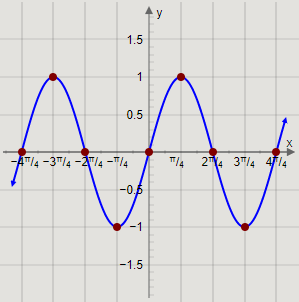
This is the required graph of the function \[y = \sin 2x\].
Note:
The period of a function \[y = \sin kx\] is given by \[\dfrac{{2\pi }}{k}\]. The period of the function \[y = \sin 2x\] is \[\dfrac{{2\pi }}{2} = \pi \]. This means that the graph of \[y = \sin 2x\] will repeat for every \[\pi \] distance on the \[x\]-axis. It can be observed that the pattern and shape of the graph of \[y = \sin 2x\] is the same from \[ - \pi \] to 0, and from 0 to \[\pi \]. The range of the sine function is from \[ - 1\] to 1.
Complete step-by-step solution:
The domain of all sine functions is the set of all real numbers.
Thus, the domain of the function \[y = \sin 2x\] is given by \[\left\{ {x:x \in R} \right\}\]. This means that the function \[y = \sin 2x\] exists for all values of \[x\], and is a continuous function.
Now, we will find some values of \[y\] for some values of \[x\] lying between \[ - \pi \] and \[\pi \].
Substituting \[x = - \pi \] in the function \[y = \sin 2x\], we get
\[\begin{array}{l}y = \sin \left( {2\left( { - \pi } \right)} \right)\\ \Rightarrow y = \sin \left( { - 2\pi } \right)\end{array}\]
The sine of an angle \[ - x\] can be written as \[\sin \left( { - x} \right) = - \sin x\].
Simplifying the expression, we get
\[\begin{array}{l} \Rightarrow y = - \sin \left( {2\pi } \right)\\ \Rightarrow y = 0\end{array}\]
Substituting \[x = - \dfrac{{3\pi }}{4}\] in the function \[y = \sin 2x\], we get
\[\begin{array}{l} \Rightarrow y = \sin \left( {2\left( { - \dfrac{{3\pi }}{4}} \right)} \right)\\ \Rightarrow y = \sin \left( { - \dfrac{{3\pi }}{2}} \right)\end{array}\]
As sine function is an odd function, so we can writ above equation as
\[ \Rightarrow y = - \sin \left( {\dfrac{{3\pi }}{2}} \right)\]
Substituting the value of the angle, we get
\[ \Rightarrow y = 1\]
Substituting \[x = - \dfrac{\pi }{2}\] in the function \[y = \sin 2x\], we get
\[\begin{array}{l} \Rightarrow y = \sin \left( {2\left( { - \dfrac{\pi }{2}} \right)} \right)\\ \Rightarrow y = \sin \left( { - \pi } \right)\end{array}\]
As sine function is an odd function, so we can writ above equation as
\[\begin{array}{l} \Rightarrow y = - \sin \left( \pi \right)\\ \Rightarrow y = 0\end{array}\]
Substituting \[x = - \dfrac{\pi }{4}\] in the function \[y = \sin 2x\], we get
\[\begin{array}{l} \Rightarrow y = \sin \left( {2\left( { - \dfrac{\pi }{4}} \right)} \right)\\ \Rightarrow y = \sin \left( { - \dfrac{\pi }{2}} \right)\end{array}\]
Substituting the value of the angle, we get
\[ \Rightarrow y = - 1\]
Substituting \[x = 0\] in the function \[y = \sin 2x\], we get
\[\begin{array}{l} \Rightarrow y = \sin \left( {2\left( 0 \right)} \right)\\ \Rightarrow y = \sin \left( 0 \right)\end{array}\]
Substituting the value of the angle, we get
\[ \Rightarrow y = 0\]
Substituting \[x = \dfrac{\pi }{4}\] in the function \[y = \sin 2x\], we get
\[\begin{array}{l} \Rightarrow y = \sin \left( {2\left( {\dfrac{\pi }{4}} \right)} \right)\\ \Rightarrow y = \sin \left( {\dfrac{\pi }{2}} \right)\end{array}\]
Substituting the value of the angle, we get
\[ \Rightarrow y = 1\]
Substituting \[x = \dfrac{\pi }{2}\] in the function \[y = \sin 2x\], we get
\[\begin{array}{l} \Rightarrow y = \sin \left( {2\left( {\dfrac{\pi }{2}} \right)} \right)\\ \Rightarrow y = \sin \left( \pi \right)\end{array}\]
Substituting the value of the angle, we get
\[ \Rightarrow y = 0\]
Substituting \[x = \dfrac{{3\pi }}{4}\] in the function \[y = \sin 2x\], we get
\[\begin{array}{l} \Rightarrow y = \sin \left( {2\left( {\dfrac{{3\pi }}{4}} \right)} \right)\\ \Rightarrow y = \sin \left( {\dfrac{{3\pi }}{2}} \right)\end{array}\]
Substituting the value of the angle, we get
\[ \Rightarrow y = - 1\]
Substituting \[x = \pi \] in the function \[y = \sin 2x\], we get
\[\begin{array}{l} \Rightarrow y = \sin \left( {2\left( \pi \right)} \right)\\ \Rightarrow y = \sin \left( {2\pi } \right)\end{array}\]
Substituting the value of the angle, we get
\[ \Rightarrow y = 0\]
Arranging the values of \[x\] and \[y\] in a table and writing the coordinates, we get
| \[x\] | \[y\] | \[\left( {x,y} \right)\] |
| \[ - \pi \] | \[0\] | \[\left( { - \pi ,0} \right)\] |
| \[ - \dfrac{{3\pi }}{4}\] | \[1\] | \[\left( { - \dfrac{{3\pi }}{4},1} \right)\] |
| \[ - \dfrac{\pi }{2}\] | \[0\] | \[\left( { - \dfrac{\pi }{2},0} \right)\] |
| \[ - \dfrac{\pi }{4}\] | \[ - 1\] | \[\left( { - \dfrac{\pi }{4}, - 1} \right)\] |
| \[0\] | \[0\] | \[\left( {0,0} \right)\] |
| \[\dfrac{\pi }{4}\] | \[1\] | \[\left( {\dfrac{\pi }{4},1} \right)\] |
| \[\dfrac{\pi }{2}\] | \[0\] | \[\left( {\dfrac{\pi }{2},0} \right)\] |
| \[\dfrac{{3\pi }}{4}\] | \[ - 1\] | \[\left( {\dfrac{{3\pi }}{4}, - 1} \right)\] |
| \[\pi \] | \[0\] | \[\left( {\pi ,0} \right)\] |
Now, we will use the coordinates of the points to plot the required graph.
Plotting the graphs and joining the curve, we get
This is the required graph of the function \[y = \sin 2x\].
Note:
The period of a function \[y = \sin kx\] is given by \[\dfrac{{2\pi }}{k}\]. The period of the function \[y = \sin 2x\] is \[\dfrac{{2\pi }}{2} = \pi \]. This means that the graph of \[y = \sin 2x\] will repeat for every \[\pi \] distance on the \[x\]-axis. It can be observed that the pattern and shape of the graph of \[y = \sin 2x\] is the same from \[ - \pi \] to 0, and from 0 to \[\pi \]. The range of the sine function is from \[ - 1\] to 1.
Recently Updated Pages
Master Class 11 English: Engaging Questions & Answers for Success

Master Class 11 Social Science: Engaging Questions & Answers for Success
Master Class 11 Maths: Engaging Questions & Answers for Success
Master Class 11 Biology: Engaging Questions & Answers for Success
Master Class 11 Physics: Engaging Questions & Answers for Success
Master Class 11 Chemistry: Engaging Questions & Answers for Success
Trending doubts
One Metric ton is equal to kg A 10000 B 1000 C 100 class 11 physics CBSE
Difference Between Prokaryotic Cells and Eukaryotic Cells
Find the value of the expression given below sin 30circ class 11 maths CBSE
1 ton equals to A 100 kg B 1000 kg C 10 kg D 10000 class 11 physics CBSE
Two of the body parts which do not appear in MRI are class 11 biology CBSE
What are hard magnetic materials class 11 physics CBSE