




How do you graph \[x + y = 0\]?
Answer
 Verified
542.4k+ views
Hint: To solve this we need to give the values of ‘x’ and we can find the values of ‘y’. Otherwise we can find the coordinate of the given equation lying on the line of x- axis, we can find this by substituting the value of ‘y’ is equal to zero (x-intercept). Similarly we can find the coordinate of the equation lying on the line of y- axis, we can find this by substituting the value of ‘x’ equal to zero (y-intercept).
Complete step-by-step solution:
Given, \[x + y = 0\].
But in this case if we put the value of ‘x’ as zero we will have the value of ‘y’ as zero and vice versa. That is the given simple linear equation passes through origin.
In this case we put the values of ‘x’ randomly and we find the corresponding ‘y’ value.
Put \[x = 1\] in \[x + y = 0\],
\[
1 + y = 0 \\
y = - 1 \\
\]
Thus we have the coordinate \[(1, - 1)\].
Put \[x = - 1\] in \[x + y = 0\],
\[
- 1 + y = 0 \\
y = 1 \\
\]
Thus we have the coordinate \[( - 1,1)\].
Put \[x = 2\] in \[x + y = 0\],
\[
2 + y = 0 \\
y = - 2 \\
\]
Thus we have the coordinate \[(2, - 2)\].
Put \[x = - 2\] in \[x + y = 0\],
\[
- 2 + y = 0 \\
y = 2 \\
\]
Thus we have the coordinate \[( - 2,2)\].
Put \[x = 3\] in \[x + y = 0\],
\[
3 + y = 0 \\
y = - 3 \\
\]
Thus we have the coordinate \[(3, - 3)\].
Put \[x = - 3\] in \[x + y = 0\],
\[
- 3 + y = 0 \\
y = - 3 \\
\]
Thus we have the coordinate \[( - 3,3)\].
Hence we have the coordinates
\[(1, - 1)\], \[( - 1,1)\], \[(2, - 2)\], \[( - 2,2)\], \[(3, - 3)\] and \[( - 3,3)\].
Let’s plot a graph for this coordinates,
We take scale x-axis= 1 unit = 1 units; y-axis= 1 unit = 1 units
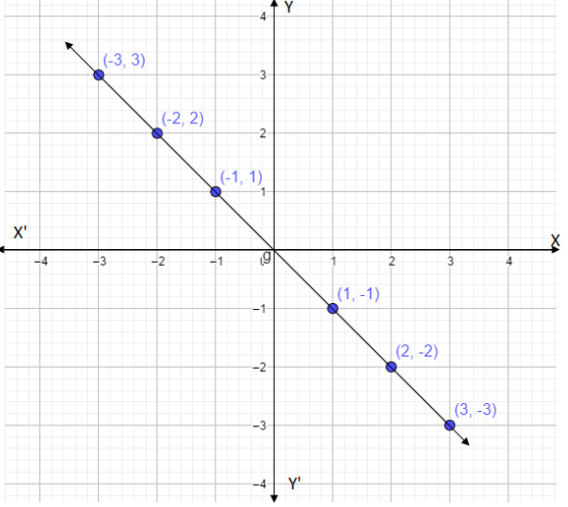
Note: A graph shows the relation between two variable quantities, it contains two axes perpendicular to each other namely the x-axis and the y-axis. Each variable is measured along one of the axes. In the question, we are given one linear equation containing two variables namely x and y, x is measured along the x-axis and y is measured along the y-axis while tracing the given equations.
Complete step-by-step solution:
Given, \[x + y = 0\].
But in this case if we put the value of ‘x’ as zero we will have the value of ‘y’ as zero and vice versa. That is the given simple linear equation passes through origin.
In this case we put the values of ‘x’ randomly and we find the corresponding ‘y’ value.
Put \[x = 1\] in \[x + y = 0\],
\[
1 + y = 0 \\
y = - 1 \\
\]
Thus we have the coordinate \[(1, - 1)\].
Put \[x = - 1\] in \[x + y = 0\],
\[
- 1 + y = 0 \\
y = 1 \\
\]
Thus we have the coordinate \[( - 1,1)\].
Put \[x = 2\] in \[x + y = 0\],
\[
2 + y = 0 \\
y = - 2 \\
\]
Thus we have the coordinate \[(2, - 2)\].
Put \[x = - 2\] in \[x + y = 0\],
\[
- 2 + y = 0 \\
y = 2 \\
\]
Thus we have the coordinate \[( - 2,2)\].
Put \[x = 3\] in \[x + y = 0\],
\[
3 + y = 0 \\
y = - 3 \\
\]
Thus we have the coordinate \[(3, - 3)\].
Put \[x = - 3\] in \[x + y = 0\],
\[
- 3 + y = 0 \\
y = - 3 \\
\]
Thus we have the coordinate \[( - 3,3)\].
Hence we have the coordinates
\[(1, - 1)\], \[( - 1,1)\], \[(2, - 2)\], \[( - 2,2)\], \[(3, - 3)\] and \[( - 3,3)\].
Let’s plot a graph for this coordinates,
We take scale x-axis= 1 unit = 1 units; y-axis= 1 unit = 1 units
Note: A graph shows the relation between two variable quantities, it contains two axes perpendicular to each other namely the x-axis and the y-axis. Each variable is measured along one of the axes. In the question, we are given one linear equation containing two variables namely x and y, x is measured along the x-axis and y is measured along the y-axis while tracing the given equations.
Recently Updated Pages
Master Class 10 Computer Science: Engaging Questions & Answers for Success

Master Class 10 General Knowledge: Engaging Questions & Answers for Success
Master Class 10 English: Engaging Questions & Answers for Success
Master Class 10 Social Science: Engaging Questions & Answers for Success
Master Class 10 Maths: Engaging Questions & Answers for Success
Master Class 10 Science: Engaging Questions & Answers for Success
Trending doubts
Which women's tennis player has 24 Grand Slam singles titles?
Who is the Brand Ambassador of Incredible India?
Why is there a time difference of about 5 hours between class 10 social science CBSE
The Equation xxx + 2 is Satisfied when x is Equal to Class 10 Maths
Which Country is Called "The Land of Festivals"?
What is Contraception List its four different methods class 10 biology CBSE