




How do you graph the line \[x + 2y = 4\]?
Answer
 Verified
615k+ views
Hint: Here, we will substitute different values of \[x\] and \[y\] in the given equation to get corresponding values of \[y\] and \[x\]. From this we will get coordinate points and using these points we will draw a graph.
Complete step by step solution:
The given equation is \[x + 2y = 4\]. We observe from this equation that the powers of \[x\] and \[y\] are both one. So, the given equation is a linear equation.
The graph of a linear equation is always a straight line. Let us draw the graph as follows:
Let us find two points lying on the graph of the given linear equation. The two points to be found are those that satisfy the linear equation.
Let us substitute \[x = 0\] in the given equation and find the value of \[y\].
\[\begin{array}{l}\left( 0 \right) + 2y = 4\\ \Rightarrow 2y = 4\end{array}\]
Dividing both sides by 2, we get
\[ \Rightarrow y = 2\]
We see that when \[x = 0\], we get \[y = 2\]. So, one of the points is \[A(0,2)\].
To find another point, put \[y = 0\].
\[x + 2\left( 0 \right) = 4\]
\[ \Rightarrow x = 4\]
In this case, we get \[x = 4\]. So, the second point is \[B(4,0)\].
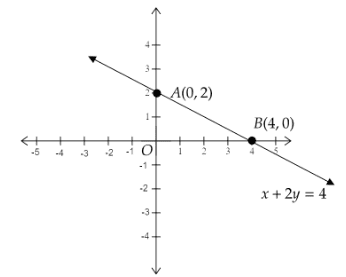
Using these points, we will draw the graph of \[x + 2y = 4\].
The point \[A(0,2)\] will lie on the \[y\]-axis, since the \[x - \]coordinate is zero. The point \[B(4,0)\] will lie on the \[x - \]axis since the \[y\]- coordinate is zero.
Therefore, we get the graph as follows:
Note:
Another method to draw the graph is by slope-intercept form. We shall compare the given linear equation to the slope-intercept form of a linear equation which is \[y = mx + c\], where \[m\]is the slope of the line and \[c\]is the \[y - \]intercept, i.e., the point where the graph cuts the \[y - \]axis.
Let us rewrite the equation \[x + 2y = 4\] as \[y = 2 - \dfrac{x}{2}\].
Comparing the equation \[y = 2 - \dfrac{x}{2}\] with \[y = mx + c\], we get
\[m = - \dfrac{1}{2}\] and \[c = 2\].
Here the slope is \[ - \dfrac{1}{2}\] and the \[y - \]intercept is \[2\]. So, one of the points is \[A(0,2)\].
First, we have to mark the \[y - \]intercept. Since, the \[y - \]intercept is positive, i.e., \[2\], it will lie on the \[ + y\] axis. Now, the slope is \[ - \dfrac{1}{2}\] .
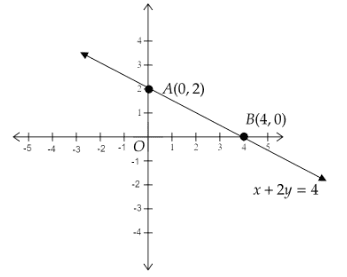
Here the numerator \[ - 1\] means we have to go 1 unit down the point \[2\] and the denominator 2 means we have to go right by 2 units. So, the point we reach is \[(2,1)\] which satisfies the equation \[x + 2y = 4\]. So, the second point is \[B(4,0)\].
Therefore, we get the graph as follows:
Complete step by step solution:
The given equation is \[x + 2y = 4\]. We observe from this equation that the powers of \[x\] and \[y\] are both one. So, the given equation is a linear equation.
The graph of a linear equation is always a straight line. Let us draw the graph as follows:
Let us find two points lying on the graph of the given linear equation. The two points to be found are those that satisfy the linear equation.
Let us substitute \[x = 0\] in the given equation and find the value of \[y\].
\[\begin{array}{l}\left( 0 \right) + 2y = 4\\ \Rightarrow 2y = 4\end{array}\]
Dividing both sides by 2, we get
\[ \Rightarrow y = 2\]
We see that when \[x = 0\], we get \[y = 2\]. So, one of the points is \[A(0,2)\].
To find another point, put \[y = 0\].
\[x + 2\left( 0 \right) = 4\]
\[ \Rightarrow x = 4\]
In this case, we get \[x = 4\]. So, the second point is \[B(4,0)\].
Using these points, we will draw the graph of \[x + 2y = 4\].
The point \[A(0,2)\] will lie on the \[y\]-axis, since the \[x - \]coordinate is zero. The point \[B(4,0)\] will lie on the \[x - \]axis since the \[y\]- coordinate is zero.
Therefore, we get the graph as follows:
Note:
Another method to draw the graph is by slope-intercept form. We shall compare the given linear equation to the slope-intercept form of a linear equation which is \[y = mx + c\], where \[m\]is the slope of the line and \[c\]is the \[y - \]intercept, i.e., the point where the graph cuts the \[y - \]axis.
Let us rewrite the equation \[x + 2y = 4\] as \[y = 2 - \dfrac{x}{2}\].
Comparing the equation \[y = 2 - \dfrac{x}{2}\] with \[y = mx + c\], we get
\[m = - \dfrac{1}{2}\] and \[c = 2\].
Here the slope is \[ - \dfrac{1}{2}\] and the \[y - \]intercept is \[2\]. So, one of the points is \[A(0,2)\].
First, we have to mark the \[y - \]intercept. Since, the \[y - \]intercept is positive, i.e., \[2\], it will lie on the \[ + y\] axis. Now, the slope is \[ - \dfrac{1}{2}\] .
Here the numerator \[ - 1\] means we have to go 1 unit down the point \[2\] and the denominator 2 means we have to go right by 2 units. So, the point we reach is \[(2,1)\] which satisfies the equation \[x + 2y = 4\]. So, the second point is \[B(4,0)\].
Therefore, we get the graph as follows:
Recently Updated Pages
Master Class 11 Social Science: Engaging Questions & Answers for Success

Master Class 11 English: Engaging Questions & Answers for Success
Master Class 11 Accountancy: Engaging Questions & Answers for Success
Master Class 11 Physics: Engaging Questions & Answers for Success
Master Class 11 Computer Science: Engaging Questions & Answers for Success
Master Class 11 Business Studies: Engaging Questions & Answers for Success
Trending doubts
One Metric ton is equal to kg A 10000 B 1000 C 100 class 11 physics CBSE
Find the value of the expression given below sin 30circ class 11 maths CBSE
Draw a diagram of nephron and explain its structur class 11 biology CBSE
10 examples of friction in our daily life
Proton was discovered by A Thomson B Rutherford C Chadwick class 11 chemistry CBSE
The teeth used for biting and cutting food are called class 11 biology CBSE