




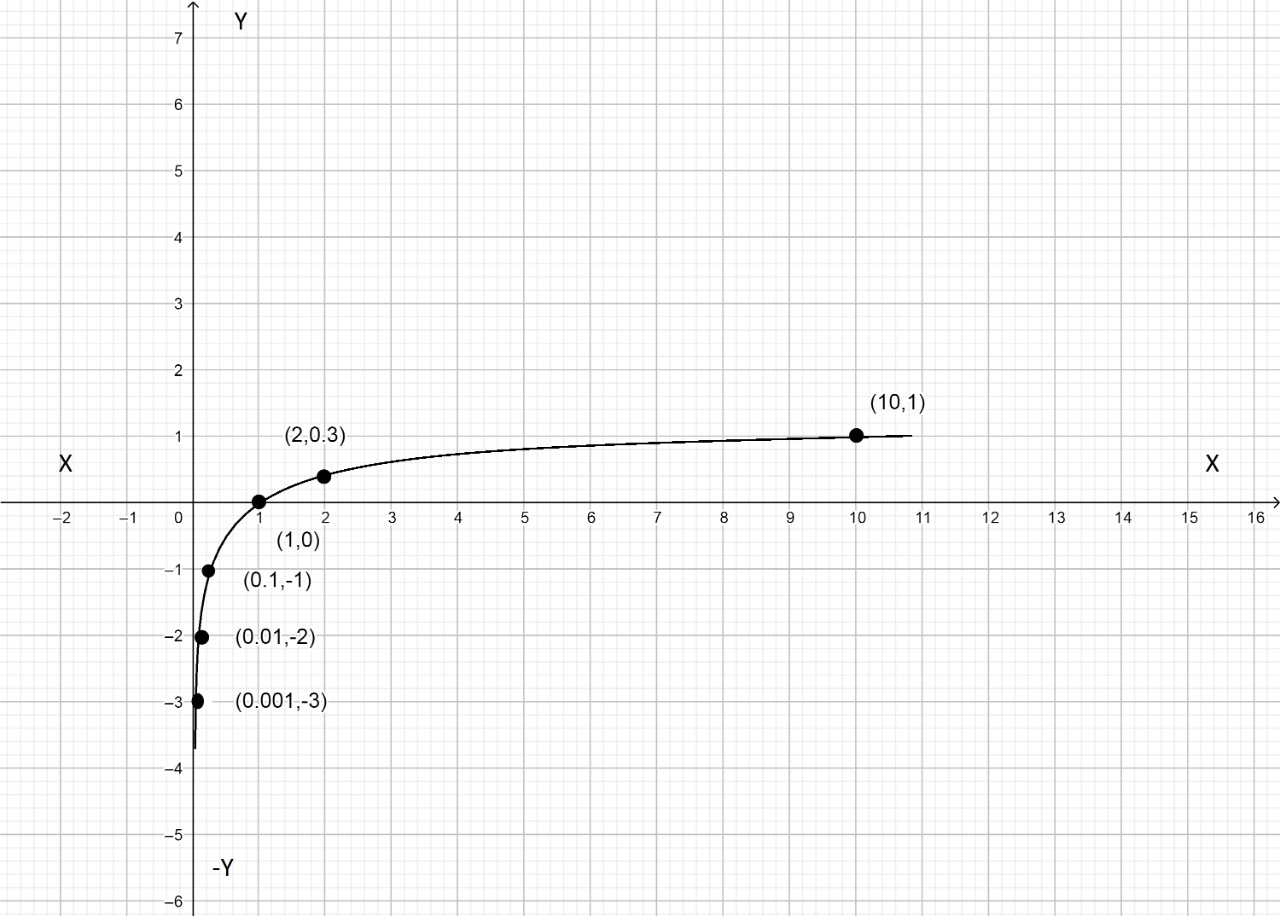
How do you graph the function y = logx?
Answer
 Verified
626.1k+ views
Hint: In this question, we need to graph the function y = logx. Since no base is given so we will consider it as 10 and draw the graph for $y={{\log }_{10}}x$. For this, we will first find the asymptote of function by putting the argument of the function (angle of the log) as zero. The graph will run along the asymptote. After that, we will take some values of x and find values of y to find points that can be drawn on the graph. Using these points we will draw a smooth curve and obtain the required graph.
Complete step by step answer:
Here we are given the function as y = logx. We need to plot a graph for this function. Here we are not given any base for logarithm so we will assume the base as 10 and draw the graph for $y={{\log }_{10}}x$.
Let us first find the equation of the line of asymptote so that we properly graph our function running along the asymptote.
For finding asymptote we need to put the argument of the logarithm as zero (angle of the log). Here we have x = 0.
So equation of asymptote is x = 0.
Now let us find some points to plot.
For x = 1 we have $y={{\log }_{10}}1=0$.
For x = 2 we have $y={{\log }_{10}}2=0.301$.
For x = 10 we have $y={{\log }_{10}}10=1$.
For $x=\dfrac{1}{10}=0.1$ we have $y={{\log }_{10}}{{\left( 10 \right)}^{-1}}=-1$.
For $x=\dfrac{1}{100}=0.01$ we have $y={{\log }_{10}}{{\left( 10 \right)}^{-2}}=-2$.
For $x=\dfrac{1}{1000}=0.001$ we have $y={{\log }_{10}}{{\left( 10 \right)}^{-3}}=-3$.
Our point table becomes
Plotting these points on the graph and taking care of asymptote our graph looks like this,
Note:
Students should note that x cannot be negative. Also, log0 does not exist. Take care while plotting the points on the graph. If the base of the logarithmic function is different our graph changes. The general shape remains the same.
Complete step by step answer:
Here we are given the function as y = logx. We need to plot a graph for this function. Here we are not given any base for logarithm so we will assume the base as 10 and draw the graph for $y={{\log }_{10}}x$.
Let us first find the equation of the line of asymptote so that we properly graph our function running along the asymptote.
For finding asymptote we need to put the argument of the logarithm as zero (angle of the log). Here we have x = 0.
So equation of asymptote is x = 0.
Now let us find some points to plot.
For x = 1 we have $y={{\log }_{10}}1=0$.
For x = 2 we have $y={{\log }_{10}}2=0.301$.
For x = 10 we have $y={{\log }_{10}}10=1$.
For $x=\dfrac{1}{10}=0.1$ we have $y={{\log }_{10}}{{\left( 10 \right)}^{-1}}=-1$.
For $x=\dfrac{1}{100}=0.01$ we have $y={{\log }_{10}}{{\left( 10 \right)}^{-2}}=-2$.
For $x=\dfrac{1}{1000}=0.001$ we have $y={{\log }_{10}}{{\left( 10 \right)}^{-3}}=-3$.
Our point table becomes
| x | $\dfrac{1}{1000}$ | $\dfrac{1}{100}$ | $\dfrac{1}{10}$ | 1 | 10 |
| y | -3 | -2 | -1 | 0 | 1 |
Plotting these points on the graph and taking care of asymptote our graph looks like this,
Note:
Students should note that x cannot be negative. Also, log0 does not exist. Take care while plotting the points on the graph. If the base of the logarithmic function is different our graph changes. The general shape remains the same.
Recently Updated Pages
Master Class 10 Computer Science: Engaging Questions & Answers for Success

Differentiate between voluntary action and reflex class 10 biology CBSE
The uses of bleaching powder are A It is used bleaching class 10 chemistry CBSE
Fill in the blanks with abstract nouns of the words class 10 english CBSE
How many threedigit numbers are there class 10 maths CBSE
What is a reflex arc class 10 biology CBSE
Trending doubts
Explain the Treaty of Vienna of 1815 class 10 social science CBSE
The highest dam in India is A Bhakra dam B Tehri dam class 10 social science CBSE
10 examples of evaporation in daily life with explanations
What is the full form of POSCO class 10 social science CBSE
Make a sketch of the human nerve cell What function class 10 biology CBSE
What is FYM class 10 biology CBSE