




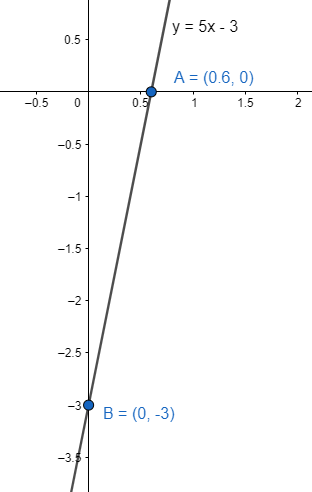
How do you graph the equation $y=5x-3$?
Answer
 Verified
592.5k+ views
Change of form of the given equation will give the x-intercept and y-intercept of the line $y=5x-3$. We change it to the form of $\dfrac{x}{p}+\dfrac{y}{q}=1$ to find the x-intercept, and y-intercept of the line as $p$ and $q$ respectively. then we place the points on the axes and from there we draw the line on the graph.
Complete step by step answer:
We are taking the general equation of a line to understand the slope and the intercept form of the line $y=5x-3$. The given equation is in the form of $y=mx+k$. m is the slope of the line. The slope of the line is $5$.
We have to find the x-intercept and y-intercept of the line $y=5x-3$.
For this we convert the given equation into the form of $\dfrac{x}{p}+\dfrac{y}{q}=1$. From the form we get that the x intercept, and y intercept of the line will be$p$ and $q$ respectively. The points will be $\left( p,0 \right),\left( 0,q \right)$.
The given equation is $y=5x-3$. Converting into the form of $\dfrac{x}{p}+\dfrac{y}{q}=1$, we get
$\begin{align}
& y=5x-3 \\
& \Rightarrow 5x-y=3 \\
& \Rightarrow \dfrac{x}{{}^{3}/{}_{5}}+\dfrac{y}{-3}=1 \\
\end{align}$
Therefore, the x intercept, and y intercept of the line $y=5x-3$ is $\dfrac{3}{5}$ and 3 respectively. The axes intersecting points are $\left( \dfrac{3}{5},0 \right),\left( 0,-3 \right)$.
Note:
A line parallel to the X-axis does not intersect the X-axis at any finite distance. Hence, we cannot get any finite x-intercept of such a line. The same goes for lines parallel to the Y-axis. In the case of the slope of a line, the range of the slope is 0 to $\infty $.
Complete step by step answer:
We are taking the general equation of a line to understand the slope and the intercept form of the line $y=5x-3$. The given equation is in the form of $y=mx+k$. m is the slope of the line. The slope of the line is $5$.
We have to find the x-intercept and y-intercept of the line $y=5x-3$.
For this we convert the given equation into the form of $\dfrac{x}{p}+\dfrac{y}{q}=1$. From the form we get that the x intercept, and y intercept of the line will be$p$ and $q$ respectively. The points will be $\left( p,0 \right),\left( 0,q \right)$.
The given equation is $y=5x-3$. Converting into the form of $\dfrac{x}{p}+\dfrac{y}{q}=1$, we get
$\begin{align}
& y=5x-3 \\
& \Rightarrow 5x-y=3 \\
& \Rightarrow \dfrac{x}{{}^{3}/{}_{5}}+\dfrac{y}{-3}=1 \\
\end{align}$
Therefore, the x intercept, and y intercept of the line $y=5x-3$ is $\dfrac{3}{5}$ and 3 respectively. The axes intersecting points are $\left( \dfrac{3}{5},0 \right),\left( 0,-3 \right)$.
Note:
A line parallel to the X-axis does not intersect the X-axis at any finite distance. Hence, we cannot get any finite x-intercept of such a line. The same goes for lines parallel to the Y-axis. In the case of the slope of a line, the range of the slope is 0 to $\infty $.
Recently Updated Pages
Master Class 12 Economics: Engaging Questions & Answers for Success

Master Class 12 English: Engaging Questions & Answers for Success
Master Class 12 Social Science: Engaging Questions & Answers for Success
Master Class 12 Maths: Engaging Questions & Answers for Success
Master Class 12 Physics: Engaging Questions & Answers for Success
Master Class 9 General Knowledge: Engaging Questions & Answers for Success
Trending doubts
Explain the Treaty of Vienna of 1815 class 10 social science CBSE
Who Won 36 Oscar Awards? Record Holder Revealed
Why is it 530 pm in india when it is 1200 afternoon class 10 social science CBSE
Make a sketch of the human nerve cell What function class 10 biology CBSE
What is the full form of POSCO class 10 social science CBSE
Define Potential, Developed, Stock and Reserved resources