




How do you graph $6x + 5y = 20$ ?
Answer
 Verified
598.5k+ views
Hint:To solve this type of question start by finding the slope and y-intercept. Next, find two ordered pairs for the given equation. After that draw x-axis and y-axis on the graph paper and mark the points. Finally, check whether all the points lie on the same line.
Complete step by step answer:Given the equation $6x + 5y = 20$ .
Let us start by solving for $y$ . That is,
Start by subtracting $6\;x$ from LHS and RHS of the equation.
$6x + 5y - 6x = 20 - 6x$
$5y = 20 - 6x$
Dividing through by $5$ , that is,
$\dfrac{{5y}}{5} = \dfrac{{20}}{5} + \dfrac{{ - 6x}}{5}$
$y = 4 - \dfrac{{6x}}{5}$
We know that the slope-intercept form is $y = mx + b$ , where $m$ is the slope, and $b$ is the y-intercept.
Next, rearrange this into the slope-intercept form. That is,
$y = - \dfrac{{6x}}{5} + 4$
So here the slope is $- \dfrac{6}{5}$ and the y-intercept is $4$ .
Next to find the $x$ and $y$ coordinates, substitute two values for $x$ in the given equation. That is, first assume that $x = 0$ . Then it can be written as,
$6 \times 0 + 5y = 20$
$5y = 20$
Dividing throughout by number $5$ , we get,
$y = 4$
Next assume $x = 2$ , then,
$6 \times 2 + 5y = 20$
$12 + 5y = 20$
Take $\;12$ to the RHS, we get,
$5y = 8$
$y = \dfrac{8}{5}$
Hence, when $x = 0$ then $y = 4$ and when $x = 2$ then $y = \dfrac{8}{5}$ .
Therefore we can graph the line using the $x$ and $y$ coordinates as shown below.
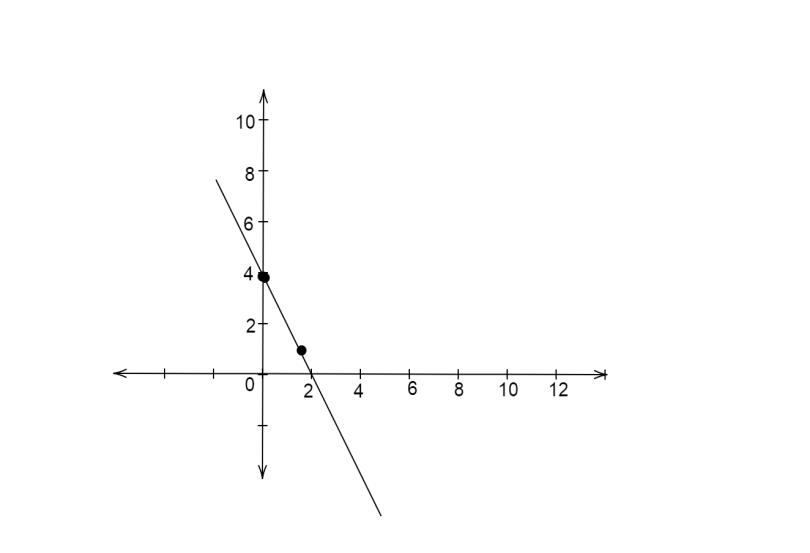
Note:
Always remember that in the case of a linear equation in two variables the graph will be a straight line. A minimum of two ordered pairs should be found for drawing the graph. If possible it is always advised to find four ordered pairs to draw the graph. Also, remember that $y = mx + b$ where $m$ is the slope and $b$ is the y-intercept is known as the slope-intercept form. The graph can either be created using the slope and y-intercept values or using the ordered pairs obtained.
Complete step by step answer:Given the equation $6x + 5y = 20$ .
Let us start by solving for $y$ . That is,
Start by subtracting $6\;x$ from LHS and RHS of the equation.
$6x + 5y - 6x = 20 - 6x$
$5y = 20 - 6x$
Dividing through by $5$ , that is,
$\dfrac{{5y}}{5} = \dfrac{{20}}{5} + \dfrac{{ - 6x}}{5}$
$y = 4 - \dfrac{{6x}}{5}$
We know that the slope-intercept form is $y = mx + b$ , where $m$ is the slope, and $b$ is the y-intercept.
Next, rearrange this into the slope-intercept form. That is,
$y = - \dfrac{{6x}}{5} + 4$
So here the slope is $- \dfrac{6}{5}$ and the y-intercept is $4$ .
Next to find the $x$ and $y$ coordinates, substitute two values for $x$ in the given equation. That is, first assume that $x = 0$ . Then it can be written as,
$6 \times 0 + 5y = 20$
$5y = 20$
Dividing throughout by number $5$ , we get,
$y = 4$
Next assume $x = 2$ , then,
$6 \times 2 + 5y = 20$
$12 + 5y = 20$
Take $\;12$ to the RHS, we get,
$5y = 8$
$y = \dfrac{8}{5}$
Hence, when $x = 0$ then $y = 4$ and when $x = 2$ then $y = \dfrac{8}{5}$ .
Therefore we can graph the line using the $x$ and $y$ coordinates as shown below.
Note:
Always remember that in the case of a linear equation in two variables the graph will be a straight line. A minimum of two ordered pairs should be found for drawing the graph. If possible it is always advised to find four ordered pairs to draw the graph. Also, remember that $y = mx + b$ where $m$ is the slope and $b$ is the y-intercept is known as the slope-intercept form. The graph can either be created using the slope and y-intercept values or using the ordered pairs obtained.
Recently Updated Pages
Master Class 11 English: Engaging Questions & Answers for Success

Master Class 11 Social Science: Engaging Questions & Answers for Success
Master Class 11 Maths: Engaging Questions & Answers for Success
Master Class 11 Biology: Engaging Questions & Answers for Success
Master Class 11 Physics: Engaging Questions & Answers for Success
Master Class 11 Chemistry: Engaging Questions & Answers for Success
Trending doubts
Explain the Treaty of Vienna of 1815 class 10 social science CBSE
What is the Total Duration of Football Match?
The shortest day of the year in India
In which year voting age was reduced from 21 to 18?
10 examples of evaporation in daily life with explanations
What planets have no moons Which one has only one moon class 10 physics CBSE