




How do you find related acute angles?
Answer
 Verified
568.5k+ views
Hint: since we have been told to find the related acute angle in the question, try to define acute angle and related acute angle first. You will get to know the difference between both of them and hence it will further make it easy to find the related acute angle from any measurement of angle.
Complete step by step answer:
An angle which is $ < {90^\circ }$ (less than 90) is called a cute angle. Now a related acute angle is defined as the acute angle which is formed by the x-axis and the terminal side only when the terminal side is in the 2-quadrant, 3-quadrant and the 4-quadrant. A terminal side is the other side of the angle the other side of the angle other than the fixed side of an angle.
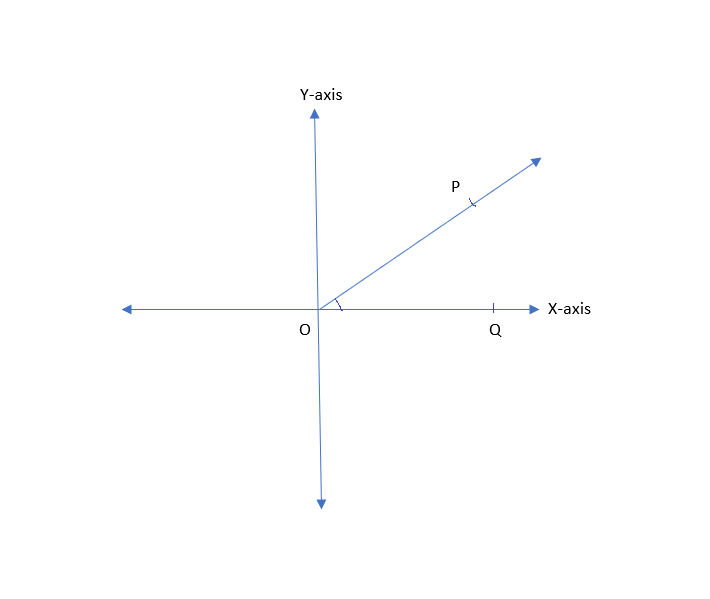
For example side PO is the terminal side of $\angle POQ$ and side OQ is the fixed side in the above figure.
Now the principal angle is the angle formed by the positive x-axis and the terminal side in an anticlockwise direction. To find the related acute angle one should follow the given steps:
1.If the terminal side lies in the 2-quadrant, subtract the principle angle from ${180^\circ }$. This will give us the related acute angle.
2.If the terminal side lies in the 3-quadrant, subtract ${180^\circ }$ from the principal angle.
3.If the terminal side lies in the 4-quadrant, subtract the principle angle from ${360^\circ }$ to find the related acute angle.
Note: For solving these types of questions the only thing you need to know is the definition correctly. The value of the related acute angle will always measure between ${0^\circ }$ and ${90^\circ }$ even if it is present in any of the four quadrants. If the related acute angle is counted in an anti-clockwise direction it will always be positive.
Complete step by step answer:
An angle which is $ < {90^\circ }$ (less than 90) is called a cute angle. Now a related acute angle is defined as the acute angle which is formed by the x-axis and the terminal side only when the terminal side is in the 2-quadrant, 3-quadrant and the 4-quadrant. A terminal side is the other side of the angle the other side of the angle other than the fixed side of an angle.
For example side PO is the terminal side of $\angle POQ$ and side OQ is the fixed side in the above figure.
Now the principal angle is the angle formed by the positive x-axis and the terminal side in an anticlockwise direction. To find the related acute angle one should follow the given steps:
1.If the terminal side lies in the 2-quadrant, subtract the principle angle from ${180^\circ }$. This will give us the related acute angle.
2.If the terminal side lies in the 3-quadrant, subtract ${180^\circ }$ from the principal angle.
3.If the terminal side lies in the 4-quadrant, subtract the principle angle from ${360^\circ }$ to find the related acute angle.
Note: For solving these types of questions the only thing you need to know is the definition correctly. The value of the related acute angle will always measure between ${0^\circ }$ and ${90^\circ }$ even if it is present in any of the four quadrants. If the related acute angle is counted in an anti-clockwise direction it will always be positive.

Recently Updated Pages
Master Class 12 Business Studies: Engaging Questions & Answers for Success

Master Class 12 Biology: Engaging Questions & Answers for Success
Master Class 12 Chemistry: Engaging Questions & Answers for Success
Class 12 Question and Answer - Your Ultimate Solutions Guide
Master Class 11 Social Science: Engaging Questions & Answers for Success
Master Class 11 English: Engaging Questions & Answers for Success
Trending doubts
Convert 200 Million dollars in rupees class 7 maths CBSE
Full Form of IASDMIPSIFSIRSPOLICE class 7 social science CBSE
100 million is equal to begingathered A 1 crore B -class-7-maths-CBSE
List of coprime numbers from 1 to 100 class 7 maths CBSE
There are three types of tickets economy business and class 7 maths CBSE
Write a summary of the poem the quality of mercy by class 7 english CBSE