




How do vectors work in physics?
Answer
 Verified
576.9k+ views
Hint: There are two major types of physical quantities in physics; quantities which have both magnitude and direction are called vectors and quantities which have only magnitude are called scalars. Vectors represent the magnitude as well as direction in space while units only represent the magnitude.
Complete answer:
In physics vectors are lines representing the magnitude and direction of a physical quantity. Vectors are drawn to scale as its length tells us about the magnitude. The vector has a head as an arrowhead and a tail, the arrow points in the direction of the quantity.
We need vectors to represent the quantities that have magnitude as well as direction. Some vector quantities are velocity, displacement, force etc.
When two or more vectors of the same type are acting on an object we calculate the resultant of all the vectors. Some laws used to calculate the resultant of vectors are triangular law of addition, parallelogram law of addition, polygon law of addition etc.
For example if more than two forces are acting on a body in different directions as shown in the figure
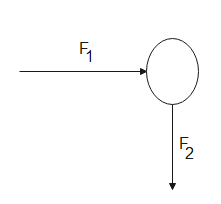
Then their resultant can be calculated as
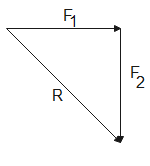
$R={{F}_{1}}+{{F}_{2}}$
Therefore, vectors are lines in space which represent the magnitude as well as direction of some physical quantities.
Note:
Other than vectors quantities, scalar quantities do not require vectors to represent them as they don’t have direction and their magnitude is represented by units. Vectors can be added, subtracted, multiplied or divided. A vector which has magnitude equal to one is said to be a unit vector.
Complete answer:
In physics vectors are lines representing the magnitude and direction of a physical quantity. Vectors are drawn to scale as its length tells us about the magnitude. The vector has a head as an arrowhead and a tail, the arrow points in the direction of the quantity.
We need vectors to represent the quantities that have magnitude as well as direction. Some vector quantities are velocity, displacement, force etc.
When two or more vectors of the same type are acting on an object we calculate the resultant of all the vectors. Some laws used to calculate the resultant of vectors are triangular law of addition, parallelogram law of addition, polygon law of addition etc.
For example if more than two forces are acting on a body in different directions as shown in the figure
Then their resultant can be calculated as
$R={{F}_{1}}+{{F}_{2}}$
Therefore, vectors are lines in space which represent the magnitude as well as direction of some physical quantities.
Note:
Other than vectors quantities, scalar quantities do not require vectors to represent them as they don’t have direction and their magnitude is represented by units. Vectors can be added, subtracted, multiplied or divided. A vector which has magnitude equal to one is said to be a unit vector.
Recently Updated Pages
Master Class 11 Social Science: Engaging Questions & Answers for Success

Master Class 11 Physics: Engaging Questions & Answers for Success
Master Class 11 Maths: Engaging Questions & Answers for Success
Master Class 11 Economics: Engaging Questions & Answers for Success
Master Class 11 Computer Science: Engaging Questions & Answers for Success
Master Class 11 Chemistry: Engaging Questions & Answers for Success
Trending doubts
One Metric ton is equal to kg A 10000 B 1000 C 100 class 11 physics CBSE
There are 720 permutations of the digits 1 2 3 4 5 class 11 maths CBSE
1 Quintal is equal to a 110 kg b 10 kg c 100kg d 1000 class 11 physics CBSE
State and prove Bernoullis theorem class 11 physics CBSE
Difference Between Prokaryotic Cells and Eukaryotic Cells
Discuss the various forms of bacteria class 11 biology CBSE