




How do polar covalent bonds form?
Answer
 Verified
606.3k+ views
Hint:When there is electronegativity difference in two atoms, the shared pair of electrons are shifted more towards the atom with more electronegative character.
This generates a polar nature in the bond formed between the two atoms. The extent of polarity depends upon the extent of difference in electronegativity of the atom.
Complete answer:
Polar covalent bonds are the bonds which are formed due to the difference in electronegativity of two atoms. The more electronegative atom attracts the shared pair of electrons towards itself, which makes the bond more polar. In other words, the atom which is attracting the bond pair acquires a partial negative charge whereas, the atom which is being polarized, acquires a partial positive charge, in the bond.
With increase in electronegativity difference between the two atoms, who are sharing a bond, the extent of polarity of the bind also increases. One of the most common examples of polar covalent bonding is hydrogen bonding. It could be observed in case of water. The polar covalent bond can also be observed in case of . And the structure signifying the dipole moment if the bond, is shown below,
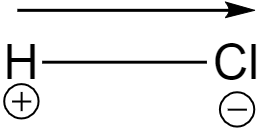
Here as we can see the positive and negative charges signify, partial positive and negative charges. As we know that the chlorine atom is more electronegative than the hydrogen, and so the bond would shift towards the chlorine atom making it partially positive in nature. The shared pair of electrons would not be present at the centre, unlike the covalent bonds, where the electronegativity of the two atoms are the same.
Note:If the electronegativity difference between two atoms is zero, or the electronegativity of two atoms are equal, then they would form a covalent bond.
If the electronegativity difference is too high, then the shared pair would be taken by the atom with higher electronegativity difference, and as a result, an ionic bond will be formed.
This generates a polar nature in the bond formed between the two atoms. The extent of polarity depends upon the extent of difference in electronegativity of the atom.
Complete answer:
Polar covalent bonds are the bonds which are formed due to the difference in electronegativity of two atoms. The more electronegative atom attracts the shared pair of electrons towards itself, which makes the bond more polar. In other words, the atom which is attracting the bond pair acquires a partial negative charge whereas, the atom which is being polarized, acquires a partial positive charge, in the bond.
With increase in electronegativity difference between the two atoms, who are sharing a bond, the extent of polarity of the bind also increases. One of the most common examples of polar covalent bonding is hydrogen bonding. It could be observed in case of water. The polar covalent bond can also be observed in case of . And the structure signifying the dipole moment if the bond, is shown below,
Here as we can see the positive and negative charges signify, partial positive and negative charges. As we know that the chlorine atom is more electronegative than the hydrogen, and so the bond would shift towards the chlorine atom making it partially positive in nature. The shared pair of electrons would not be present at the centre, unlike the covalent bonds, where the electronegativity of the two atoms are the same.
Note:If the electronegativity difference between two atoms is zero, or the electronegativity of two atoms are equal, then they would form a covalent bond.
If the electronegativity difference is too high, then the shared pair would be taken by the atom with higher electronegativity difference, and as a result, an ionic bond will be formed.
Recently Updated Pages
Basicity of sulphurous acid and sulphuric acid are

Master Class 11 English: Engaging Questions & Answers for Success
Master Class 11 Physics: Engaging Questions & Answers for Success
Master Class 11 Computer Science: Engaging Questions & Answers for Success
Master Class 11 Chemistry: Engaging Questions & Answers for Success
Master Class 11 Social Science: Engaging Questions & Answers for Success
Trending doubts
Difference Between Prokaryotic Cells and Eukaryotic Cells
Two of the body parts which do not appear in MRI are class 11 biology CBSE
One Metric ton is equal to kg A 10000 B 1000 C 100 class 11 physics CBSE
10 examples of friction in our daily life
Draw a diagram of nephron and explain its structur class 11 biology CBSE
What will happen if the mucus is not secreted by the class 11 biology CBSE