




How can two nuclei fuse together?
Answer
 Verified
580.2k+ views
Hint: The fusion of atomic nuclei is called nuclear fusion. While, the splitting of the atomic nuclei is called nuclear fission. These reactions are used in nuclear reactors.
Complete answer:
As the study of atoms and molecules became advanced, various experiments on elements led us to the property of certain atoms which showed their association with other atoms. Various atoms fused together through their respective nucleus and became one atom. This property of some atoms, which allows them to fuse their nucleus with the nucleus of other similar or different atoms, came to be known as nuclear fusion.
The nuclei of atoms fuse in such a way that they form another atom and along with forming it they also produce some energy.
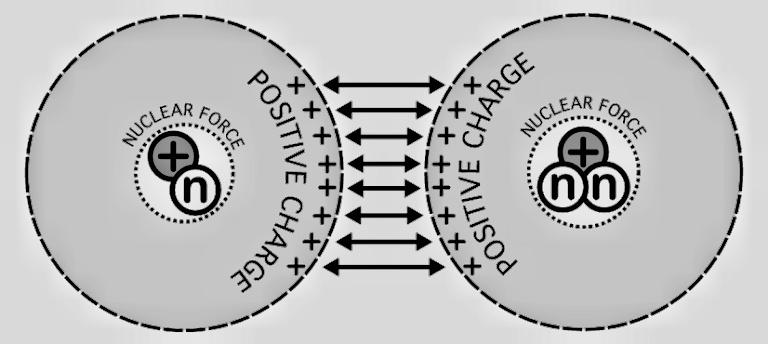
As we know there are two types of forces that come into action when two atoms come close to each other. One is the nuclear force, that causes the attractive force between protons and neutrons of both the atoms, and other is the repelling force between the protons of both the atoms. The repelling force is of short range and does not prevail for long, so the nuclear force overcomes this repulsive force and causes the fusion between two atoms.
The simplest example of nuclear fusion is the fusion of isotopes of hydrogen (deuterium and tritium) to form helium as:
\[{}_{1}^{2}D+{}_{1}^{3}T\to {}_{2}^{4}He+{}_{0}^{1}n\]
Hence, nuclei of various atoms fuse together through strong nuclear forces and produce a bigger atom with energy.
Note:
When the fusion of atoms occurs, it is observed that energy is released in the fusion of lighter atoms due to smaller distance between their nuclei, while energy is absorbed in the fusion of heavier atoms due to more distance between their nuclei.
Complete answer:
As the study of atoms and molecules became advanced, various experiments on elements led us to the property of certain atoms which showed their association with other atoms. Various atoms fused together through their respective nucleus and became one atom. This property of some atoms, which allows them to fuse their nucleus with the nucleus of other similar or different atoms, came to be known as nuclear fusion.
The nuclei of atoms fuse in such a way that they form another atom and along with forming it they also produce some energy.
As we know there are two types of forces that come into action when two atoms come close to each other. One is the nuclear force, that causes the attractive force between protons and neutrons of both the atoms, and other is the repelling force between the protons of both the atoms. The repelling force is of short range and does not prevail for long, so the nuclear force overcomes this repulsive force and causes the fusion between two atoms.
The simplest example of nuclear fusion is the fusion of isotopes of hydrogen (deuterium and tritium) to form helium as:
\[{}_{1}^{2}D+{}_{1}^{3}T\to {}_{2}^{4}He+{}_{0}^{1}n\]
Hence, nuclei of various atoms fuse together through strong nuclear forces and produce a bigger atom with energy.
Note:
When the fusion of atoms occurs, it is observed that energy is released in the fusion of lighter atoms due to smaller distance between their nuclei, while energy is absorbed in the fusion of heavier atoms due to more distance between their nuclei.
Recently Updated Pages
Master Class 11 English: Engaging Questions & Answers for Success

Master Class 11 Social Science: Engaging Questions & Answers for Success
Master Class 11 Maths: Engaging Questions & Answers for Success
Master Class 11 Biology: Engaging Questions & Answers for Success
Master Class 11 Physics: Engaging Questions & Answers for Success
Master Class 11 Chemistry: Engaging Questions & Answers for Success
Trending doubts
One Metric ton is equal to kg A 10000 B 1000 C 100 class 11 physics CBSE
What is cell theory Who formulated it class 11 biology CBSE
Phyllotaxy is the arrangement of ALeaflets BLeaves class 11 biology CBSE
Difference Between Prokaryotic Cells and Eukaryotic Cells
The symbiotic association of fungi and algae is called class 11 biology CBSE
Cell theory was formulated by A Schleiden and Schwann class 11 biology CBSE