




Where will the hour hand of a clock stops if it starts:
a) From \[6\] and turns through \[1\] right angle?
b) From \[8\] and turns through \[2\] right angles?
c) From \[10\] and turns through \[3\] right angles?
d) From \[7\] and turns through \[2\] straight angles?
Answer
 Verified
539.4k+ views
Hint: A clock is in the form of a complete circle. Total angle made in one complete rotation by any of the hands of the clock is \[360^\circ \]. Which consists of four right angles. The angle measured in the direction of the moving clock is in a clockwise direction and if it is measured in the opposite direction of the movement of the needle or hand then it is in an anticlockwise direction.
Complete step by step answer:
We have to get the final position of the hour hand after it follows certain given conditions.
One complete rotation of the hour hand makes \[360^\circ \] which is equal to \[4\] right angles or \[2\] straight angles.
Total number of hours in one complete cycle is \[12{\text{ }}hours\]
This implies one right angle counts \[3\] hours of an hour hand of a clock. Similarly one straight angle counts \[6{\text{ }}hours\] of the hour hand.
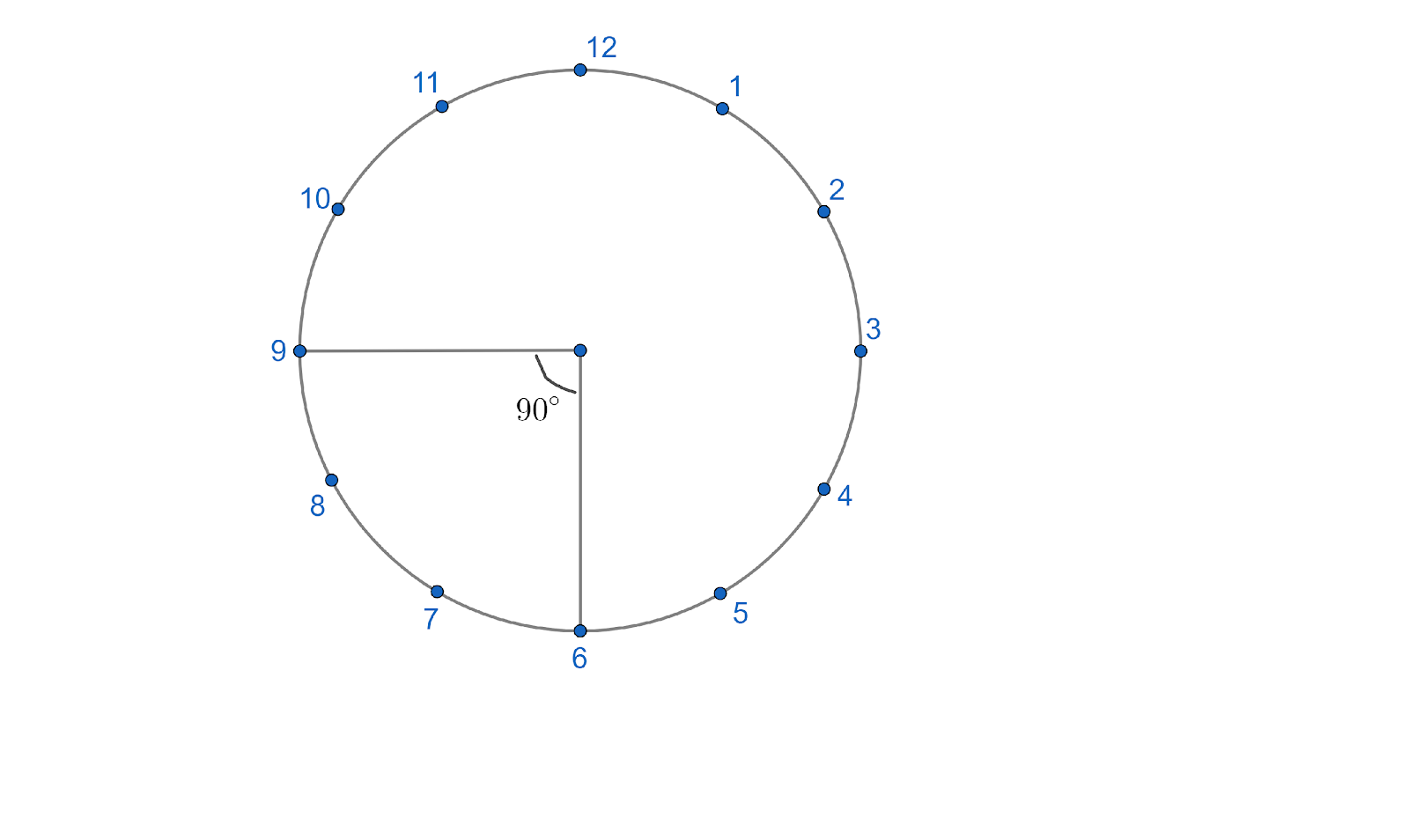
a) Hour hand of clock stops when it starts from \[6\] and turns through \[1\] right angles:
As explained above \[1\] right angle counts for the \[3\] hours of the hour hand
So the clock hand will stop at \[6 + 3 = 9\] hour mark.
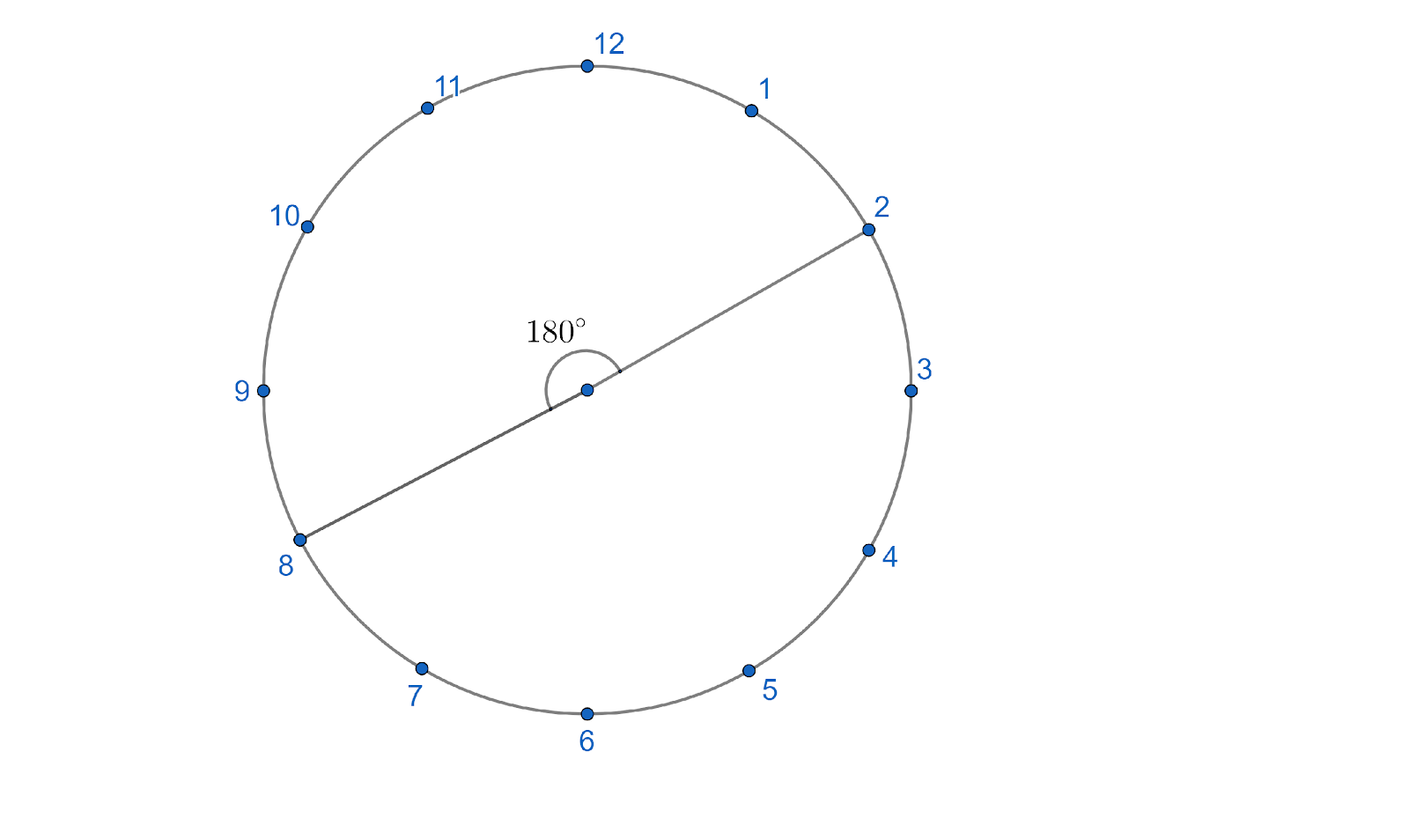
b) Hour hand of clock stops when it starts from \[8\] and turns \[2\] right angles:
Again here we have \[2\] right angles, one right angle measures \[3\] hours. So \[2\] right angles will count for \[3 \times 2 = 6{\text{ }}hours\]
Hence the clock hand will stop at \[8 + 6 = 14hours\]
As the clock is of \[12\] hours marks only so \[14 - 12 = 2\]
This implies it will stop at \[2\] on clock.
c) Hour hand of clock stops when it starts from\[10\] and turns \[3\] right angles:
Here we have \[3\] right angles, as one right angle measure for \[3\] hours so \[3\] right angles will count \[3 \times 3 = 9{\text{ }}hours\]
Hence the clock will stop at \[10 + 9 = 19{\text{ }}hours\]
As the clock is of \[12\] hours marks only so \[19 - 12 = 7\]
This implies it will stop at \[7\] on clock.

d) Hour hand of clock stops when it starts from \[7\] and turns \[2\] straight angles:
Here we have \[2\] straight angles. One straight angle measure \[6\] hours here we have\[2\] straight angles so it counts for \[6 \times 2 = 12{\text{ }}hours\]
Hence the clock will stop at \[7 + 12 = 19{\text{ }}hours\]
As the clock is of \[12\] hours marks only so \[19 - 12 = 7\]
This implies it will stop at \[7\] on clock.

Note:
Angle made by the hour hand in \[1\] hour is \[30\]. Angle made by the minute hand of a clock in \[1\] minute is \[6\]. Angle made by the second hand of the clock in \[1\] second is also\[6\]. The angle measured in the clock is always measured clockwise by default unless it is mentioned in any particular direction. However the angle measured in a clockwise direction is taken as a negative angle in trigonometry and slope concepts.
Complete step by step answer:
We have to get the final position of the hour hand after it follows certain given conditions.
One complete rotation of the hour hand makes \[360^\circ \] which is equal to \[4\] right angles or \[2\] straight angles.
Total number of hours in one complete cycle is \[12{\text{ }}hours\]
This implies one right angle counts \[3\] hours of an hour hand of a clock. Similarly one straight angle counts \[6{\text{ }}hours\] of the hour hand.
a) Hour hand of clock stops when it starts from \[6\] and turns through \[1\] right angles:
As explained above \[1\] right angle counts for the \[3\] hours of the hour hand
So the clock hand will stop at \[6 + 3 = 9\] hour mark.
b) Hour hand of clock stops when it starts from \[8\] and turns \[2\] right angles:
Again here we have \[2\] right angles, one right angle measures \[3\] hours. So \[2\] right angles will count for \[3 \times 2 = 6{\text{ }}hours\]
Hence the clock hand will stop at \[8 + 6 = 14hours\]
As the clock is of \[12\] hours marks only so \[14 - 12 = 2\]
This implies it will stop at \[2\] on clock.
c) Hour hand of clock stops when it starts from\[10\] and turns \[3\] right angles:
Here we have \[3\] right angles, as one right angle measure for \[3\] hours so \[3\] right angles will count \[3 \times 3 = 9{\text{ }}hours\]
Hence the clock will stop at \[10 + 9 = 19{\text{ }}hours\]
As the clock is of \[12\] hours marks only so \[19 - 12 = 7\]
This implies it will stop at \[7\] on clock.
d) Hour hand of clock stops when it starts from \[7\] and turns \[2\] straight angles:
Here we have \[2\] straight angles. One straight angle measure \[6\] hours here we have\[2\] straight angles so it counts for \[6 \times 2 = 12{\text{ }}hours\]
Hence the clock will stop at \[7 + 12 = 19{\text{ }}hours\]
As the clock is of \[12\] hours marks only so \[19 - 12 = 7\]
This implies it will stop at \[7\] on clock.
Note:
Angle made by the hour hand in \[1\] hour is \[30\]. Angle made by the minute hand of a clock in \[1\] minute is \[6\]. Angle made by the second hand of the clock in \[1\] second is also\[6\]. The angle measured in the clock is always measured clockwise by default unless it is mentioned in any particular direction. However the angle measured in a clockwise direction is taken as a negative angle in trigonometry and slope concepts.

Recently Updated Pages
Master Class 6 English: Engaging Questions & Answers for Success

Master Class 6 Maths: Engaging Questions & Answers for Success
Master Class 6 Science: Engaging Questions & Answers for Success
Master Class 6 Social Science: Engaging Questions & Answers for Success
Class 6 Question and Answer - Your Ultimate Solutions Guide
Master Class 12 Economics: Engaging Questions & Answers for Success
Trending doubts
Give 10 examples for herbs , shrubs , climbers , creepers
How many millions make a billion class 6 maths CBSE
Number of Prime between 1 to 100 is class 6 maths CBSE
Why is the Earth called a unique planet class 6 social science CBSE
What is the shape of Earth A Circle B Square C Sphere class 6 social science CBSE
What are the main physical divisions of India class 6 social science CBSE