




Hooke’s law is only valid up to
A. Plastic point
B. Limit of proportionality
C. Breaking point
D. None of these
Answer
 Verified
611.7k+ views
Hint: You can start by defining Hooke’s law in terms of strain and stress. Also write down the equation of Hooke’s law, i.e. \[Strain\; \propto Stress\]. Then define the limit of proportionality, plastic region, and breaking point with a diagram. Then write how Hooke’s law is only followed until the limit of proportionality.
Complete step by step answer:
According to Hooke’s law, the strain in a material is directly proportional to the stress applied.
\[Strain\; \propto Stress\]
The general stress-strain graph is given below
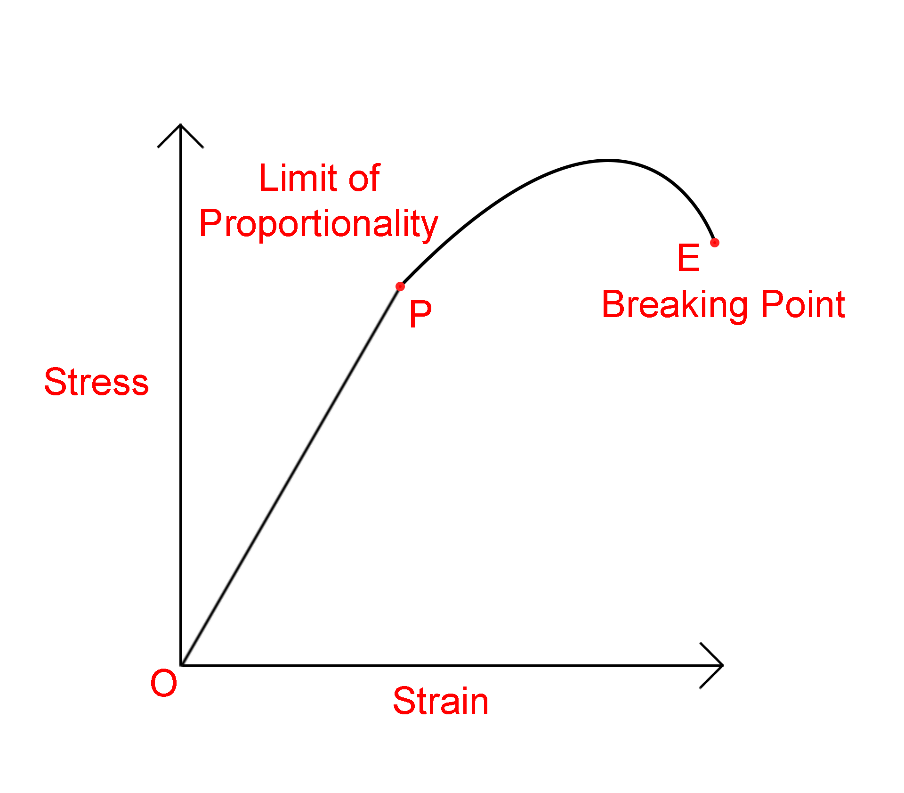
We have to only focus on the points O, P, and E.
Limit of proportionality – It is the point P in the stress-strain graph. Before this point, Hooke’s law is followed. As you can see in the region OA (also called the elastic region), the slope is linear, this represents that as the stress on the body is increasing the strain is also increasing at a constant rate. If we were to remove the applied force while we were in the region OA, the body will go back to its original dimensions.
Plastic region – It is the region PE in the stress-strain graph. It starts right after point P (the limit of proportionality), which means that Hooke’s law is not obeyed in this region (essentially the strain does not increase at a constant rate with the increase in stress). After entering this region, if the stress on the body was brought down to zero, there would still be some permanent strain on the body.
Breaking point – This is the point E in the stress-strain graph. After point E, the body cannot bear anymore and the body breaks into two.
So, Hooke’s law is followed only up to the limit of proportionality.
Hence, option B is the correct choice.
Note:
The concept of stress and strain used in the solution is very important. It has a very important practical use. In our day to day life, we interact with many things that are prone to continuous change in stress and strain like bridges, roads, beds, etc. This can cause permanent deformation in these objects which can sometimes be lethal, and to prevent accidents there are multiple quality checks in place to ensure the long life of day to day objects.
Complete step by step answer:
According to Hooke’s law, the strain in a material is directly proportional to the stress applied.
\[Strain\; \propto Stress\]
The general stress-strain graph is given below
We have to only focus on the points O, P, and E.
Limit of proportionality – It is the point P in the stress-strain graph. Before this point, Hooke’s law is followed. As you can see in the region OA (also called the elastic region), the slope is linear, this represents that as the stress on the body is increasing the strain is also increasing at a constant rate. If we were to remove the applied force while we were in the region OA, the body will go back to its original dimensions.
Plastic region – It is the region PE in the stress-strain graph. It starts right after point P (the limit of proportionality), which means that Hooke’s law is not obeyed in this region (essentially the strain does not increase at a constant rate with the increase in stress). After entering this region, if the stress on the body was brought down to zero, there would still be some permanent strain on the body.
Breaking point – This is the point E in the stress-strain graph. After point E, the body cannot bear anymore and the body breaks into two.
So, Hooke’s law is followed only up to the limit of proportionality.
Hence, option B is the correct choice.
Note:
The concept of stress and strain used in the solution is very important. It has a very important practical use. In our day to day life, we interact with many things that are prone to continuous change in stress and strain like bridges, roads, beds, etc. This can cause permanent deformation in these objects which can sometimes be lethal, and to prevent accidents there are multiple quality checks in place to ensure the long life of day to day objects.
Recently Updated Pages
Master Class 12 Economics: Engaging Questions & Answers for Success

Master Class 12 English: Engaging Questions & Answers for Success
Master Class 12 Social Science: Engaging Questions & Answers for Success
Master Class 12 Maths: Engaging Questions & Answers for Success
Master Class 12 Physics: Engaging Questions & Answers for Success
Master Class 9 General Knowledge: Engaging Questions & Answers for Success
Trending doubts
One Metric ton is equal to kg A 10000 B 1000 C 100 class 11 physics CBSE
Difference Between Prokaryotic Cells and Eukaryotic Cells
Two of the body parts which do not appear in MRI are class 11 biology CBSE
1 ton equals to A 100 kg B 1000 kg C 10 kg D 10000 class 11 physics CBSE
Draw a diagram of nephron and explain its structur class 11 biology CBSE
10 examples of friction in our daily life