



Hofmann degradation of m- Bromo benzamide gives :
a.) aniline
b.) m- bromoaniline
c.) bromobenzene
d.) m- Bromo ethyl benzene
Answer
 Verified
638.1k+ views
Hint: The Hofmann degradation reaction is used to convert primary amide to a primary amine. The general Hofmann’s Bromo amide reaction may be written as -
$RCON{H_2} + B{r_2} + KOH \to RN{H_2}$
Complete answer:
First, let us see what is the Hofmann degradation reaction. This is the reaction to convert primary amide to a primary amine. The general Hofmann’s Bromo amide reaction may be written as -
$RCON{H_2} + B{r_2} + KOH \to RN{H_2}$
So, the reaction of m- Bromo benzamide may be written as -
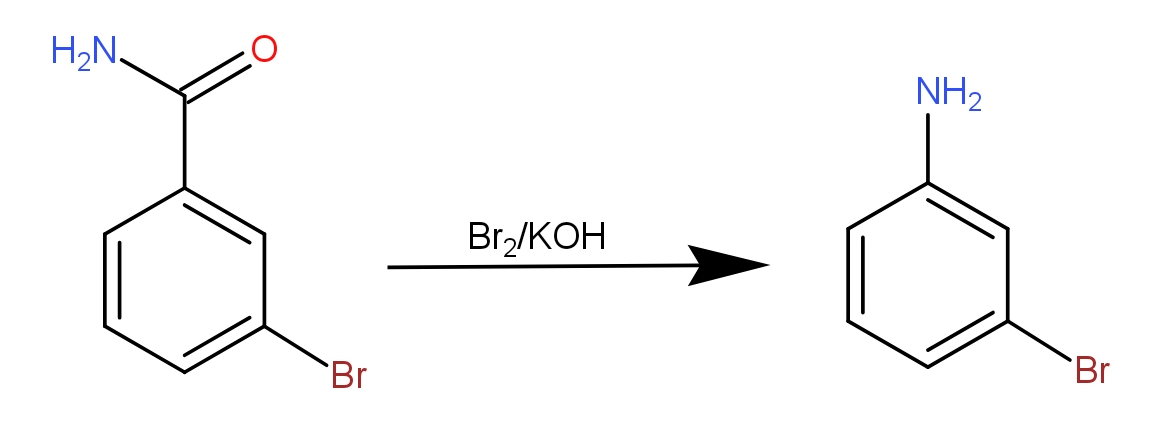
So, the Hofmann degradation of m- Bromo benzamide can give aniline.
Thus, the correct answer is the option a.).
Additional information:
In this reaction, one carbon atom decreases in the product. The reaction of bromine with potassium hydroxide forms potassium hypobromite that converts the primary amide into isocyanate intermediate. This intermediate is then hydrolysed to primary amine and the carbon dioxide is also formed along with the product. The sodium hydroxide can also be used in place of potassium hydroxide. It also reacts in a similar way. The bromine can also be substituted by many other reagents. Such as - Sodium hypochlorite, lead tetraacetate, N- Bromosuccinimide etc. could also be used.
Note: It has various applications. It is used to convert the aliphatic and aromatic both types of amides into amines. It is used in the preparation of anthranilic acid from phthalimide. By using this reaction, the Nicotinic acid can also be converted into 3- Aminopyridine.
$RCON{H_2} + B{r_2} + KOH \to RN{H_2}$
Complete answer:
First, let us see what is the Hofmann degradation reaction. This is the reaction to convert primary amide to a primary amine. The general Hofmann’s Bromo amide reaction may be written as -
$RCON{H_2} + B{r_2} + KOH \to RN{H_2}$
So, the reaction of m- Bromo benzamide may be written as -
So, the Hofmann degradation of m- Bromo benzamide can give aniline.
Thus, the correct answer is the option a.).
Additional information:
In this reaction, one carbon atom decreases in the product. The reaction of bromine with potassium hydroxide forms potassium hypobromite that converts the primary amide into isocyanate intermediate. This intermediate is then hydrolysed to primary amine and the carbon dioxide is also formed along with the product. The sodium hydroxide can also be used in place of potassium hydroxide. It also reacts in a similar way. The bromine can also be substituted by many other reagents. Such as - Sodium hypochlorite, lead tetraacetate, N- Bromosuccinimide etc. could also be used.
Note: It has various applications. It is used to convert the aliphatic and aromatic both types of amides into amines. It is used in the preparation of anthranilic acid from phthalimide. By using this reaction, the Nicotinic acid can also be converted into 3- Aminopyridine.
Recently Updated Pages
Which of the following graphs shows the variation of class 12 physics CBSE

Draw a labelled diagram of the human male reproductive class 12 biology CBSE
Describe the experiment to compare the emf of two cells class 12 physics CBSE
What is standard hydrogen electrode
What is conventional current and electric current class 12 physics CBSE
2Bromopentane is treated with an alcoholic KOH solution class 12 chemistry CBSE
Trending doubts
Draw a labelled sketch of the human eye class 12 physics CBSE
Which are the Top 10 Largest Countries of the World?
Draw ray diagrams each showing i myopic eye and ii class 12 physics CBSE
Give one example of a reptile that is viviparous class 12 biology CBSE
Which is the correct genotypic ratio of mendel dihybrid class 12 biology CBSE
Give 10 examples of unisexual and bisexual flowers