




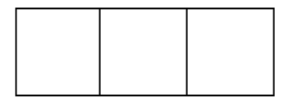
Here is an incomplete net for making a cube. Complete it in at least two different ways. Remember that a cube has six faces. How many faces are there in the net here? (Give two separate diagrams. If you like, you may use a squared sheet for easy manipulation).
Answer
 Verified
640.2k+ views
Hint: We know that a cube has 6 faces. We will take an example of opening a die as we know that a die is also a cube having 6 faces. First, we will add the three consecutive faces vertically from one end and then we will place that vertical face in the middle of the three faces given.
Complete step-by-step solution -
It is given in the question that we have to complete the net for making a cube in two different ways.
So, we know that a cube has 6 equal faces, it can be represented as shown below.
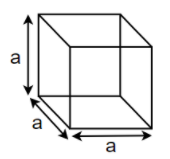
Basically a cube is a 3 dimensional solid shape in which all the sides of faces are equal, that is, the length, breadth and height are equal. An example of a cube is a die.
Now, here we are given an incomplete net of cube with 3 faces as shown below.
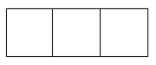
So, as we know that a cube has 6 faces, we require 3 more faces to complete this net of the cube.
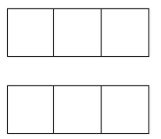
Now, we will arrange 6 faces in two different ways.
The first arrangement can be made by placing the 3 squares vertically at the end and it is represented as shown below.
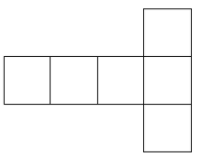
The second arrangement can be made by placing the 1 square on top of the middle square and 2 below it as shown below.
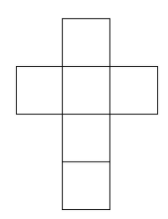
Therefore, we have completed the net for making cube by using two different ways.
Note: Most of the students think that the following two arrangements, (i) and (ii) are different but actually they are the same.
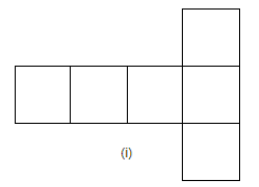
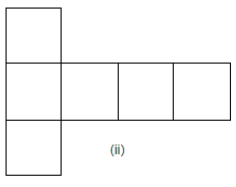
It is because we know that all faces of a cube are exactly equal. So, arrangement (i) and arrangement (ii) will be considered the same.
Complete step-by-step solution -
It is given in the question that we have to complete the net for making a cube in two different ways.
So, we know that a cube has 6 equal faces, it can be represented as shown below.
Basically a cube is a 3 dimensional solid shape in which all the sides of faces are equal, that is, the length, breadth and height are equal. An example of a cube is a die.
Now, here we are given an incomplete net of cube with 3 faces as shown below.
So, as we know that a cube has 6 faces, we require 3 more faces to complete this net of the cube.
Now, we will arrange 6 faces in two different ways.
The first arrangement can be made by placing the 3 squares vertically at the end and it is represented as shown below.
The second arrangement can be made by placing the 1 square on top of the middle square and 2 below it as shown below.
Therefore, we have completed the net for making cube by using two different ways.
Note: Most of the students think that the following two arrangements, (i) and (ii) are different but actually they are the same.
It is because we know that all faces of a cube are exactly equal. So, arrangement (i) and arrangement (ii) will be considered the same.

Recently Updated Pages
Master Class 11 English: Engaging Questions & Answers for Success

Master Class 11 Social Science: Engaging Questions & Answers for Success
Master Class 11 Maths: Engaging Questions & Answers for Success
Master Class 11 Biology: Engaging Questions & Answers for Success
Master Class 11 Physics: Engaging Questions & Answers for Success
Master Class 11 Chemistry: Engaging Questions & Answers for Success
Trending doubts
How many millions make a billion class 6 maths CBSE
Give 10 examples for herbs , shrubs , climbers , creepers
Number of Prime between 1 to 100 is class 6 maths CBSE
Check whether the given numbers are divisible by 11 class 6 maths CBSE
What are the main physical divisions of India class 6 social science CBSE
What is the smallest onedigit number that is 0 or class 6 maths CBSE