




Heart-shaped fern prothallus is
(a)Saprophyte
(b)Sporophyte
(c)Parasite
(d)Gametophyte
Answer
 Verified
645.9k+ views
Hint: A prothallus, the word ‘pro’ means forwards and ‘thallus’ means twig. It grew from a spore which had been formed by meiosis in the life of a fern or other pteridophyte. The prothallus develops from a germinating spore.
Complete answer:
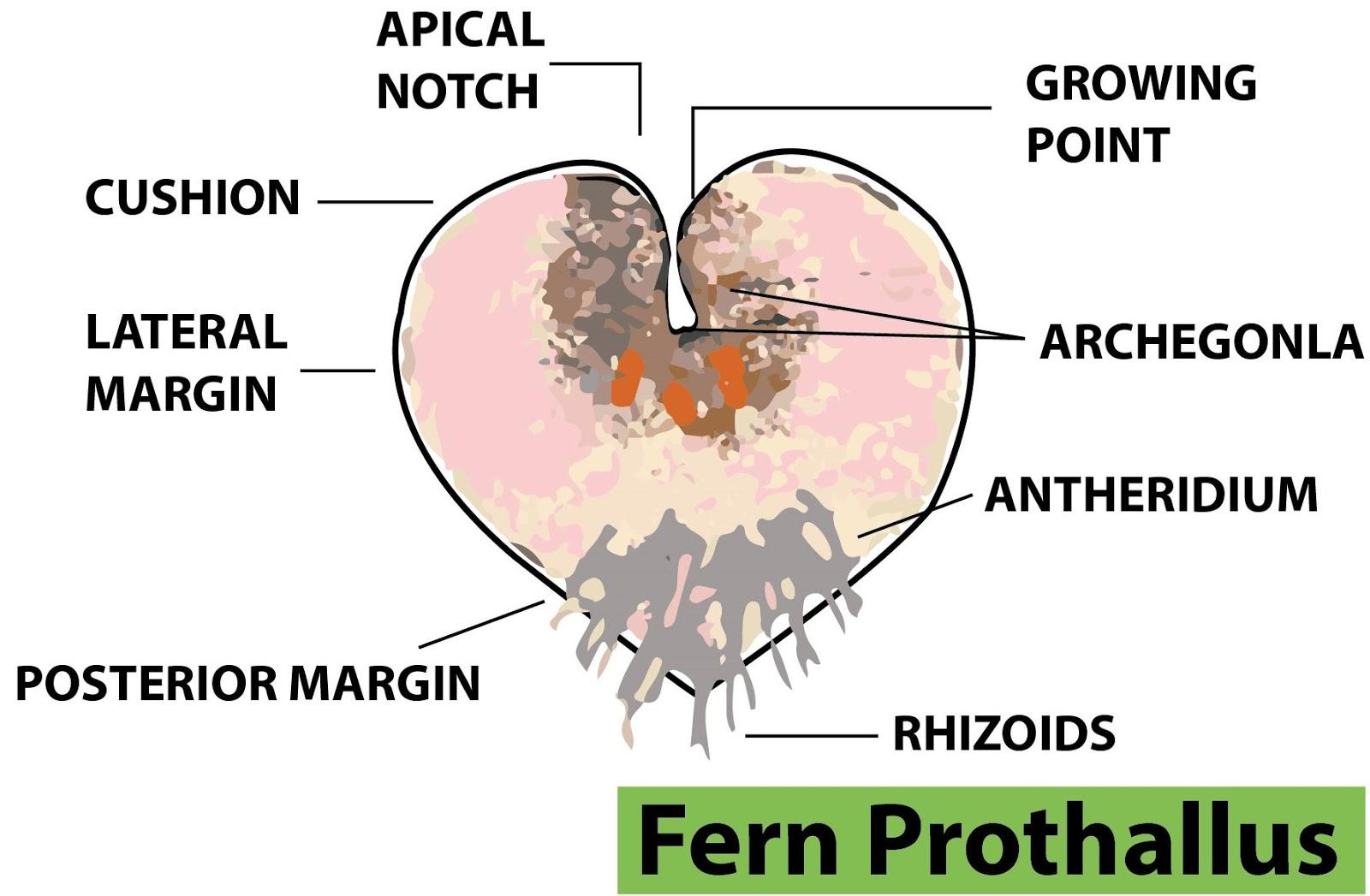
Prothallium or prothallus is typically the gametophyte stage within the life cycle. The prothallus develops from a germinating spore. Prothallium is a short-lived and inconspicuous heart-shaped structure typically 2–5 millimeters wide, with a diversity of rhizoids (root-like hairs) growing underneath. The colors of some fern are green, they conduct photosynthesis despite others are colorless and nourish themselves underground as saprotrophs. Prothallus of fern is flat, autotrophic, dorsiventral, short-lived, about 5-l0mm in size, free-living independent, nonvascular gametophyte.
Additional Information: - The prothallus is haploid
- It grew from a spore which had been formed by meiosis.
- It does not have any vascular tissue and uses small rhizoids to anchor it to the ground.
-The sex organs: archegonia are for female and antheridium is for male. Appearance varies quite a lot between species.
-The sperm are released by the antheridium and swim through a thin film of water to a nearby archegonium for fertilizing the egg.
Since all the given options are found in the prothallus of fern that is heart-shaped, green, and dorsiventral.
So, the correct answer is ' Gametophyte’.
Note: After fertilization, the zygote grows into an embryo that remains attached to the prothallus. The embryonic plant depends upon the prothallus for its water and nutrients. The embryo grows and develops into a mature diploid plant, then prothallus dies. This mature plant is named the sporophyte generation since it produces spores. The sporophyte plant is the one most ordinarily recognized as a fern.
Complete answer:
Prothallium or prothallus is typically the gametophyte stage within the life cycle. The prothallus develops from a germinating spore. Prothallium is a short-lived and inconspicuous heart-shaped structure typically 2–5 millimeters wide, with a diversity of rhizoids (root-like hairs) growing underneath. The colors of some fern are green, they conduct photosynthesis despite others are colorless and nourish themselves underground as saprotrophs. Prothallus of fern is flat, autotrophic, dorsiventral, short-lived, about 5-l0mm in size, free-living independent, nonvascular gametophyte.
Additional Information: - The prothallus is haploid
- It grew from a spore which had been formed by meiosis.
- It does not have any vascular tissue and uses small rhizoids to anchor it to the ground.
-The sex organs: archegonia are for female and antheridium is for male. Appearance varies quite a lot between species.
-The sperm are released by the antheridium and swim through a thin film of water to a nearby archegonium for fertilizing the egg.
Since all the given options are found in the prothallus of fern that is heart-shaped, green, and dorsiventral.
So, the correct answer is ' Gametophyte’.
Note: After fertilization, the zygote grows into an embryo that remains attached to the prothallus. The embryonic plant depends upon the prothallus for its water and nutrients. The embryo grows and develops into a mature diploid plant, then prothallus dies. This mature plant is named the sporophyte generation since it produces spores. The sporophyte plant is the one most ordinarily recognized as a fern.
Recently Updated Pages
Master Class 11 Social Science: Engaging Questions & Answers for Success

Master Class 11 English: Engaging Questions & Answers for Success
Master Class 11 Accountancy: Engaging Questions & Answers for Success
Master Class 11 Physics: Engaging Questions & Answers for Success
Master Class 11 Computer Science: Engaging Questions & Answers for Success
Master Class 11 Business Studies: Engaging Questions & Answers for Success
Trending doubts
One Metric ton is equal to kg A 10000 B 1000 C 100 class 11 physics CBSE
Find the value of the expression given below sin 30circ class 11 maths CBSE
Draw a diagram of nephron and explain its structur class 11 biology CBSE
10 examples of friction in our daily life
Proton was discovered by A Thomson B Rutherford C Chadwick class 11 chemistry CBSE
The teeth used for biting and cutting food are called class 11 biology CBSE