




Heart of Rabbit does not have
(a)Right Auricle
(b)Sinus venosus
(c)Conus arteriosus
(d)Both b and c
Answer
 Verified
649.8k+ views
Hint: The first chamber of the heart in fish, amphibians, and reptiles, emptying into the right atrium and the upper front part of the right ventricle of the heart are not seen in the animal like rabbits.
Complete answer:
Sinus venosus and conus arteriosus are not found in rabbits but they are present in the frog. In rabbits, sinus venosus is formed in the embryo, but later becomes a part of the right wall of the auricle. In rabbits, conus arteriosus forms a part of the upper wall of the right ventricle in which the pulmonary artery originates.
Additional Information: The circulatory system in Rabbits:
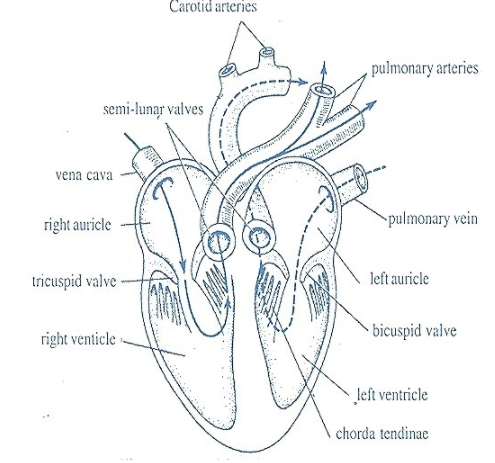
The heart of the rabbit is four-chambered. There are two atria (auricles) and two ventricles. The ventricular chambers are larger than the auricles. The auricles are thin-walled compared to the ventricles. The right auricle and left auricle are separated by the interauricular septum. The aperture in the right ventricle is known as sinus-auricular aperture. This aperture is guarded by valves. The pulmonary vein opens in the left auricle through an oblique aperture. The two auricles are separated from the ventricles by auriculo-ventricular septum. The right and left auricle open into the ventricle through the auriculo-ventricular aperture. The auriculo-ventricular aperture is guarded by an auricular ventricular valve. This valve has four flaps. Chordae tendinae are thread-like chords which are attached to the muscular wall of the ventricle at their other ends.
This part runs obliquely on the ventral surface of the right auricle. The basal, broad and thick-walled portion of the truncus arteries is known as conus arteriosus. The anterior, thin-walled and narrow portion of the truncus arteriosus is known as the ventral aorta. There is a spinal valve in the conus arteriosus. This valve divides the lumen of conus arteriosus into a left cavum pulmocutaneous and right cavum aortic. Each lateral aorta is divided into two arches, carotid arch and systemic arch.
So, the correct answer is “both b and c.”
Note: The blood vascular system of rabbit (mammal) consists of a circulatory media, called the blood, channels through which the blood flows, called blood vessels, and a central pumping organ, the heart, which pumps the blood in the blood vessels. Like that of the other vertebrates, the blood vascular system of the rabbit is of closed type.
Complete answer:
Sinus venosus and conus arteriosus are not found in rabbits but they are present in the frog. In rabbits, sinus venosus is formed in the embryo, but later becomes a part of the right wall of the auricle. In rabbits, conus arteriosus forms a part of the upper wall of the right ventricle in which the pulmonary artery originates.
Additional Information: The circulatory system in Rabbits:
The heart of the rabbit is four-chambered. There are two atria (auricles) and two ventricles. The ventricular chambers are larger than the auricles. The auricles are thin-walled compared to the ventricles. The right auricle and left auricle are separated by the interauricular septum. The aperture in the right ventricle is known as sinus-auricular aperture. This aperture is guarded by valves. The pulmonary vein opens in the left auricle through an oblique aperture. The two auricles are separated from the ventricles by auriculo-ventricular septum. The right and left auricle open into the ventricle through the auriculo-ventricular aperture. The auriculo-ventricular aperture is guarded by an auricular ventricular valve. This valve has four flaps. Chordae tendinae are thread-like chords which are attached to the muscular wall of the ventricle at their other ends.
This part runs obliquely on the ventral surface of the right auricle. The basal, broad and thick-walled portion of the truncus arteries is known as conus arteriosus. The anterior, thin-walled and narrow portion of the truncus arteriosus is known as the ventral aorta. There is a spinal valve in the conus arteriosus. This valve divides the lumen of conus arteriosus into a left cavum pulmocutaneous and right cavum aortic. Each lateral aorta is divided into two arches, carotid arch and systemic arch.
So, the correct answer is “both b and c.”
Note: The blood vascular system of rabbit (mammal) consists of a circulatory media, called the blood, channels through which the blood flows, called blood vessels, and a central pumping organ, the heart, which pumps the blood in the blood vessels. Like that of the other vertebrates, the blood vascular system of the rabbit is of closed type.
Recently Updated Pages
Master Class 11 Social Science: Engaging Questions & Answers for Success

Master Class 11 English: Engaging Questions & Answers for Success
Master Class 11 Accountancy: Engaging Questions & Answers for Success
Master Class 11 Physics: Engaging Questions & Answers for Success
Master Class 11 Computer Science: Engaging Questions & Answers for Success
Master Class 11 Business Studies: Engaging Questions & Answers for Success
Trending doubts
Find the value of the expression given below sin 30circ class 11 maths CBSE
One Metric ton is equal to kg A 10000 B 1000 C 100 class 11 physics CBSE
Draw a diagram of nephron and explain its structur class 11 biology CBSE
10 examples of friction in our daily life
Proton was discovered by A Thomson B Rutherford C Chadwick class 11 chemistry CBSE
The teeth used for biting and cutting food are called class 11 biology CBSE