




What would have happened if meiosis does not occur during the production of the human sperm cells and egg cells?
Answer
 Verified
498k+ views
Hint: Meiosis is the reductional division which takes place in the reproductive cells. Reductional division means that the number of chromosomes reduces to half and the gametes produced are four in number. Meiosis takes place in the diploid parent.
Complete answer:
Meiosis is the Greek word lessening. It is the type of division that takes place in the germ cells. This reproduction takes place in the organisms which reproduce sexually. The meiosis takes place in two steps-
Meiosis 1 is a reductional division in which the diploid cells are split into 2 haploid cells. It also involves crossing over in which the chromosome segments are exchanged between the male and the female.
Meiosis 2 is the equational division in which the haploid gametes form four haploid cells. These haploid gametes fuse to form a diploid zygote.
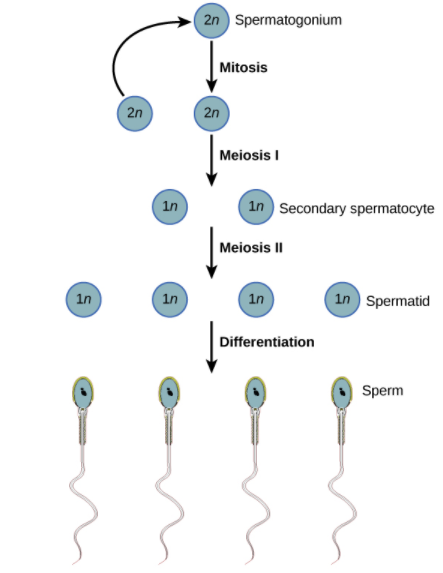
Let us discuss what happens if meiosis does not take place.
For instance, if the meiosis does not take place then the diploid gametes would result in the formation of the tetraploid zygote. The tetraploid zygote will further undergo reductional division to form a diploid organism. The main purpose of meiosis is to maintain the constant chromosome number in an organism. Also, it helps in reshuffling the genetic material which leads to more superior and diverse offspring. If the meiosis is absent then the chromosome number will not be maintained and the shuffling of the genes will not be possible.
Note: In the case of asexual reproduction and the somatic cells, the cell division takes place by the process of mitosis in which the chromosome number remains constant. As it does not involve crossing over, the offsprings produced are the exact copies of the parents. In humans, there are 23 pairs of chromosomes in which 22 pairs are somatic cells or autosomes which show mitotic division and one pair is the sex chromosome which divides by the process of meiosis.
Complete answer:
Meiosis is the Greek word lessening. It is the type of division that takes place in the germ cells. This reproduction takes place in the organisms which reproduce sexually. The meiosis takes place in two steps-
Meiosis 1 is a reductional division in which the diploid cells are split into 2 haploid cells. It also involves crossing over in which the chromosome segments are exchanged between the male and the female.
Meiosis 2 is the equational division in which the haploid gametes form four haploid cells. These haploid gametes fuse to form a diploid zygote.
Let us discuss what happens if meiosis does not take place.
For instance, if the meiosis does not take place then the diploid gametes would result in the formation of the tetraploid zygote. The tetraploid zygote will further undergo reductional division to form a diploid organism. The main purpose of meiosis is to maintain the constant chromosome number in an organism. Also, it helps in reshuffling the genetic material which leads to more superior and diverse offspring. If the meiosis is absent then the chromosome number will not be maintained and the shuffling of the genes will not be possible.
Note: In the case of asexual reproduction and the somatic cells, the cell division takes place by the process of mitosis in which the chromosome number remains constant. As it does not involve crossing over, the offsprings produced are the exact copies of the parents. In humans, there are 23 pairs of chromosomes in which 22 pairs are somatic cells or autosomes which show mitotic division and one pair is the sex chromosome which divides by the process of meiosis.
Recently Updated Pages
Master Class 11 Social Science: Engaging Questions & Answers for Success

Master Class 11 Physics: Engaging Questions & Answers for Success
Master Class 11 Maths: Engaging Questions & Answers for Success
Master Class 11 Economics: Engaging Questions & Answers for Success
Master Class 11 Computer Science: Engaging Questions & Answers for Success
Master Class 11 Chemistry: Engaging Questions & Answers for Success
Trending doubts
One Metric ton is equal to kg A 10000 B 1000 C 100 class 11 physics CBSE
There are 720 permutations of the digits 1 2 3 4 5 class 11 maths CBSE
1 Quintal is equal to a 110 kg b 10 kg c 100kg d 1000 class 11 physics CBSE
State and prove Bernoullis theorem class 11 physics CBSE
Difference Between Prokaryotic Cells and Eukaryotic Cells
Discuss the various forms of bacteria class 11 biology CBSE