




When Grignard reagents react with ethanol, which product is formed?
Answer
 Verified
568.8k+ views
Hint: Grignard reagent is used in many chemical reactions and it is represented as $ RMgX $ . Where $ R $ represents the attached alkyl group, $ Mg $ represents the magnesium metal and $ X $ represents the halide. Therefore, it is commonly known as magnesium halide.
Complete answer:
Grignard reagent acts as a very good nucleophile therefore it has a tendency to attack the electrophiles to form the compound. The electrophile which combines with Grignard reagent may be an epoxide, or any carbonyl center.
When Grignard reagents react with ethanol, due to nucleophilic nature it tends to extract the hydrogen atom attached with the hydroxyl group.
The reaction between the ethanol and Grignard reagent is considered as an acid base reaction because alcohol acts as an acid while Grignard reagent acts as a base.
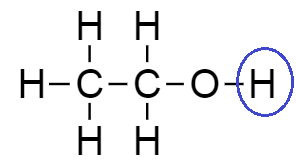
From the structure of ethanol, we see that there is one hydrogen which is attached directly with an oxygen atom hence, it is considered as an acidic hydrogen.
Hence when Grignard reagent with acidic hydrogen process of neutralization occurs by removal of acidic hydrogen from alcohol.
The alkyl group of the Grignard reagent combines with hydrogen extracted from alcohol to form an alkane.
For example- reaction between ethanol $ {C_2}{H_5}OH $ and methyl magnesium chloride $ C{H_3}MgCl $ .
$ {C_2}{H_5}OH $ $ + $ $ C{H_3}MgCl $ $ \to C{H_4} + {C_2}{H_5}OMgCl $
$ \Rightarrow $ Grignard reagent reacts with ethanol to produce alkane.
Note:
Always remember that the alkyl group of Grignard reagent is used in the newly formed alkane. Grignard reagent is also used in the synthesis of alcohol by reacting with carbonyl group aldehyde or ketone. Grignard reagent is used to prepare aliphatic as well as aromatic alcohol.
Complete answer:
Grignard reagent acts as a very good nucleophile therefore it has a tendency to attack the electrophiles to form the compound. The electrophile which combines with Grignard reagent may be an epoxide, or any carbonyl center.
When Grignard reagents react with ethanol, due to nucleophilic nature it tends to extract the hydrogen atom attached with the hydroxyl group.
The reaction between the ethanol and Grignard reagent is considered as an acid base reaction because alcohol acts as an acid while Grignard reagent acts as a base.
From the structure of ethanol, we see that there is one hydrogen which is attached directly with an oxygen atom hence, it is considered as an acidic hydrogen.
Hence when Grignard reagent with acidic hydrogen process of neutralization occurs by removal of acidic hydrogen from alcohol.
The alkyl group of the Grignard reagent combines with hydrogen extracted from alcohol to form an alkane.
For example- reaction between ethanol $ {C_2}{H_5}OH $ and methyl magnesium chloride $ C{H_3}MgCl $ .
$ {C_2}{H_5}OH $ $ + $ $ C{H_3}MgCl $ $ \to C{H_4} + {C_2}{H_5}OMgCl $
$ \Rightarrow $ Grignard reagent reacts with ethanol to produce alkane.
Note:
Always remember that the alkyl group of Grignard reagent is used in the newly formed alkane. Grignard reagent is also used in the synthesis of alcohol by reacting with carbonyl group aldehyde or ketone. Grignard reagent is used to prepare aliphatic as well as aromatic alcohol.
Recently Updated Pages
Explain the structure of megasporangium class 12 biology CBSE

Why is chloroform kept in dark coloured bottles class 12 chemistry CBSE
Derive the balancing condition of a Wheatstone bri class 12 physics CBSE
Draw VI characteristics of a pn junction diode Explain class 12 physics CBSE
Is it possible to carry pride in ones language too class 12 english CBSE
In a population at Hardy Weinberg equilibrium the allele class 12 biology CBSE
Trending doubts
Draw a labelled sketch of the human eye class 12 physics CBSE
Which are the Top 10 Largest Countries of the World?
Draw ray diagrams each showing i myopic eye and ii class 12 physics CBSE
One megawatt is equal to how many units of electri class 12 physics CBSE
Which is the correct genotypic ratio of mendel dihybrid class 12 biology CBSE
Give 10 examples of unisexual and bisexual flowers