




Graphs between pressure and volume are plotted at different temperatures. Which of the following isotherms represents Boyle’s law as ${\text{PV}} = {\text{Constant}}$?

A) Only (ii) is a correct representation of Boyle’s law.
B) Only (iv) is the correct representation of Boyle’s law.
C) All are correct representations of Boyle’s law.
D) None of these representations is correct for Boyle’s law.
Answer
 Verified
603k+ views
Hint: To solve this we must know Boyle's law. Boyle’s law states that at constant temperature the volume of an ideal gas is inversely proportional to the pressure of the gas.
Complete step by step answer:
We know that Boyle's law states that at constant temperature the volume of an ideal gas is inversely proportional to the pressure of the gas.
The expression for Boyle’s law is as follows:
${\text{P}} \propto \dfrac{1}{{\text{V}}}$ …… (1)
Where ${\text{P}}$ is the pressure,
${\text{V}}$ is the volume.
Using equation (1), the graph of Boyle’s law is as follows:
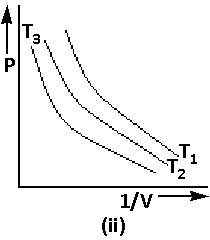
The equation (1) can be written as follows:
${\text{P}} = {\text{K}}\dfrac{1}{{\text{V}}}$ …… (2)
Where ${\text{K}}$ is the constant.
Using equation (2), the graph of Boyle’s law is as follows:
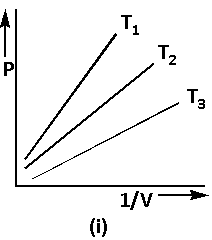
We are given that ${\text{PV}} = {\text{Constant}}$. Thus,
${\text{PV}} = {\text{K}}$ …… (3)
The equation (3) can also be written as follows:
${\text{PV}} = \dfrac{{\text{K}}}{{\text{P}}} \times {\text{P}}$ …… (4)
Using equation (4), the graph of Boyle’s law is as follows:
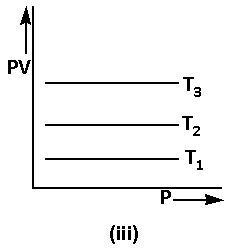
The equation (2) can be written in the form of log as follows:
${\text{log P}} = - \log {\text{ V}} + \log {\text{ K}}$ …… (5)
Using equation (5), the graph of Boyle’s law is as follows:

From the above graphs, we can say that all the graphs are the correct representations of Boyle’s law.
Thus, the correct option is (C).
Note: We know that Boyle's law states that at constant temperature the volume of an ideal gas is inversely proportional to the pressure of the gas. Thus, as the volume of the gas increases, the pressure decreases or as the volume of the gas decreases, the pressure increases.
Complete step by step answer:
We know that Boyle's law states that at constant temperature the volume of an ideal gas is inversely proportional to the pressure of the gas.
The expression for Boyle’s law is as follows:
${\text{P}} \propto \dfrac{1}{{\text{V}}}$ …… (1)
Where ${\text{P}}$ is the pressure,
${\text{V}}$ is the volume.
Using equation (1), the graph of Boyle’s law is as follows:
The equation (1) can be written as follows:
${\text{P}} = {\text{K}}\dfrac{1}{{\text{V}}}$ …… (2)
Where ${\text{K}}$ is the constant.
Using equation (2), the graph of Boyle’s law is as follows:
We are given that ${\text{PV}} = {\text{Constant}}$. Thus,
${\text{PV}} = {\text{K}}$ …… (3)
The equation (3) can also be written as follows:
${\text{PV}} = \dfrac{{\text{K}}}{{\text{P}}} \times {\text{P}}$ …… (4)
Using equation (4), the graph of Boyle’s law is as follows:
The equation (2) can be written in the form of log as follows:
${\text{log P}} = - \log {\text{ V}} + \log {\text{ K}}$ …… (5)
Using equation (5), the graph of Boyle’s law is as follows:
From the above graphs, we can say that all the graphs are the correct representations of Boyle’s law.
Thus, the correct option is (C).
Note: We know that Boyle's law states that at constant temperature the volume of an ideal gas is inversely proportional to the pressure of the gas. Thus, as the volume of the gas increases, the pressure decreases or as the volume of the gas decreases, the pressure increases.
Recently Updated Pages
Master Class 11 English: Engaging Questions & Answers for Success

Master Class 11 Social Science: Engaging Questions & Answers for Success
Master Class 11 Maths: Engaging Questions & Answers for Success
Master Class 11 Biology: Engaging Questions & Answers for Success
Master Class 11 Physics: Engaging Questions & Answers for Success
Master Class 11 Chemistry: Engaging Questions & Answers for Success
Trending doubts
One Metric ton is equal to kg A 10000 B 1000 C 100 class 11 physics CBSE
Difference Between Prokaryotic Cells and Eukaryotic Cells
Two of the body parts which do not appear in MRI are class 11 biology CBSE
Find the value of the expression given below sin 30circ class 11 maths CBSE
Draw a diagram of a plant cell and label at least eight class 11 biology CBSE
10 examples of friction in our daily life