




How do you graph the parabola \[y=2{{x}^{2}}-4x-6\]using vertex, intercept and additional points?
Answer
 Verified
600k+ views
Hint: In this problem, we have the quadratic equation o \[y=2{{x}^{2}}-4x-6\], from which we have to draw the graph. To plot the points in the graph, we have to find the x-coordinate and y-coordinate of the vertex, x-intercept and y-intercept and some additional points to be plotted. We know that for x-intercept y=0 and for y-intercept, x=0, to find the x and y-intercept.
Complete step by step answer:
We know that the given quadratic equation is,
\[y=2{{x}^{2}}-4x-6\]…….. (1)
We also know that the standard form of the quadratic equation is,
\[y=a{{x}^{2}}+bx+c\]……… (2)
Now, we can compare the equation (1) and (2), we get
a = 2, b = -4, c = -6.
Now we have to find the vertex which is the maximum or minimum point of the parabola.
We know that, since a>0, the vertex is the minimum point and the parabola opens upwards.
Now, we can find the x-coordinate of the vertex, we also know the for the axis of symmetry,
\[x=\dfrac{-b}{2a}\]…… (3)
We can now substitute the value of a and b in (3), we get
\[\begin{align}
& \Rightarrow x=\dfrac{-\left( -4 \right)}{2\left( 2 \right)} \\
& \Rightarrow x=1 \\
\end{align}\]
Now, we can find the y-coordinate of the vertex by substituting the value of x in equation (1), we get
\[\begin{align}
& \Rightarrow y=2{{\left( 1 \right)}^{2}}-4\left( 1 \right)-6 \\
& \Rightarrow y=-8 \\
\end{align}\]
Therefore, the vertex is \[\left( 1,-8 \right)\]
Now, we have to find the x and y-intercept.
We know that, for y-intercept x=0, from equation (1),
\[\begin{align}
& \Rightarrow y=2{{\left( 0 \right)}^{2}}-4\left( 0 \right)-6 \\
& \Rightarrow y=-6 \\
\end{align}\]
Therefore, the y-intercept is \[\left( 0,-6 \right)\]
Now, we have to find the x-intercept, where y=0, from (1) we get
\[\Rightarrow 2{{x}^{2}}-4x-6=0\]
By factoring this above equation, we get
\[\begin{align}
& \Rightarrow 2\left( x+1 \right)\left( x-3 \right) \\
& \Rightarrow x=\left( -1,3 \right) \\
\end{align}\]
The x-intercepts are \[\left( -1,0 \right),\left( 3,0 \right)\].
Now we can find the additional points by choosing value for x and y,
When x=2, then the value of y is,
\[\begin{align}
& \Rightarrow y=2{{\left( 2 \right)}^{2}}-4\left( 2 \right)-6 \\
& \Rightarrow y=8-8-6 \\
& \Rightarrow y=-6 \\
\end{align}\]
One of the points is \[\left( 2,-6 \right)\]
We can find another point for x = -2, then y is,
\[\begin{align}
& \Rightarrow y=2{{\left( -2 \right)}^{2}}-4\left( -2 \right)-6 \\
& \Rightarrow y=8+8-6 \\
& \Rightarrow y=10 \\
\end{align}\]
The other point is \[\left( -2,10 \right)\]
When x=4, the value of y is,
\[\begin{align}
& \Rightarrow y=2{{\left( 4 \right)}^{2}}-4\left( 4 \right)-6 \\
& \Rightarrow y=10 \\
\end{align}\]
Therefore, the third point is \[\left( 4,10 \right)\]
Now we can plot the vertex\[\left( 1,-8 \right)\], x-intercepts\[\left( -1,0 \right),\left( 3,0 \right)\], y-intercept\[\left( 0,-6 \right)\] and
other points\[\left( 2,-6 \right)\],\[\left( -2,10 \right)\], \[\left( 4,10 \right)\]
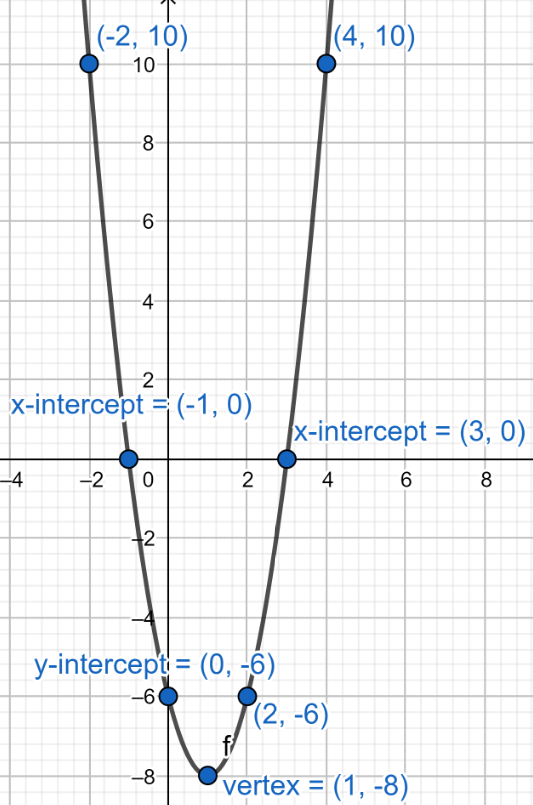
Note: Students may make mistakes in finding the value of vertex, it is done by using the axis symmetry formula of the parabola. Students should know some basic parabolic formulas to solve these types of problems. Students should remember that at x-intercept the value of y is 0 and at y-intercept the value of x is 0.
Complete step by step answer:
We know that the given quadratic equation is,
\[y=2{{x}^{2}}-4x-6\]…….. (1)
We also know that the standard form of the quadratic equation is,
\[y=a{{x}^{2}}+bx+c\]……… (2)
Now, we can compare the equation (1) and (2), we get
a = 2, b = -4, c = -6.
Now we have to find the vertex which is the maximum or minimum point of the parabola.
We know that, since a>0, the vertex is the minimum point and the parabola opens upwards.
Now, we can find the x-coordinate of the vertex, we also know the for the axis of symmetry,
\[x=\dfrac{-b}{2a}\]…… (3)
We can now substitute the value of a and b in (3), we get
\[\begin{align}
& \Rightarrow x=\dfrac{-\left( -4 \right)}{2\left( 2 \right)} \\
& \Rightarrow x=1 \\
\end{align}\]
Now, we can find the y-coordinate of the vertex by substituting the value of x in equation (1), we get
\[\begin{align}
& \Rightarrow y=2{{\left( 1 \right)}^{2}}-4\left( 1 \right)-6 \\
& \Rightarrow y=-8 \\
\end{align}\]
Therefore, the vertex is \[\left( 1,-8 \right)\]
Now, we have to find the x and y-intercept.
We know that, for y-intercept x=0, from equation (1),
\[\begin{align}
& \Rightarrow y=2{{\left( 0 \right)}^{2}}-4\left( 0 \right)-6 \\
& \Rightarrow y=-6 \\
\end{align}\]
Therefore, the y-intercept is \[\left( 0,-6 \right)\]
Now, we have to find the x-intercept, where y=0, from (1) we get
\[\Rightarrow 2{{x}^{2}}-4x-6=0\]
By factoring this above equation, we get
\[\begin{align}
& \Rightarrow 2\left( x+1 \right)\left( x-3 \right) \\
& \Rightarrow x=\left( -1,3 \right) \\
\end{align}\]
The x-intercepts are \[\left( -1,0 \right),\left( 3,0 \right)\].
Now we can find the additional points by choosing value for x and y,
When x=2, then the value of y is,
\[\begin{align}
& \Rightarrow y=2{{\left( 2 \right)}^{2}}-4\left( 2 \right)-6 \\
& \Rightarrow y=8-8-6 \\
& \Rightarrow y=-6 \\
\end{align}\]
One of the points is \[\left( 2,-6 \right)\]
We can find another point for x = -2, then y is,
\[\begin{align}
& \Rightarrow y=2{{\left( -2 \right)}^{2}}-4\left( -2 \right)-6 \\
& \Rightarrow y=8+8-6 \\
& \Rightarrow y=10 \\
\end{align}\]
The other point is \[\left( -2,10 \right)\]
When x=4, the value of y is,
\[\begin{align}
& \Rightarrow y=2{{\left( 4 \right)}^{2}}-4\left( 4 \right)-6 \\
& \Rightarrow y=10 \\
\end{align}\]
Therefore, the third point is \[\left( 4,10 \right)\]
Now we can plot the vertex\[\left( 1,-8 \right)\], x-intercepts\[\left( -1,0 \right),\left( 3,0 \right)\], y-intercept\[\left( 0,-6 \right)\] and
other points\[\left( 2,-6 \right)\],\[\left( -2,10 \right)\], \[\left( 4,10 \right)\]
Note: Students may make mistakes in finding the value of vertex, it is done by using the axis symmetry formula of the parabola. Students should know some basic parabolic formulas to solve these types of problems. Students should remember that at x-intercept the value of y is 0 and at y-intercept the value of x is 0.
Recently Updated Pages
Master Class 11 English: Engaging Questions & Answers for Success

Master Class 11 Social Science: Engaging Questions & Answers for Success
Master Class 11 Maths: Engaging Questions & Answers for Success
Master Class 11 Biology: Engaging Questions & Answers for Success
Master Class 11 Physics: Engaging Questions & Answers for Success
Master Class 11 Chemistry: Engaging Questions & Answers for Success
Trending doubts
Explain the Treaty of Vienna of 1815 class 10 social science CBSE
What is the full form of CNG A Complete Natural Gas class 10 social science CBSE
In cricket, what is a "Yorker" designed to do?
What is the full form of POSCO class 10 social science CBSE
Define Potential, Developed, Stock and Reserved resources
What were the majoritarian measures taken in Sri Lanka class 10 social science CBSE