




How do you graph the line that passes through the origin parallel to the line $x+y=10$?
Answer
 Verified
588.6k+ views
Hint: First we will find the equation of the line. To do this, we will assume the required equation of the line passing through the origin in slope intercept form as $y=mx$, where m = slope. The value of m will be equal to the value of the slope of the given line $x+y=10$. Now, to find the slope of $x+y=10$ we will compare it with the general form $y=mx+c$, where c = y – intercept. Once the value of slope is found we will easily plot the graph.
Complete step by step solution:
Here, we have been asked to plot the graph of a line which passes through the origin and is parallel to the line $x+y=10$.
Now, to plot the graph first we need to determine the equation of the required line. We know that the general equation of the line in slope intercept form is given as $y=mx+c$, where m = slope and c = y – intercept. It has been given to us that the line is passing through the origin, so the y – intercept will be 0. Therefore, the equation of the line becomes,
$\Rightarrow y=mx$
Now, since the above line is parallel to the line $x+y=10$, as stated in the question, so their slopes will be equal. We can write the equation of line $x+y=10$ in slope intercept form as:
$\Rightarrow y=-x+10$
On comparing it with the general form $y=mx+c$ we get $m=-1$, so the equation of the assumed line becomes:
$\begin{align}
& \Rightarrow y=-x \\
& \Rightarrow x+y=0...............\left( i \right) \\
\end{align}$
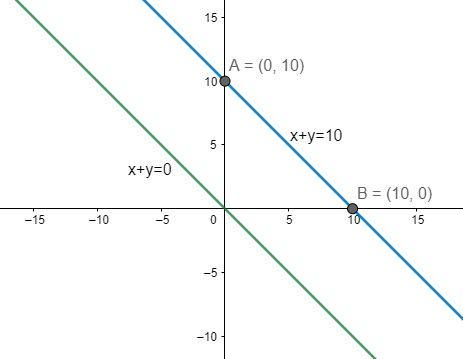
Therefore, the plot of the two lines $x+y=0$ and $x+y=10$ can be shown as below:
Note: It is necessary to determine the equation of the line because it will be difficult to draw the graph if we don’t know the equation of line. Always remember that when a line passes through the origin then its y – intercept is 0. This can be proved by considering the fact that if the line passes through the origin then it will satisfy the point O (0, 0), i.e. the origin.
Complete step by step solution:
Here, we have been asked to plot the graph of a line which passes through the origin and is parallel to the line $x+y=10$.
Now, to plot the graph first we need to determine the equation of the required line. We know that the general equation of the line in slope intercept form is given as $y=mx+c$, where m = slope and c = y – intercept. It has been given to us that the line is passing through the origin, so the y – intercept will be 0. Therefore, the equation of the line becomes,
$\Rightarrow y=mx$
Now, since the above line is parallel to the line $x+y=10$, as stated in the question, so their slopes will be equal. We can write the equation of line $x+y=10$ in slope intercept form as:
$\Rightarrow y=-x+10$
On comparing it with the general form $y=mx+c$ we get $m=-1$, so the equation of the assumed line becomes:
$\begin{align}
& \Rightarrow y=-x \\
& \Rightarrow x+y=0...............\left( i \right) \\
\end{align}$
Therefore, the plot of the two lines $x+y=0$ and $x+y=10$ can be shown as below:
Note: It is necessary to determine the equation of the line because it will be difficult to draw the graph if we don’t know the equation of line. Always remember that when a line passes through the origin then its y – intercept is 0. This can be proved by considering the fact that if the line passes through the origin then it will satisfy the point O (0, 0), i.e. the origin.
Recently Updated Pages
Basicity of sulphurous acid and sulphuric acid are

Master Class 11 English: Engaging Questions & Answers for Success
Master Class 11 Physics: Engaging Questions & Answers for Success
Master Class 11 Computer Science: Engaging Questions & Answers for Success
Master Class 11 Chemistry: Engaging Questions & Answers for Success
Master Class 11 Social Science: Engaging Questions & Answers for Success
Trending doubts
Difference Between Prokaryotic Cells and Eukaryotic Cells
Two of the body parts which do not appear in MRI are class 11 biology CBSE
One Metric ton is equal to kg A 10000 B 1000 C 100 class 11 physics CBSE
10 examples of friction in our daily life
Draw a diagram of nephron and explain its structur class 11 biology CBSE
What will happen if the mucus is not secreted by the class 11 biology CBSE