




How do I graph the function of \[r = \cos 2\theta \] ?
Answer
 Verified
570.9k+ views
Hint: Here in this question, we have to plot the graph of the given trigonometric equation. To plot the graph first we have to find the coordinate \[\left( {r,\theta } \right)\] by comparing the general equation of the rose curve i.e., \[r = a\cos \left( {n\theta } \right)\] . By finding the coordinate we can plot the required graph of given trigonometric equation
Complete step by step solution:
In general let we consider \[r = a\cos \left( {n\theta } \right)\] or \[r = a\sin (n\theta )\] where \[a \ne 0\] and n is a positive number greater than 1. For the graph of rose if the value of n is odd then rose will have n petals or if the value of n is even then the rose will have 2n petals. Here “a” represents the radius of the circle where the rose petals lies.
Now consider the given equation \[r = \cos 2\theta \] . Here a=1, the radius of circle is 1 and n=2, the number is even so we have 2n petals i.e., 4 petals for the rose.
Now consider the given equations ------- (1)
Substitute r=0 in equation (1) we have
\[ \Rightarrow 0 = \cos 2\theta \]
By taking the inverse we have
\[ \Rightarrow {\cos ^{ - 1}}(0) = 2\theta \]
By the table of trigonometry ratios for standard angles in radians we have \[\cos \left( {\dfrac{{n\pi }}{2}} \right) = 0\] , where n= 1, 3, 5, 7, … then \[{\cos ^{ - 1}}\left( 0 \right) = \dfrac{\pi }{2}\] .
\[ \Rightarrow \dfrac{\pi }{2} = 2\theta \]
Dividing by 2 on the both sides we have
\[ \Rightarrow \theta = \dfrac{\pi }{4}\]
Therefore, when \[r = 0\] we have \[\theta = \dfrac{\pi }{4},\dfrac{{3\pi }}{4},\dfrac{{5\pi }}{4},\dfrac{{7\pi }}{4}\]
Similarly:
When \[\theta = 0\] , we have \[r = 0,\dfrac{\pi }{2},\pi ,\dfrac{{3\pi }}{2},2\pi \] .
While determining the area we use the above coordinates
Hence the graph of the given rose curve equation \[r = \cos 2\theta \] is:
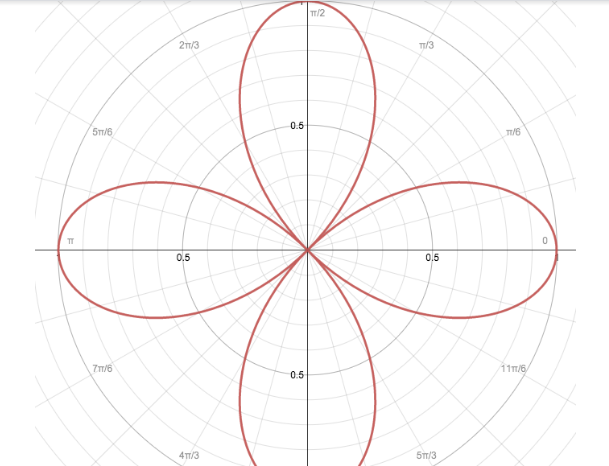
Note: Here we have to plot the polar graph. The polar graph is plotted versus \[r\] and \[\theta \] . By substituting the value of \[\theta \] we can determine the value of \[r\] . Here a=1, the radius of the circle is 1 and n=3, the number is odd so we have 3 petals for the rose. The petals will not exceed the circle of radius.
Complete step by step solution:
In general let we consider \[r = a\cos \left( {n\theta } \right)\] or \[r = a\sin (n\theta )\] where \[a \ne 0\] and n is a positive number greater than 1. For the graph of rose if the value of n is odd then rose will have n petals or if the value of n is even then the rose will have 2n petals. Here “a” represents the radius of the circle where the rose petals lies.
Now consider the given equation \[r = \cos 2\theta \] . Here a=1, the radius of circle is 1 and n=2, the number is even so we have 2n petals i.e., 4 petals for the rose.
Now consider the given equations ------- (1)
Substitute r=0 in equation (1) we have
\[ \Rightarrow 0 = \cos 2\theta \]
By taking the inverse we have
\[ \Rightarrow {\cos ^{ - 1}}(0) = 2\theta \]
By the table of trigonometry ratios for standard angles in radians we have \[\cos \left( {\dfrac{{n\pi }}{2}} \right) = 0\] , where n= 1, 3, 5, 7, … then \[{\cos ^{ - 1}}\left( 0 \right) = \dfrac{\pi }{2}\] .
\[ \Rightarrow \dfrac{\pi }{2} = 2\theta \]
Dividing by 2 on the both sides we have
\[ \Rightarrow \theta = \dfrac{\pi }{4}\]
Therefore, when \[r = 0\] we have \[\theta = \dfrac{\pi }{4},\dfrac{{3\pi }}{4},\dfrac{{5\pi }}{4},\dfrac{{7\pi }}{4}\]
Similarly:
When \[\theta = 0\] , we have \[r = 0,\dfrac{\pi }{2},\pi ,\dfrac{{3\pi }}{2},2\pi \] .
While determining the area we use the above coordinates
Hence the graph of the given rose curve equation \[r = \cos 2\theta \] is:
Note: Here we have to plot the polar graph. The polar graph is plotted versus \[r\] and \[\theta \] . By substituting the value of \[\theta \] we can determine the value of \[r\] . Here a=1, the radius of the circle is 1 and n=3, the number is odd so we have 3 petals for the rose. The petals will not exceed the circle of radius.
Recently Updated Pages
Master Class 11 English: Engaging Questions & Answers for Success

Master Class 11 Social Science: Engaging Questions & Answers for Success
Master Class 11 Maths: Engaging Questions & Answers for Success
Master Class 11 Biology: Engaging Questions & Answers for Success
Master Class 11 Physics: Engaging Questions & Answers for Success
Master Class 11 Chemistry: Engaging Questions & Answers for Success
Trending doubts
One Metric ton is equal to kg A 10000 B 1000 C 100 class 11 physics CBSE
Difference Between Prokaryotic Cells and Eukaryotic Cells
1 ton equals to A 100 kg B 1000 kg C 10 kg D 10000 class 11 physics CBSE
Find the value of the expression given below sin 30circ class 11 maths CBSE
Two of the body parts which do not appear in MRI are class 11 biology CBSE
What are hard magnetic materials class 11 physics CBSE