




How do you graph and solve $y = \left| { - \dfrac{1}{4}x - 1} \right|$?
Answer
 Verified
571.8k+ views
Hint: Plotting a graph depends on the type of equation we have. In the problem, we have a linear equation of the absolute function. Here, first, we have to explain the modulus function which is . Now for different values of $x$ find $y = f\left( x \right)$. After that use the points to plot the graph.
Complete step-by-step solution:
Now, we can define the modulus function.
The modulus function generally refers to the function that gives the positive value of any variable or a number. Also known as the absolute value function, it can generate a non-negative value for any independent variable, irrespective of it being positive or negative. Commonly represented as: \[y = \left| x \right|\], where x represents a real number, and \[y = f\left( x \right)\], representing all positive real numbers.
The expression in which a modulus can be defined is:
First take -1 common from the right side,
$ \Rightarrow y = \left| { - 1\left( {\dfrac{1}{4}x + 1} \right)} \right|$
Break the terms,
$ \Rightarrow y = \left| { - 1} \right|\left| {\dfrac{1}{4}x + 1} \right|$
As we know, $\left| { - 1} \right| = 1$. Then,
$ \Rightarrow y = \left| {\dfrac{1}{4}x + 1} \right|$
Now, let us check $y$ for different values of $x$.
Consider, $x = - 4$, we have $x < 0,y = \left| {\dfrac{1}{4}x + 1} \right|$
$ \Rightarrow y = - \left( { - \dfrac{1}{4} \times 4 + 1} \right)$
Simplify the terms,
$ \Rightarrow y = - \left( { - 1 + 1} \right)$
Subtract the terms,
$ \Rightarrow y = 0$
So, the point is (-4, 0).
Consider, $x = 0$, we have $x \ge 0,y = \left| {\dfrac{1}{4}x + 1} \right|$
$ \Rightarrow y = \left( {\dfrac{1}{4} \times 0 + 1} \right)$
Simplify the terms,
$ \Rightarrow y = 1$
So, the point is (0, 1).
Consider, $x = 4$, we have $x \ge 0,y = \left| {\dfrac{1}{4}x + 1} \right|$
$ \Rightarrow y = \left( {\dfrac{1}{4} \times 4 + 1} \right)$
Simplify the terms,
$ \Rightarrow y = \left( {1 + 1} \right)$
Add the terms,
$ \Rightarrow y = 2$
So, the point is (4, 2).
So, we draw the table for x and y.
We plot the above points and join them to have the graph as
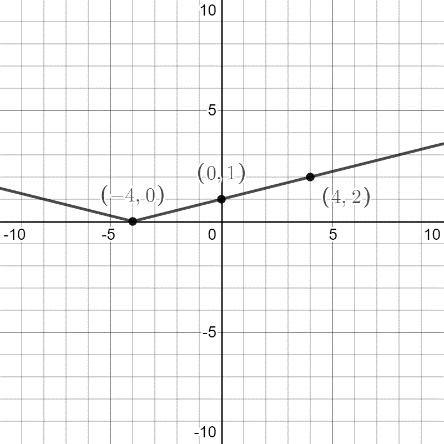
Note: To solve a quadratic equation student can use the factorization method, completing the square method or quadratic formula method. When the time is less and we are sure about the quadratic formula, then it is best to use this method. We can cross verify the factors by opening parenthesis and solving.
Complete step-by-step solution:
Now, we can define the modulus function.
The modulus function generally refers to the function that gives the positive value of any variable or a number. Also known as the absolute value function, it can generate a non-negative value for any independent variable, irrespective of it being positive or negative. Commonly represented as: \[y = \left| x \right|\], where x represents a real number, and \[y = f\left( x \right)\], representing all positive real numbers.
The expression in which a modulus can be defined is:
First take -1 common from the right side,
$ \Rightarrow y = \left| { - 1\left( {\dfrac{1}{4}x + 1} \right)} \right|$
Break the terms,
$ \Rightarrow y = \left| { - 1} \right|\left| {\dfrac{1}{4}x + 1} \right|$
As we know, $\left| { - 1} \right| = 1$. Then,
$ \Rightarrow y = \left| {\dfrac{1}{4}x + 1} \right|$
Now, let us check $y$ for different values of $x$.
Consider, $x = - 4$, we have $x < 0,y = \left| {\dfrac{1}{4}x + 1} \right|$
$ \Rightarrow y = - \left( { - \dfrac{1}{4} \times 4 + 1} \right)$
Simplify the terms,
$ \Rightarrow y = - \left( { - 1 + 1} \right)$
Subtract the terms,
$ \Rightarrow y = 0$
So, the point is (-4, 0).
Consider, $x = 0$, we have $x \ge 0,y = \left| {\dfrac{1}{4}x + 1} \right|$
$ \Rightarrow y = \left( {\dfrac{1}{4} \times 0 + 1} \right)$
Simplify the terms,
$ \Rightarrow y = 1$
So, the point is (0, 1).
Consider, $x = 4$, we have $x \ge 0,y = \left| {\dfrac{1}{4}x + 1} \right|$
$ \Rightarrow y = \left( {\dfrac{1}{4} \times 4 + 1} \right)$
Simplify the terms,
$ \Rightarrow y = \left( {1 + 1} \right)$
Add the terms,
$ \Rightarrow y = 2$
So, the point is (4, 2).
So, we draw the table for x and y.
| X | -4 | 0 | 4 |
| Y | 0 | 1 | 2 |
We plot the above points and join them to have the graph as
Note: To solve a quadratic equation student can use the factorization method, completing the square method or quadratic formula method. When the time is less and we are sure about the quadratic formula, then it is best to use this method. We can cross verify the factors by opening parenthesis and solving.
Recently Updated Pages
Basicity of sulphurous acid and sulphuric acid are

Master Class 10 English: Engaging Questions & Answers for Success
Master Class 10 Social Science: Engaging Questions & Answers for Success
Master Class 10 Computer Science: Engaging Questions & Answers for Success
Class 10 Question and Answer - Your Ultimate Solutions Guide
Master Class 10 General Knowledge: Engaging Questions & Answers for Success
Trending doubts
Which country won the ICC Men's ODI World Cup in 2023?
In cricket, how many legal balls are there in a standard over?
Explain the Treaty of Vienna of 1815 class 10 social science CBSE
A boat goes 24 km upstream and 28 km downstream in class 10 maths CBSE
What does "powerplay" mean in limited-overs cricket?
What is the "Powerplay" in T20 cricket?