




Gram (−)ve bacteria possess peptidoglycan and an extra layer of
(A) Protein
(B) Lipoprotein
(C) Lipopolysaccharide
(D) Lipid
Answer
 Verified
602.7k+ views
Hint: Gram (−)ve bacteria also possess an extra layer which is also known as endotoxins and are large molecules and consist of lipid A, oligosaccharide, and O antigen. It also protects the bacteria from the various chemical attacks it comes across.
Complete answer:
Lipopolysaccharide (LPS)is also known as endotoxins. LPS is an additional layer that is present in gram-negative bacteria. Peptidoglycan is common in both bacteria i.e gram-positive and gram-negative.
Additional Information: Gram-negative bacteria are bacteria that do not retain the gentian violet stain utilized within the Gram staining method of bacterial differentiation. Gram-negative bacteria are characterized by their cell envelopes, which are composed of only a few layered peptidoglycan cell walls which are present between an inner cytoplasmic cell membrane and a bacterial outer membrane. Gram-negative bacteria are a crucial medical challenge, as their outer membrane protects them from many antibiotics (including penicillin); detergents that might normally damage the peptidoglycans of the inner cell membrane; and lysozyme, an antimicrobial enzyme produced by animals that forms a part of the innate system.
The drugs that can effectively work on gram-negative organisms are aminoglycosides, monobactams (aztreonam), and ciprofloxacin.
So, the correct answer is ‘Lipopolysaccharide '.
Note: Gram-negative bacteria display these characteristics:
An inner cell wall is present.
A thin peptidoglycan layer is present which is far thicker in gram-positive bacteria.
Has an outer membrane containing lipopolysaccharides in its outer leaflet and phospholipids within the inner leaflet.
Porins exist within the outer membrane, which acts like pores for particular molecules.
Between the outer membrane and therefore the cytoplasmic membrane there's an area crammed with a concentrated gel-like substance called periplasm.
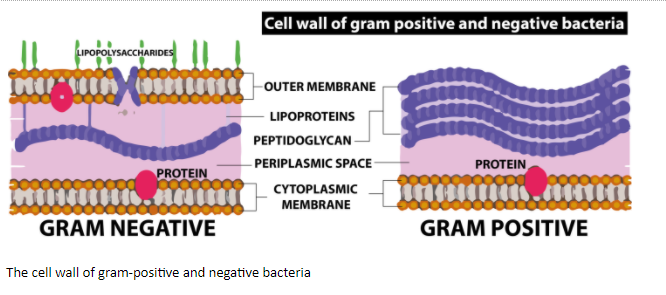
Complete answer:
Lipopolysaccharide (LPS)is also known as endotoxins. LPS is an additional layer that is present in gram-negative bacteria. Peptidoglycan is common in both bacteria i.e gram-positive and gram-negative.
Additional Information: Gram-negative bacteria are bacteria that do not retain the gentian violet stain utilized within the Gram staining method of bacterial differentiation. Gram-negative bacteria are characterized by their cell envelopes, which are composed of only a few layered peptidoglycan cell walls which are present between an inner cytoplasmic cell membrane and a bacterial outer membrane. Gram-negative bacteria are a crucial medical challenge, as their outer membrane protects them from many antibiotics (including penicillin); detergents that might normally damage the peptidoglycans of the inner cell membrane; and lysozyme, an antimicrobial enzyme produced by animals that forms a part of the innate system.
The drugs that can effectively work on gram-negative organisms are aminoglycosides, monobactams (aztreonam), and ciprofloxacin.
So, the correct answer is ‘Lipopolysaccharide '.
Note: Gram-negative bacteria display these characteristics:
An inner cell wall is present.
A thin peptidoglycan layer is present which is far thicker in gram-positive bacteria.
Has an outer membrane containing lipopolysaccharides in its outer leaflet and phospholipids within the inner leaflet.
Porins exist within the outer membrane, which acts like pores for particular molecules.
Between the outer membrane and therefore the cytoplasmic membrane there's an area crammed with a concentrated gel-like substance called periplasm.
Recently Updated Pages
Master Class 11 Social Science: Engaging Questions & Answers for Success

Master Class 11 Physics: Engaging Questions & Answers for Success
Master Class 11 Maths: Engaging Questions & Answers for Success
Master Class 11 Economics: Engaging Questions & Answers for Success
Master Class 11 Computer Science: Engaging Questions & Answers for Success
Master Class 11 Chemistry: Engaging Questions & Answers for Success
Trending doubts
One Metric ton is equal to kg A 10000 B 1000 C 100 class 11 physics CBSE
There are 720 permutations of the digits 1 2 3 4 5 class 11 maths CBSE
1 Quintal is equal to a 110 kg b 10 kg c 100kg d 1000 class 11 physics CBSE
State and prove Bernoullis theorem class 11 physics CBSE
Difference Between Prokaryotic Cells and Eukaryotic Cells
Which among the following are examples of coming together class 11 social science CBSE