




Glycolysis occurs in the ____________ of the cell.
Answer
 Verified
648k+ views
Hint: Fluid within the cell which contains various organelles and enclosed by the cell membrane.
Complete answer:
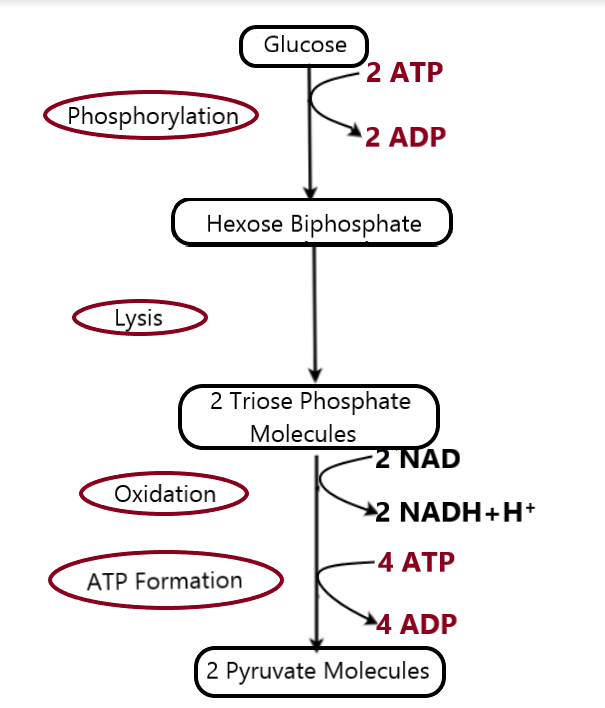
Glycolysis is a process by which the breakdown of glucose takes place to produce energy for cellular metabolism. It occurs in the cytosol of the cell. It produces two molecules of pyruvate, $C{ H }_{ 3 }{ C }{ O }{ C }{ O }{ O }{ - }$ (pyruvic acid)and a hydrogen ion H+. The free energy released during this process is employed to make the high energy molecule ATP and NADH. It is an oxygen-independent metabolic pathway which is a sequence of ten enzyme-catalyzed reactions. The pathway can be separated into two phases:-
1.Phase one - the preparatory or investment phase wherein ATP is consumed.
2.Phase two - the pay off phase wherein ATP is produced.
Glycolysis occurs in the cytosol of the cell cytoplasm because the glucose and other related enzymes required for the glycolytic pathway can be easily found there in high concentration. The cytoplasm may be a thick solution that fills each cell and is enclosed by the cell wall. It is mainly composed of water, salts, and protein. In eukaryotic cells, the cytoplasm includes all of the fabric inside the cell and out of the doors of the nucleus. It occurs in both prokaryotic and eukaryotic cells.
Additional Information: -Phase one of glycolysis is also known as the energy-requiring steps. This pathway traps the glucose molecule in the cell and uses energy to modify it so that the six-carbon sugar molecule can be split evenly into the two three-carbon molecules.
-Phase two of glycolysis is also known as energy-releasing steps. Extracts energy from the molecules and stores it within the sort of ATP and NADH, the reduced sort of NAD.
Note:
-Pyruvate is a molecule of three-carbon sugar $C{ H }_{ 3 }{ C }{ O }{ C }{ O }{ O }{ - }$
-ATP-Adenosine triphosphate.
-NADH-Nicotinamide adenine dinucleotide.
-Mature mammalian red blood cells are not capable of aerobic respiration.
Complete answer:
Glycolysis is a process by which the breakdown of glucose takes place to produce energy for cellular metabolism. It occurs in the cytosol of the cell. It produces two molecules of pyruvate, $C{ H }_{ 3 }{ C }{ O }{ C }{ O }{ O }{ - }$ (pyruvic acid)and a hydrogen ion H+. The free energy released during this process is employed to make the high energy molecule ATP and NADH. It is an oxygen-independent metabolic pathway which is a sequence of ten enzyme-catalyzed reactions. The pathway can be separated into two phases:-
1.Phase one - the preparatory or investment phase wherein ATP is consumed.
2.Phase two - the pay off phase wherein ATP is produced.
Glycolysis occurs in the cytosol of the cell cytoplasm because the glucose and other related enzymes required for the glycolytic pathway can be easily found there in high concentration. The cytoplasm may be a thick solution that fills each cell and is enclosed by the cell wall. It is mainly composed of water, salts, and protein. In eukaryotic cells, the cytoplasm includes all of the fabric inside the cell and out of the doors of the nucleus. It occurs in both prokaryotic and eukaryotic cells.
Additional Information: -Phase one of glycolysis is also known as the energy-requiring steps. This pathway traps the glucose molecule in the cell and uses energy to modify it so that the six-carbon sugar molecule can be split evenly into the two three-carbon molecules.
-Phase two of glycolysis is also known as energy-releasing steps. Extracts energy from the molecules and stores it within the sort of ATP and NADH, the reduced sort of NAD.
Note:
-Pyruvate is a molecule of three-carbon sugar $C{ H }_{ 3 }{ C }{ O }{ C }{ O }{ O }{ - }$
-ATP-Adenosine triphosphate.
-NADH-Nicotinamide adenine dinucleotide.
-Mature mammalian red blood cells are not capable of aerobic respiration.
Fig.- Glycolysis
Recently Updated Pages
Master Class 11 Social Science: Engaging Questions & Answers for Success

Master Class 11 English: Engaging Questions & Answers for Success
Master Class 11 Accountancy: Engaging Questions & Answers for Success
Master Class 11 Physics: Engaging Questions & Answers for Success
Master Class 11 Computer Science: Engaging Questions & Answers for Success
Master Class 11 Business Studies: Engaging Questions & Answers for Success
Trending doubts
Find the value of the expression given below sin 30circ class 11 maths CBSE
Draw a diagram of nephron and explain its structur class 11 biology CBSE
Proton was discovered by A Thomson B Rutherford C Chadwick class 11 chemistry CBSE
The teeth used for biting and cutting food are called class 11 biology CBSE
Frogs heart when taken out of the body continues to class 11 biology CBSE
10 examples of diffusion in everyday life