




Given two equal chords \[AB\] and \[CD\], of a circle with centre \[O\], intersecting each other at point \[P\] inside the circle. Prove that:
\[AP = CP\]
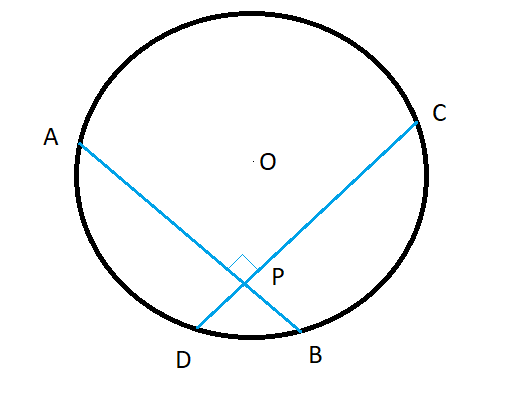
Answer
 Verified
547.5k+ views
Hint: In the given question, we have to prove that the point of intersection on two equal chords will result in equidistant from point of intersection to the point on circle. We can prove this by drawing two perpendicular points from the centre of the circle to the base of the two chords and using Right Angle-Hypotenuse-Side (RHS) congruence criteria.
Complete step-by-step answer:
Let us draw \[\overline {OM} \]and \[\overline {ON} \]perpendicular to chords \[AB\]and \[CD\]respectively from centre \[O\]. We will also join centre \[O\] to the point of intersection of chord i.e. point \[P\].
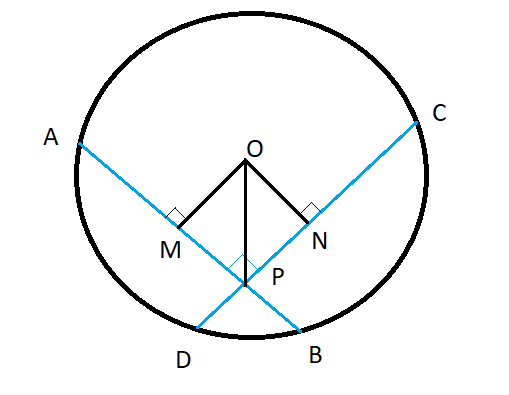
By observing the diagram, we can conclude the following:
In \[\vartriangle OMP\]and \[\vartriangle ONP\], \[OP\]is the common side.
\[\angle OMP = \angle ONP = {90^ \circ }\]
Now using the circle property that the chords that are equal in length are equidistant from the centre, we can say that-
\[OM = ON\]
Hence, using RHS congruence theorem, we can conclude that-
\[\vartriangle OMP \cong \vartriangle ONP\]
Therefore, the corresponding parts of congruent triangle (CPCT) will be equal as follows:
\[MP = NP\]
We are given that \[AB = CD\]
Using the property that the radius drawn perpendicular to the chord bisects the chord, and chords are of equal length, we can say that,
\[AM = CN\]
And as per CPCT,
\[AM + MP = CN + NP\]
But \[AM + MP = AP\] and \[CN + NP = CP\] as shown in the diagram.
Hence, we can conclude that:
\[AP = CP\]
Note: The chord of a circle is the line segment that connects any two points on the circle's circumference. The diameter of a circle is the longest chord that passes through the centre of the circle.
RHS congruence theorem is stated as follows and given for understanding:
In two right-angled triangles, if the length of the hypotenuse and one side of one triangle, is equal to the length of the hypotenuse and corresponding side of the other triangle, then the two triangles are congruent.
In the given case, \[OP\]is the common hypotenuse and corresponding equal sides are \[OM = ON\]in two right-angled triangles \[\vartriangle OMP\]and \[\vartriangle ONP\].
The CPCT theorem is given as follows for understanding:
It states that if two or more triangles are congruent, then all of their corresponding angles and sides are as well congruent.
Complete step-by-step answer:
Let us draw \[\overline {OM} \]and \[\overline {ON} \]perpendicular to chords \[AB\]and \[CD\]respectively from centre \[O\]. We will also join centre \[O\] to the point of intersection of chord i.e. point \[P\].
By observing the diagram, we can conclude the following:
In \[\vartriangle OMP\]and \[\vartriangle ONP\], \[OP\]is the common side.
\[\angle OMP = \angle ONP = {90^ \circ }\]
Now using the circle property that the chords that are equal in length are equidistant from the centre, we can say that-
\[OM = ON\]
Hence, using RHS congruence theorem, we can conclude that-
\[\vartriangle OMP \cong \vartriangle ONP\]
Therefore, the corresponding parts of congruent triangle (CPCT) will be equal as follows:
\[MP = NP\]
We are given that \[AB = CD\]
Using the property that the radius drawn perpendicular to the chord bisects the chord, and chords are of equal length, we can say that,
\[AM = CN\]
And as per CPCT,
\[AM + MP = CN + NP\]
But \[AM + MP = AP\] and \[CN + NP = CP\] as shown in the diagram.
Hence, we can conclude that:
\[AP = CP\]
Note: The chord of a circle is the line segment that connects any two points on the circle's circumference. The diameter of a circle is the longest chord that passes through the centre of the circle.
RHS congruence theorem is stated as follows and given for understanding:
In two right-angled triangles, if the length of the hypotenuse and one side of one triangle, is equal to the length of the hypotenuse and corresponding side of the other triangle, then the two triangles are congruent.
In the given case, \[OP\]is the common hypotenuse and corresponding equal sides are \[OM = ON\]in two right-angled triangles \[\vartriangle OMP\]and \[\vartriangle ONP\].
The CPCT theorem is given as follows for understanding:
It states that if two or more triangles are congruent, then all of their corresponding angles and sides are as well congruent.
Recently Updated Pages
Master Class 12 Business Studies: Engaging Questions & Answers for Success

Master Class 12 Biology: Engaging Questions & Answers for Success
Master Class 12 Chemistry: Engaging Questions & Answers for Success
Class 12 Question and Answer - Your Ultimate Solutions Guide
Master Class 11 Social Science: Engaging Questions & Answers for Success
Master Class 11 English: Engaging Questions & Answers for Success
Trending doubts
Explain the Treaty of Vienna of 1815 class 10 social science CBSE
Which Indian city is known as the "City of Victory"?
Which instrument is used to measure the Blood Pressure?
Who Won 36 Oscar Awards? Record Holder Revealed
What is the median of the first 10 natural numbers class 10 maths CBSE
Why is it 530 pm in india when it is 1200 afternoon class 10 social science CBSE