




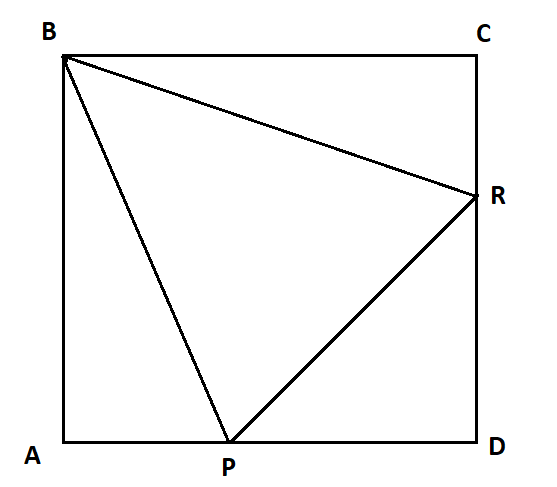
Given the equilateral triangle inscribed in a square of side s find the ratio of $\Delta BCR$ to $\Delta PRD$ ?
Answer
 Verified
549.3k+ views
Hint: The main objective is to find the ratio of two triangles. $\Delta BCR$ is a part of the square. We cannot assume that it is an equilateral triangle. Hence it can be found from the sides of the square. Since the square is perpendicular.
Formula used:
Area of the triangle.
$\Delta = \dfrac{1}{2} \times b \times h$
b is the base of the triangle and h is the height of the triangle.
Complete step by step answer:
Given,
To find $\dfrac{{\Delta BCR}}{{\Delta PRD}}$
$\Delta BCR = \dfrac{1}{2} \times BC \times CR$
The $\Delta BCR$ is symmetric, The symmetric with respect to side $BD$ ,
The angle $CBR$ is the angle which is obtained by half the angle between the perpendicular line and the angle of $\Delta BCR$.
The value of BC is s.
Since $\Delta BCR$ is equilateral triangle angle, each corner has same angle such as $60{}^0$
The perpendicular angle is ${90^0}$ .
$\left| \!{\underline {\,
{CBR} \,}} \right. = \dfrac{{{{90}^0} - {{60}^0}}}{2}$
Subtract the values in the numerator
$\left| \!{\underline {\,
{CBR} \,}} \right. = \dfrac{{{{30}^0}}}{2}$
Divide the numerator and denominator
$\left| \!{\underline {\,
{CBR} \,}} \right. = {15^0}$
To find the side of CR of $\Delta BCR$ , The side of square should be multiplied by the angle of $\left| \!{\underline {\,
{CBR} \,}} \right. = {15^0}$
$CR = s \times \tan {15^0}$
Substitute the value of $\tan {15^0}$ in the above equation,
We know $\tan {15^0} = \tan ({45^0} - {30^0})$
We know the formula for $\tan (A - B) = \dfrac{{\operatorname{Tan} B - \operatorname{Tan} A}}{{1 + \tan A\tan B}}$
$\tan (45 - 30) = \dfrac{{\tan 30 - \tan 45}}{{1 + \tan 45\tan 30}}$
Substitute the value of $\tan 45 = 1$and $\tan 30 = \sqrt 3 $
$\tan (45 - 30) = \dfrac{{\sqrt 3 - 1}}{{1 + \sqrt 3 }}$
$\tan 15 = \dfrac{{\sqrt 3 - 1}}{{1 + \sqrt 3 }}$
Substitute $\tan {15^0}$ value in the equation $CR = s \times \tan {15^0}$
$CR = s \times \dfrac{{\sqrt 3 - 1}}{{1 + \sqrt 3 }}$
Substitute $CR$ and $BC$ in area formula
Area of $\Delta BCR = \dfrac{1}{2} \times BC \times CR$
$\Delta BCR = \dfrac{1}{2} \times s \times \dfrac{{\sqrt 3 - 1}}{{1 + \sqrt 3 }} \times s$
Multiply the s terms
$\Delta BCR = \dfrac{1}{2} \times {s^2} \times \dfrac{{\sqrt 3 - 1}}{{1 + \sqrt 3 }}$
Now we need to calculate area of $\Delta PRD$
$\Delta PRD = \dfrac{1}{2} \times DR \times DR$
Since we know that the side DR is equal to the square distance subtracts the Side CR
$DR = s - CR$
Substitute $CR = s \times \dfrac{{\sqrt 3 - 1}}{{1 + \sqrt 3 }}$ in above equation
$DR = s - s \times \dfrac{{\sqrt 3 - 1}}{{1 + \sqrt 3 }}$
Taking common out s
$DR = s\left( {1 - \dfrac{{\sqrt 3 - 1}}{{1 + \sqrt 3 }}} \right)$
Evaluate the values in right side
\[DR = s\left( {\dfrac{{1 + \sqrt 3 - \left( {\sqrt 3 - 1} \right)}}{{1 + \sqrt 3 }}} \right)\]
Subtract the terms
$DR = s\left( {\dfrac{2}{{1 + \sqrt 3 }}} \right)$
Substitute DR in area of $\Delta PRD$
$\Delta PRD = \dfrac{1}{2} \times {\left( {s\left( {\dfrac{2}{{1 + \sqrt 3 }}} \right)} \right)^2}$
Square the terms
$\Delta PRD = \dfrac{1}{2} \times {s^2} \times \dfrac{4}{{{{(\sqrt 3 + 1)}^2}}}$
We need to calculate
$\dfrac{{\Delta BCR}}{{\Delta PRD}} = \dfrac{{\dfrac{1}{2} \times {s^2} \times \dfrac{{\sqrt 3 - 1}}{{1 + \sqrt 3 }}}}{{\dfrac{1}{2} \times {s^2} \times \dfrac{4}{{{{(\sqrt 3 + 1)}^2}}}}}$
Cancel the same terms in the numerator and denominator
\[\dfrac{{\Delta BCR}}{{\Delta PRD}} = \dfrac{{\sqrt 3 - 1}}{{\dfrac{4}{{\sqrt 3 + 1}}}}\]
The value in the denominator goes to numerator by multiplication
\[\dfrac{{\Delta BCR}}{{\Delta PRD}} = \sqrt 3 - 1 \times \dfrac{{\sqrt 3 + 1}}{4}\]
We know $(a - b)(a + b) = {a^2} - {b^2}$
\[\dfrac{{\Delta BCR}}{{\Delta PRD}} = \dfrac{{{{\left( {\sqrt 3 } \right)}^2} - {1^2}}}{4}\]
Squaring the terms, root and square get cancelled
\[\dfrac{{\Delta BCR}}{{\Delta PRD}} = \dfrac{{3 - 1}}{4}\]
Subtract the values in numerator
\[\dfrac{{\Delta BCR}}{{\Delta PRD}} = \dfrac{2}{4}\]
Divide the value in numerator and denominator
\[\dfrac{{\Delta BCR}}{{\Delta PRD}} = \dfrac{1}{2}\]
The ratio of $\Delta BCR$ to $\Delta PRD$ is $1:2$.
Note:
The side value should be taken correctly. Major mistakes can be made while choosing an angle as sometimes students forgets to take half of the angle. We should know that we can only proceed further because of the angle property of the equilateral triangle.
Formula used:
Area of the triangle.
$\Delta = \dfrac{1}{2} \times b \times h$
b is the base of the triangle and h is the height of the triangle.
Complete step by step answer:
Given,
To find $\dfrac{{\Delta BCR}}{{\Delta PRD}}$
$\Delta BCR = \dfrac{1}{2} \times BC \times CR$
The $\Delta BCR$ is symmetric, The symmetric with respect to side $BD$ ,
The angle $CBR$ is the angle which is obtained by half the angle between the perpendicular line and the angle of $\Delta BCR$.
The value of BC is s.
Since $\Delta BCR$ is equilateral triangle angle, each corner has same angle such as $60{}^0$
The perpendicular angle is ${90^0}$ .
$\left| \!{\underline {\,
{CBR} \,}} \right. = \dfrac{{{{90}^0} - {{60}^0}}}{2}$
Subtract the values in the numerator
$\left| \!{\underline {\,
{CBR} \,}} \right. = \dfrac{{{{30}^0}}}{2}$
Divide the numerator and denominator
$\left| \!{\underline {\,
{CBR} \,}} \right. = {15^0}$
To find the side of CR of $\Delta BCR$ , The side of square should be multiplied by the angle of $\left| \!{\underline {\,
{CBR} \,}} \right. = {15^0}$
$CR = s \times \tan {15^0}$
Substitute the value of $\tan {15^0}$ in the above equation,
We know $\tan {15^0} = \tan ({45^0} - {30^0})$
We know the formula for $\tan (A - B) = \dfrac{{\operatorname{Tan} B - \operatorname{Tan} A}}{{1 + \tan A\tan B}}$
$\tan (45 - 30) = \dfrac{{\tan 30 - \tan 45}}{{1 + \tan 45\tan 30}}$
Substitute the value of $\tan 45 = 1$and $\tan 30 = \sqrt 3 $
$\tan (45 - 30) = \dfrac{{\sqrt 3 - 1}}{{1 + \sqrt 3 }}$
$\tan 15 = \dfrac{{\sqrt 3 - 1}}{{1 + \sqrt 3 }}$
Substitute $\tan {15^0}$ value in the equation $CR = s \times \tan {15^0}$
$CR = s \times \dfrac{{\sqrt 3 - 1}}{{1 + \sqrt 3 }}$
Substitute $CR$ and $BC$ in area formula
Area of $\Delta BCR = \dfrac{1}{2} \times BC \times CR$
$\Delta BCR = \dfrac{1}{2} \times s \times \dfrac{{\sqrt 3 - 1}}{{1 + \sqrt 3 }} \times s$
Multiply the s terms
$\Delta BCR = \dfrac{1}{2} \times {s^2} \times \dfrac{{\sqrt 3 - 1}}{{1 + \sqrt 3 }}$
Now we need to calculate area of $\Delta PRD$
$\Delta PRD = \dfrac{1}{2} \times DR \times DR$
Since we know that the side DR is equal to the square distance subtracts the Side CR
$DR = s - CR$
Substitute $CR = s \times \dfrac{{\sqrt 3 - 1}}{{1 + \sqrt 3 }}$ in above equation
$DR = s - s \times \dfrac{{\sqrt 3 - 1}}{{1 + \sqrt 3 }}$
Taking common out s
$DR = s\left( {1 - \dfrac{{\sqrt 3 - 1}}{{1 + \sqrt 3 }}} \right)$
Evaluate the values in right side
\[DR = s\left( {\dfrac{{1 + \sqrt 3 - \left( {\sqrt 3 - 1} \right)}}{{1 + \sqrt 3 }}} \right)\]
Subtract the terms
$DR = s\left( {\dfrac{2}{{1 + \sqrt 3 }}} \right)$
Substitute DR in area of $\Delta PRD$
$\Delta PRD = \dfrac{1}{2} \times {\left( {s\left( {\dfrac{2}{{1 + \sqrt 3 }}} \right)} \right)^2}$
Square the terms
$\Delta PRD = \dfrac{1}{2} \times {s^2} \times \dfrac{4}{{{{(\sqrt 3 + 1)}^2}}}$
We need to calculate
$\dfrac{{\Delta BCR}}{{\Delta PRD}} = \dfrac{{\dfrac{1}{2} \times {s^2} \times \dfrac{{\sqrt 3 - 1}}{{1 + \sqrt 3 }}}}{{\dfrac{1}{2} \times {s^2} \times \dfrac{4}{{{{(\sqrt 3 + 1)}^2}}}}}$
Cancel the same terms in the numerator and denominator
\[\dfrac{{\Delta BCR}}{{\Delta PRD}} = \dfrac{{\sqrt 3 - 1}}{{\dfrac{4}{{\sqrt 3 + 1}}}}\]
The value in the denominator goes to numerator by multiplication
\[\dfrac{{\Delta BCR}}{{\Delta PRD}} = \sqrt 3 - 1 \times \dfrac{{\sqrt 3 + 1}}{4}\]
We know $(a - b)(a + b) = {a^2} - {b^2}$
\[\dfrac{{\Delta BCR}}{{\Delta PRD}} = \dfrac{{{{\left( {\sqrt 3 } \right)}^2} - {1^2}}}{4}\]
Squaring the terms, root and square get cancelled
\[\dfrac{{\Delta BCR}}{{\Delta PRD}} = \dfrac{{3 - 1}}{4}\]
Subtract the values in numerator
\[\dfrac{{\Delta BCR}}{{\Delta PRD}} = \dfrac{2}{4}\]
Divide the value in numerator and denominator
\[\dfrac{{\Delta BCR}}{{\Delta PRD}} = \dfrac{1}{2}\]
The ratio of $\Delta BCR$ to $\Delta PRD$ is $1:2$.
Note:
The side value should be taken correctly. Major mistakes can be made while choosing an angle as sometimes students forgets to take half of the angle. We should know that we can only proceed further because of the angle property of the equilateral triangle.
Recently Updated Pages
Differentiate between voluntary action and reflex class 10 biology CBSE

The uses of bleaching powder are A It is used bleaching class 10 chemistry CBSE
Fill in the blanks with abstract nouns of the words class 10 english CBSE
How many threedigit numbers are there class 10 maths CBSE
What is a reflex arc class 10 biology CBSE
Construct a square whose diagonal is 6cm Measure the class 10 maths CBSE
Trending doubts
Explain the Treaty of Vienna of 1815 class 10 social science CBSE
The slogan Jai Hind was given by A Lal Bahadur Shastri class 10 social science CBSE
10 examples of evaporation in daily life with explanations
What is the full form of POSCO class 10 social science CBSE
Identify the feminine form of noun nephew a shenephew class 10 english CBSE
CSIR full form?