




Given, n Capacitors of \[2\,\mu F\] each are connected in parallel and a P.D. of 200 V is applied to the combination. The total charge on them was 1 C then n is equal to
A. 3333
B. 3000
C. 2500
D. 25
Answer
 Verified
615.3k+ views
Hint: In this question, we are asked to find the number of capacitors connected in the parallel form. We will use the formula that relates the capacitance of the capacitors, the total charge and the potential difference to obtain the number of capacitors.
Formula used:
\[C=\dfrac{Q}{V}\]
Complete answer:
From the data, we have the data as follows.
Two potential difference applied to the combination of the capacitors, V = 200 V
The total charge on the combination of the capacitors, Q = 1 C
The capacitance of each capacitor equals, C = \[2\,\mu F\]
The total number of capacitors connected in the parallel form, n =?
A circuit diagram representing the n capacitors parallel connection.
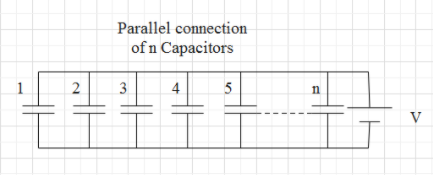
The formula used to compute the equivalent capacitance of the capacitors is given as follows.
\[C=\dfrac{Q}{V}\]
Where C is the capacitance of the capacitors connected in parallel/series combination, Q is the net charge on the capacitors and V is the potential difference applied across the plates of the capacitor.
The basic formula for calculating the capacitance of the capacitor can be modified in such a way that the original form remains the same.
We are given the ‘n’ number of capacitors.
The formula may represent the capacitance of any number of capacitors, as it depends on how we make use of that formula.
So, the modified formula is as follows.
\[\begin{align}
& nC=\dfrac{Q}{V} \\
& \Rightarrow n=\dfrac{Q}{CV} \\
\end{align}\]
Substitute the given values in the above equation.
\[\begin{align}
& n=\dfrac{1}{(2\times {{10}^{-6}})(200)} \\
& \Rightarrow n=2500 \\
\end{align}\]
As the number of capacitors connected in parallel is 2500, thus, option (C) is correct.
Note:
In order to confuse the students, the question states as, “n Capacitors of each are connected in parallel”, as, for any value of the capacitance or the number of capacitors, the amount of charge equals to the product of the capacitance of the capacitors (the net capacitance) and the potential difference applied between the plates.
Formula used:
\[C=\dfrac{Q}{V}\]
Complete answer:
From the data, we have the data as follows.
Two potential difference applied to the combination of the capacitors, V = 200 V
The total charge on the combination of the capacitors, Q = 1 C
The capacitance of each capacitor equals, C = \[2\,\mu F\]
The total number of capacitors connected in the parallel form, n =?
A circuit diagram representing the n capacitors parallel connection.
The formula used to compute the equivalent capacitance of the capacitors is given as follows.
\[C=\dfrac{Q}{V}\]
Where C is the capacitance of the capacitors connected in parallel/series combination, Q is the net charge on the capacitors and V is the potential difference applied across the plates of the capacitor.
The basic formula for calculating the capacitance of the capacitor can be modified in such a way that the original form remains the same.
We are given the ‘n’ number of capacitors.
The formula may represent the capacitance of any number of capacitors, as it depends on how we make use of that formula.
So, the modified formula is as follows.
\[\begin{align}
& nC=\dfrac{Q}{V} \\
& \Rightarrow n=\dfrac{Q}{CV} \\
\end{align}\]
Substitute the given values in the above equation.
\[\begin{align}
& n=\dfrac{1}{(2\times {{10}^{-6}})(200)} \\
& \Rightarrow n=2500 \\
\end{align}\]
As the number of capacitors connected in parallel is 2500, thus, option (C) is correct.
Note:
In order to confuse the students, the question states as, “n Capacitors of each are connected in parallel”, as, for any value of the capacitance or the number of capacitors, the amount of charge equals to the product of the capacitance of the capacitors (the net capacitance) and the potential difference applied between the plates.
Recently Updated Pages
Master Class 11 English: Engaging Questions & Answers for Success

Master Class 11 Social Science: Engaging Questions & Answers for Success
Master Class 11 Maths: Engaging Questions & Answers for Success
Master Class 11 Biology: Engaging Questions & Answers for Success
Master Class 11 Physics: Engaging Questions & Answers for Success
Master Class 11 Chemistry: Engaging Questions & Answers for Success
Trending doubts
One Metric ton is equal to kg A 10000 B 1000 C 100 class 11 physics CBSE
Difference Between Prokaryotic Cells and Eukaryotic Cells
Find the value of the expression given below sin 30circ class 11 maths CBSE
1 ton equals to A 100 kg B 1000 kg C 10 kg D 10000 class 11 physics CBSE
Two of the body parts which do not appear in MRI are class 11 biology CBSE
What are hard magnetic materials class 11 physics CBSE