




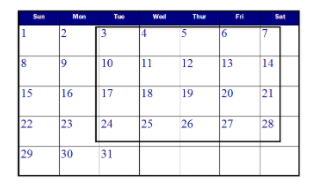
Given is the image of a calendar. The sum of numbers enclosed in the rectangle is:
Answer
 Verified
656.7k+ views
Hint: To find the sum of all the elements inside the rectangle, first find the sum of the elements in each row of the rectangle and add the results to reach the final answer. By row it is meant to find 3+4+6+7 separately, 10+11+12+13+14 separately and so on.
Complete step-by-step answer:
Let us start by drawing the rectangular part of the calendar page of whose elements we have to find the sum. It will give us a clear idea of the rows and the elements.
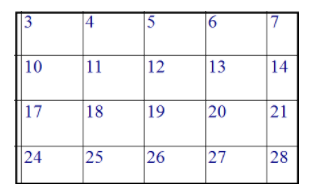
To find the sum of all the elements inside the rectangle, first find the sum of the elements in each row of the rectangle and add the results to reach the final answer. So, first let us find the sum of elements of the first row.
3+4+5+6+7=25
Now let us move to the second row. So, the sum of the elements of the second row is:
10+11+12+13+14=60
Similarly, let us find the sum of the third and the fourth row as well.
17+18+19+20+21=95
24+25+26+27+28=130
So, the final answer is the sum of the above results. So, the final answer is 25+60+95+130=310.
Hence, the answer to the above question is 310.
Note: If we see the addition is also not too lengthy but if you have noticed that the sum of each of the rows placed in increasing order forms an arithmetic progression with common difference 35. So, if you want you can use the formula of sum of an AP as well, but here that won’t save you anytime but might be helpful for some extensions of the question.
Complete step-by-step answer:
Let us start by drawing the rectangular part of the calendar page of whose elements we have to find the sum. It will give us a clear idea of the rows and the elements.
To find the sum of all the elements inside the rectangle, first find the sum of the elements in each row of the rectangle and add the results to reach the final answer. So, first let us find the sum of elements of the first row.
3+4+5+6+7=25
Now let us move to the second row. So, the sum of the elements of the second row is:
10+11+12+13+14=60
Similarly, let us find the sum of the third and the fourth row as well.
17+18+19+20+21=95
24+25+26+27+28=130
So, the final answer is the sum of the above results. So, the final answer is 25+60+95+130=310.
Hence, the answer to the above question is 310.
Note: If we see the addition is also not too lengthy but if you have noticed that the sum of each of the rows placed in increasing order forms an arithmetic progression with common difference 35. So, if you want you can use the formula of sum of an AP as well, but here that won’t save you anytime but might be helpful for some extensions of the question.
Recently Updated Pages
Master Class 11 Social Science: Engaging Questions & Answers for Success

Master Class 11 English: Engaging Questions & Answers for Success
Master Class 11 Accountancy: Engaging Questions & Answers for Success
Master Class 11 Physics: Engaging Questions & Answers for Success
Master Class 11 Computer Science: Engaging Questions & Answers for Success
Master Class 11 Business Studies: Engaging Questions & Answers for Success
Trending doubts
One Metric ton is equal to kg A 10000 B 1000 C 100 class 11 physics CBSE
Find the value of the expression given below sin 30circ class 11 maths CBSE
Draw a diagram of nephron and explain its structur class 11 biology CBSE
10 examples of friction in our daily life
Proton was discovered by A Thomson B Rutherford C Chadwick class 11 chemistry CBSE
The teeth used for biting and cutting food are called class 11 biology CBSE