




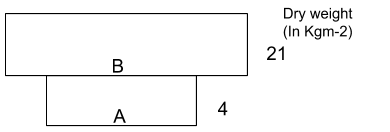
Given figure represents a pyramid of biomass in an aquatic ecosystem. Identify A and B and select the correct answer.
(i) A is the crop which supports and B is the crop which is supported.
(ii)A is the crop which is supported and B is the crop which supports.
(iii) A is phytoplanktons and B is zooplanktons.
(iv) A is zooplanktons and B is phytoplanktons.
A.(i) and (iv)
B.(ii) and (iii)
C.(i) and (iii)
D.(ii) and (iv)
Answer
 Verified
582.3k+ views
Hint: The relationship of different organisms concerning food, energy, etc at different trophic levels are described with the help of ecological pyramids.
Complete answer:
1)The base of the ecological pyramid is the first trophic level and it includes the producers and the apex of the pyramid includes the highest consumers.
2)Mostly the ecological pyramids are upright but it can be inverted in the case where the number of consumers is more than that of producers.
3)Phytoplankton and zooplankton both are planktons but the phytoplankton is a plant whereas zooplankton is an animal. The zooplankton feeds on the phytoplankton.
4)In a sea, the biomass of the producer that is plankton is less than that of the zooplankton which is a consumer. Hence the ecological pyramid of biomass in the sea is inverted.
Option C: A is the producer that is phytoplankton which is less in number and B is the consumer zooplankton present in large numbers and the population of phytoplankton supports the population of zooplankton. Therefore, this is the incorrect option.
All other options are irrelevant.
Hence, the correct answer is option (C)
Note: Whenever we are considering any trophic level, it is very necessary to consider all the animals belonging to that trophic level so that an accurate ecological pyramid can be drawn. An organism can sometimes occupy multiple trophic levels also. The three main ecological pyramids are the number pyramid, biomass pyramid and energy pyramid.
Complete answer:
1)The base of the ecological pyramid is the first trophic level and it includes the producers and the apex of the pyramid includes the highest consumers.
2)Mostly the ecological pyramids are upright but it can be inverted in the case where the number of consumers is more than that of producers.
3)Phytoplankton and zooplankton both are planktons but the phytoplankton is a plant whereas zooplankton is an animal. The zooplankton feeds on the phytoplankton.
4)In a sea, the biomass of the producer that is plankton is less than that of the zooplankton which is a consumer. Hence the ecological pyramid of biomass in the sea is inverted.
Option C: A is the producer that is phytoplankton which is less in number and B is the consumer zooplankton present in large numbers and the population of phytoplankton supports the population of zooplankton. Therefore, this is the incorrect option.
All other options are irrelevant.
Hence, the correct answer is option (C)
Note: Whenever we are considering any trophic level, it is very necessary to consider all the animals belonging to that trophic level so that an accurate ecological pyramid can be drawn. An organism can sometimes occupy multiple trophic levels also. The three main ecological pyramids are the number pyramid, biomass pyramid and energy pyramid.
Recently Updated Pages
Master Class 12 Business Studies: Engaging Questions & Answers for Success

Master Class 12 Biology: Engaging Questions & Answers for Success
Master Class 12 Chemistry: Engaging Questions & Answers for Success
Class 12 Question and Answer - Your Ultimate Solutions Guide
Master Class 11 Social Science: Engaging Questions & Answers for Success
Master Class 11 English: Engaging Questions & Answers for Success
Trending doubts
Which are the Top 10 Largest Countries of the World?
Draw a labelled sketch of the human eye class 12 physics CBSE
Name the crygenes that control cotton bollworm and class 12 biology CBSE
Differentiate between homogeneous and heterogeneous class 12 chemistry CBSE
Ribosomal RNA is actively synthesised in A Nucleoplasm class 12 biology CBSE
How many molecules of ATP and NADPH are required information class 12 biology CBSE